Written by:

- Opening Bell
- September 21, 2026
- 5 min read
Trump-Xi Summit Tests the Tech-Led Risk-On Rebound
Markets are starting the week in recovery mode. Nasdaq futures were up around 1.1% before Monday’s open, S&P 500 futures gained about 0.7%, and Brent crude fell roughly 2.6% towards $101 a barrel. The pullback in oil also helped the U.S. 10-year Treasury yield slip back below 5%.
That matters because last week’s pressure came from several directions at once. The Federal Reserve delivered a 25-basis-point hike, oil stayed above $100 and longer-dated yields pushed into levels that weighed on growth stocks. With crude and yields easing together, some of that pressure is being unwound, but this still looks more like a relief phase than a repaired macro backdrop.
The next major test comes on Thursday, when U.S. President Donald Trump and Chinese President Xi Jinping are due to meet in Washington. Trade, artificial intelligence, supply chains and geopolitical tensions are expected to feature in the talks.
Energy is one of the more tangible areas to watch.
U.S. and Chinese negotiators have discussed reducing or removing China’s 15% tariff on American LNG, according to Reuters. A concrete change would matter more than broad diplomatic language because U.S.-to-China LNG trade largely stopped after the tariff was introduced.
China’s currency is already reflecting some of that optimism. The yuan strengthened to its highest level in more than three years as the People’s Bank of China allowed a firmer fixing ahead of the summit. That is supportive for risk sentiment, although Reuters-cited analysts cautioned that it may reflect policy-managed stability around the meeting rather than the start of a lasting yuan re-rating.
The equity market is sending a more complicated message. The S&P 500 remains inside its rising weekly channel and is testing support around its 50-day EMA centred, one-standard-deviation Bollinger Bands®, but both breadth measures on the chart have dropped below the 50% line. Weekly RSI is also around 61 and has failed to match the index’s recent price highs, adding a momentum warning to the breadth deterioration.
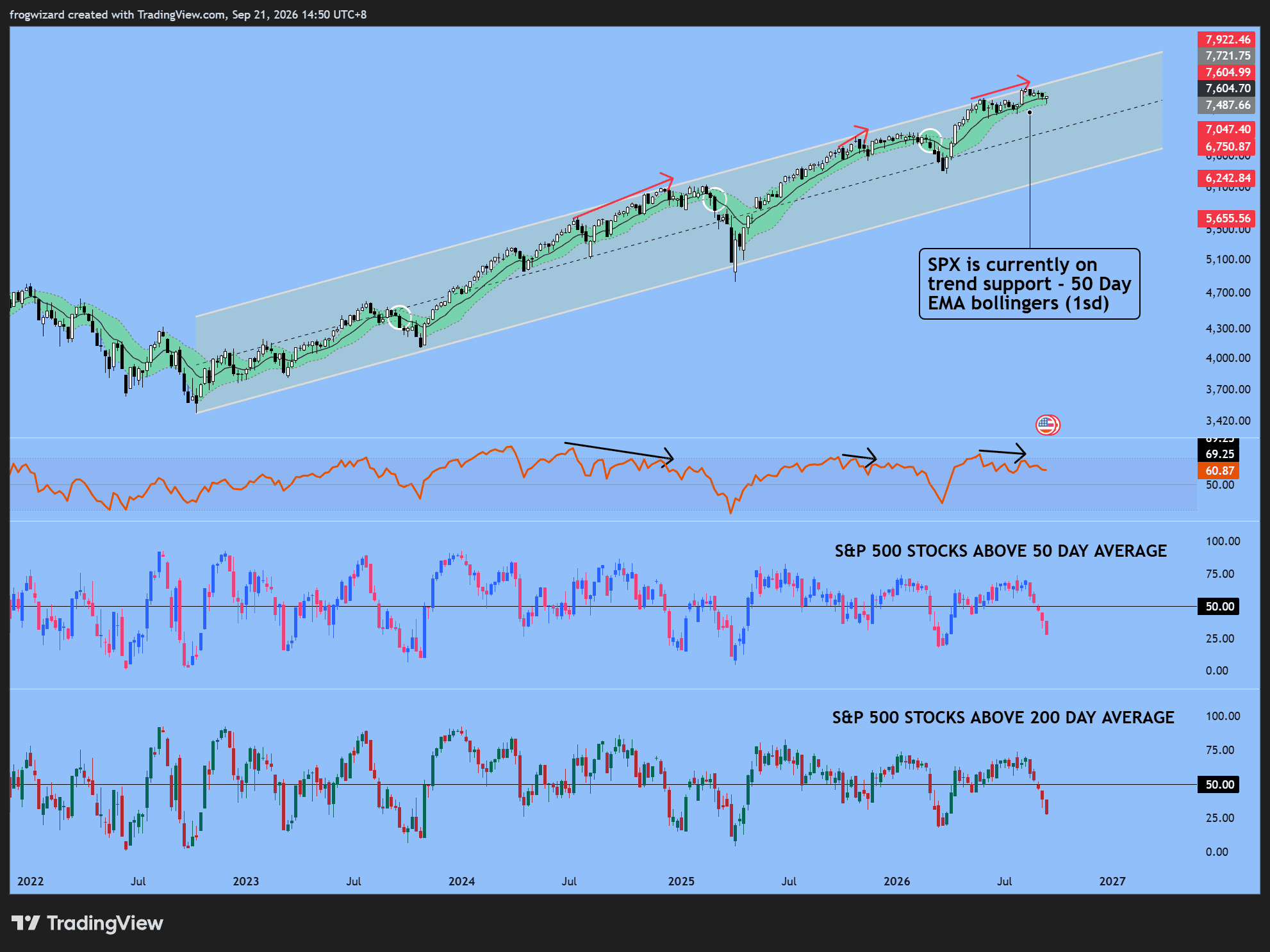
| S&P 500: price resilience is masking weaker breadth. The index remains inside its rising weekly structure while the share of constituents above key moving averages has fallen. Source: TradingView / Alchemy Markets analysis, 21 Sep 2026. |
That divergence matters. A market can keep rising with narrow leadership, but the move becomes increasingly dependent on a small group of large companies. For the recovery to become more durable, breadth needs to stabilise rather than continue to contract.
Technology is the clearest place to look for confirmation. USTEC has rallied back into the 30,000-30,200 region, where a descending trendline and prior resistance meet. A clean close above that area would improve the technical picture, while another rejection would keep the recovery vulnerable to a pullback towards the lower support zones.
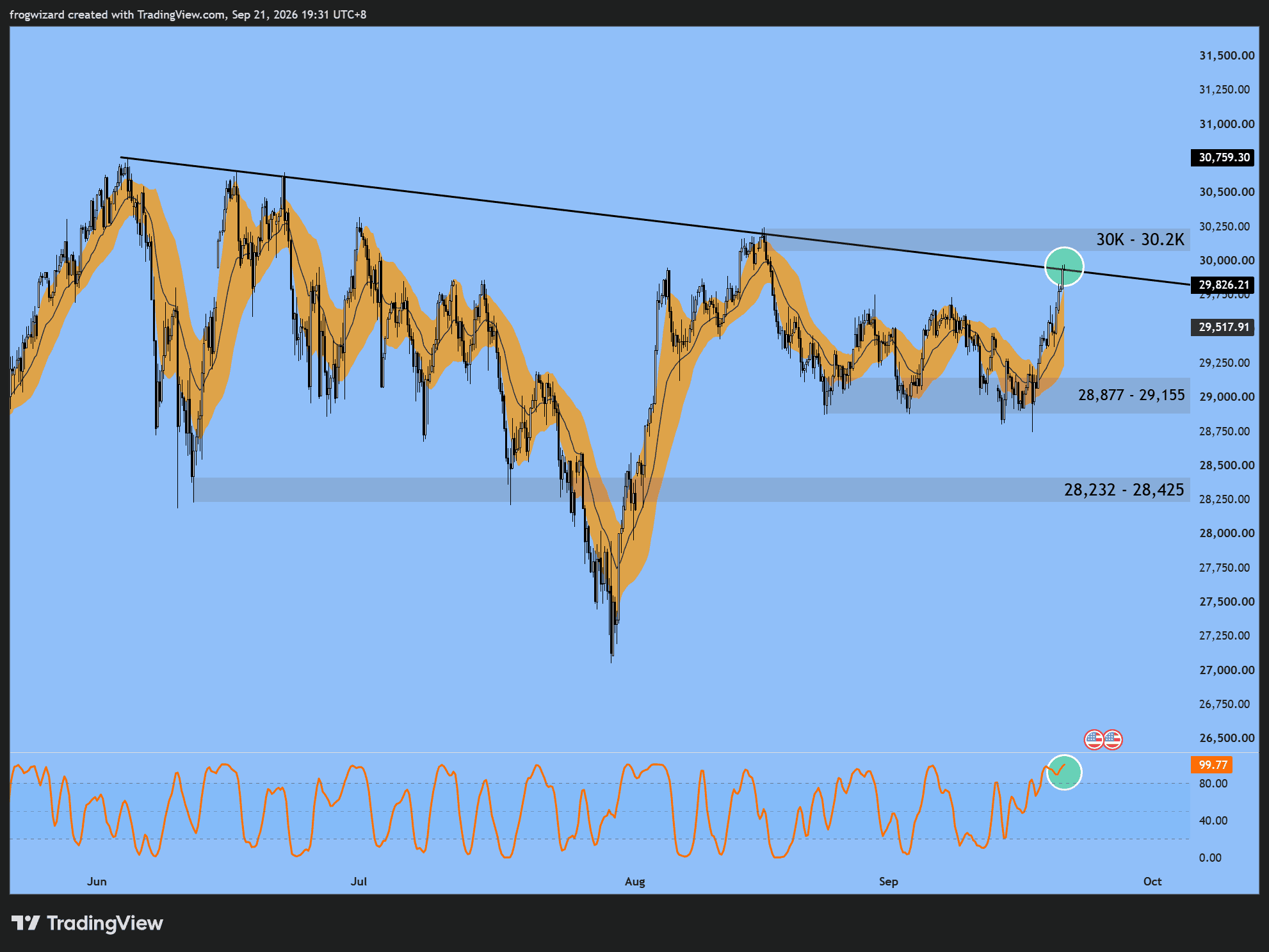
| USTEC: 30,000-30,200 is the decision zone. The four-hour Stoch RSI is already near an extreme, so the key signal is a break and hold rather than a first touch. Source: TradingView / Alchemy Markets analysis, 21 Sep 2026. |
Semiconductors provide the second confirmation signal. SMH is indicated near the 582-583 area in pre-market trading after holding above its broader retracement support, but it remains well below the prior 2026 high near 671. A gap-and-hold would strengthen the technology-led recovery; a gap that quickly fades would fit the broader picture of narrow leadership rather than a clean risk-on breakout.
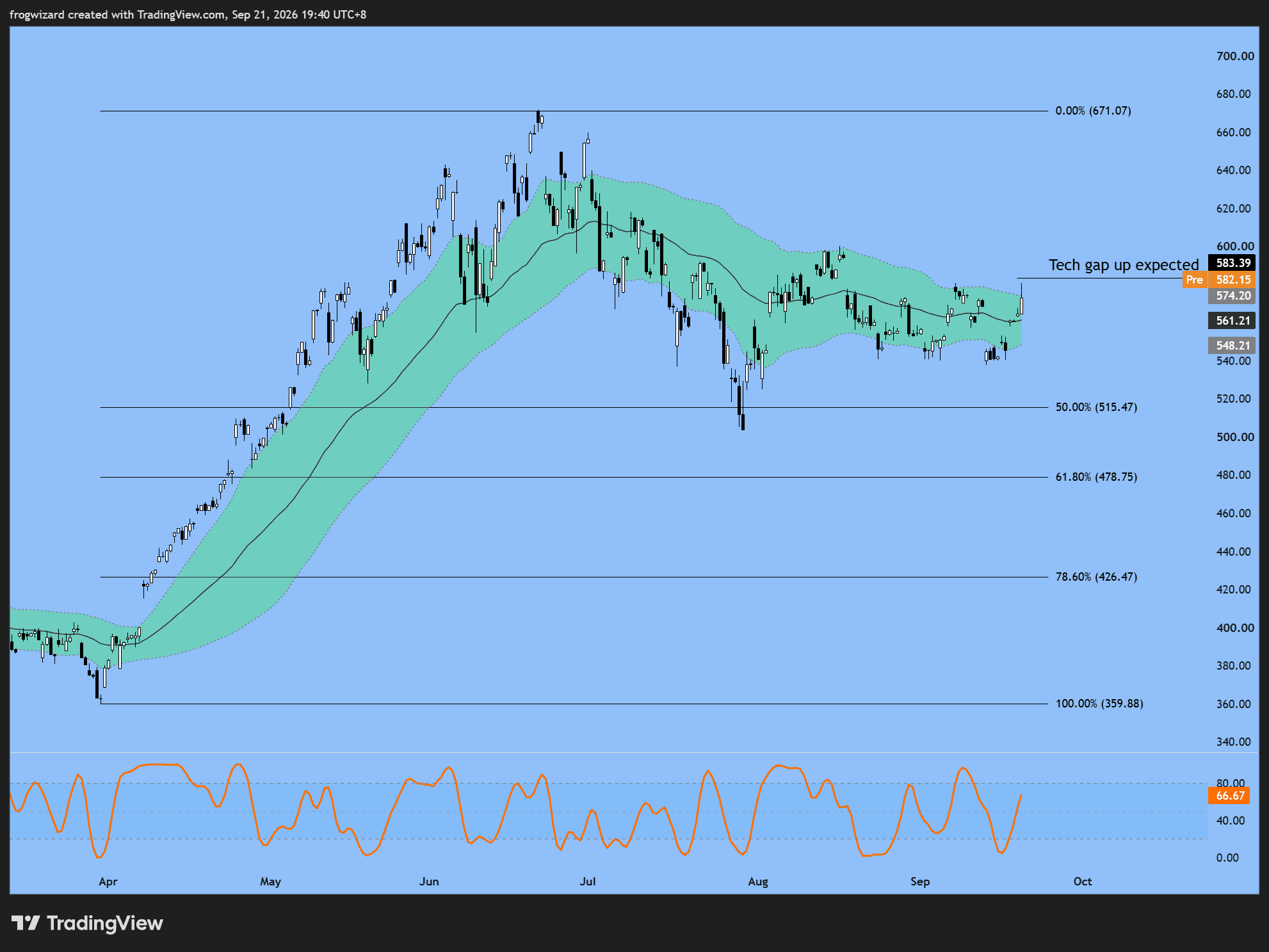
| SMH: A gap into roughly 582-583 would support the rebound, but the sector is still below its prior 2026 high near 671. Source: TradingView / Alchemy Markets analysis, 21 Sep 2026. |
Oil is also reaching a more important technical point than the headline decline suggests. November WTI was around $93.49 on Monday, placing it inside the roughly $91.75-$94.82 support zone highlighted by the recent chart structure. If that area holds and crude rebounds, inflation and bond-yield pressure could return quickly; a decisive break lower would give technology more room to extend the recovery.
That leaves the 10-year Treasury yield as the cross-asset pressure gauge. A sustained move below 5% would keep easing the valuation headwind for growth stocks, while a rebound above recent highs alongside firmer oil would challenge the current risk-on move. Gold provides a secondary check because it remains caught between safe-haven demand, a firm dollar and restrictive real-rate conditions.
The market verdict is therefore constructive but conditional. For the rebound to become more convincing, USTEC needs to clear resistance, semiconductor strength needs to hold after the open, and S&P 500 breadth needs to stop deteriorating. Oil and yields also need to remain contained rather than simply pausing before another leg higher.
Thursday’s Trump-Xi meeting adds the catalyst. Concrete tariff, LNG or trade measures could broaden the relief move beyond megacap technology. A summit that delivers little beyond diplomatic language would leave the market dependent on the same narrow leadership that is carrying it today.
What traders should watch next
- USTEC: look for a four-hour close above 30,000-30,200 and a hold on any retest; the oscillator is already stretched.
- S&P 500 breadth: both 50-day and 200-day participation measures are below the 50% line; stabilisation would improve the quality of the rebound.
- Semiconductors: whether SMH can hold the 582-583 pre-market area rather than give back the gap after the U.S. open.
- Oil and rates: WTI support at roughly $91.75-$94.82 and whether the U.S. 10-year yield can stay below 5%.
- Trump-Xi summit: concrete tariff, LNG or trade measures rather than headline-only progress.