Written by:


- Opening Bell
- September 17, 2026
- 4 min read
Fed Hikes, Markets Reassess the Path Ahead
The Federal Reserve delivered the 25bp rate hike markets were expecting on Wednesday, lifting the federal funds target range to 3.75%–4.00%. The more important message, however, was not the hike itself but what the Fed said about the economy and the path from here.
The statement was clearly firmer on inflation. The Fed said economic activity is expanding at a solid pace, domestic spending has remained resilient, productivity growth is strong and capital investment remains robust. At the same time, inflation remains elevated, with policymakers saying the latest move should support a “timelier return” to the 2% target. The decision was unanimous, reinforcing the message that the Committee sees enough resilience in growth and employment to keep prioritising price stability.
The updated projections added another hawkish layer. Sixteen of the 18 policymakers submitting a rate projection see at least one further increase before the end of 2026, while the median path points to rates reaching 4.00%–4.25% and staying there through 2027. Warsh also avoided giving the market much forward guidance, leaving policy heavily dependent on the incoming inflation and growth data.
That combination initially pressured risk assets. The S&P 500 fell around 1% into Wednesday’s close, the 2-year Treasury yield rose around 7bp to 4.73%, the 10-year briefly moved back above 5%, and the dollar strengthened.
The picture looks calmer this morning, though. US index futures have recovered, with S&P 500 futures up around 0.7%and Nasdaq 100 futures close to 1% earlier in the session. Longer-dated Treasury yields have also eased back below 5%.
That suggests the market is beginning to distinguish between two things.
The Fed has clearly become more serious about inflation, but this still does not necessarily mean an aggressive multi-meeting hiking cycle. The median projection currently implies only one further hike this year. Markets may therefore be starting to view Wednesday’s move as a removal of uncertainty rather than the beginning of something significantly more restrictive.
S&P 500: Support remains intact for now
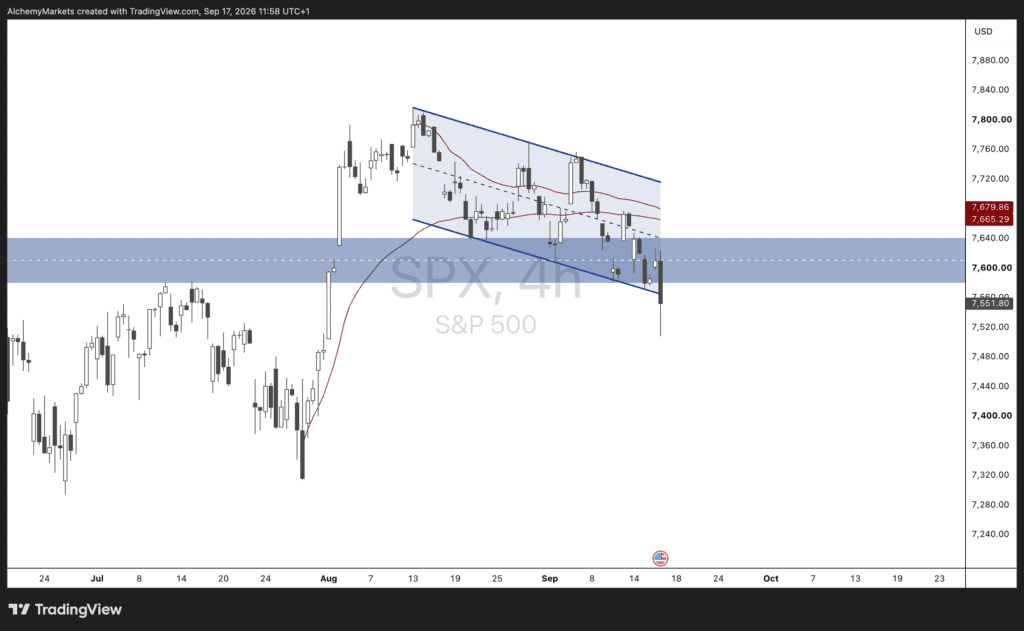
Technically, the S&P 500 remains in an interesting position.
The index has been consolidating lower since the August peak, but the structure can still be interpreted as a bull flag rather than a confirmed bearish reversal.
For now, the key area is the 7,500–7,600 support zone.
Wednesday’s post-Fed sell-off briefly pushed price lower, but buyers have so far defended the broader support region. As long as the index continues to hold around this zone, the possibility remains that the recent decline is simply a corrective move within the broader uptrend.
The next hurdle is overhead.
Two anchored VWAPs — one drawn from the July lows and another from the August highs — are now sitting above price and acting as near-term resistance. The index therefore needs to reclaim roughly the 7,660–7,700 region before the bullish technical case begins to strengthen again.
A clean break above those VWAPs would bring the upper boundary of the bull flag back into focus around the 7,720–7,760 area, with a breakout potentially reopening the August highs.
But the downside level remains equally important.
If 7,500–7,600 fails decisively, particularly on a daily closing basis, the bull-flag interpretation starts to weaken. At that point, the post-Fed move would look less like consolidation and more like the beginning of a deeper correction.
What matters from here
The Fed has now made its first move. The question for markets becomes whether the economy can absorb tighter policy without earnings expectations deteriorating.
For equities, the most important confirmation may therefore come from the bond market rather than the next Fed headline.
If the 10-year Treasury continues to reject 5% and equity futures hold their recovery, Wednesday’s sell-off may prove to have been largely an event-driven shakeout.
If yields instead resume their climb and the 10-year establishes itself above 5%, the valuation headwind becomes much harder for equities to ignore.
For now, the technical picture remains finely balanced:
7,500–7,600 keeps the bull-flag scenario alive.
7,660–7,700 is the first meaningful obstacle.
A break above the descending channel would restore stronger bullish momentum.
The Fed has delivered the hike. The next move now belongs to the market.