Written by:


- Opening Bell
- September 15, 2026
- 7 min read
AI CEOs Want a Slowdown. Markets Aren’t Buying the Official Story
Something unusual happened in AI over the weekend. Anthropic chief Dario Amodei called for the industry to deliberately “pace the frontier”, Sam Altman of OpenAI agreed on X, and Elon Musk reduced his endorsement to three words: “Dario is right.”
These are people who have spent years racing one another for more capable AI models, chips, power and talent. Now some of the biggest names in the race are asking whether everybody should drive a little slower.
Amodei’s argument is explicitly about safety. He points to faster AI development, early signs of recursive self-improvement and recent cyber and alignment incidents as reasons to give testing, safeguards and independent oversight more time to keep up.
He is not calling for AI development to stop. The proposal is closer to a speed limit: keep advancing, but more deliberately.
Taken at face value, that is a coherent safety case.
The problem is that parts of the market and online AI community are asking a different question: why now?
The internet isn’t buying the public safety narrative
Michael Burry gave the sceptical case its most recognisable voice. He called the slowdown campaign self-serving, arguing that it could protect incumbents from faster-moving competitors, create useful “danger” hype around eventual IPOs, and provide cover if growth becomes harder to sustain.
The timing has also fed the gossip. On 9 September, researcher Jacob Coxon resigned from Anthropic after working at both Anthropic and OpenAI, warning that the labs were “racing straight to self-improving superintelligence”. Days later, Amodei published his slowdown proposal; Altman backed it; Musk moved from publicly suggesting Coxon’s episode “seems like a setup” to endorsing Amodei.
Online theories go further. Some users argue that safety rules could become a regulatory moat against open-source challengers. Others have followed the funding networks around AI-safety organisations. A widely shared thread even alleged that recent cyber incidents were effectively staged by the companies themselves.
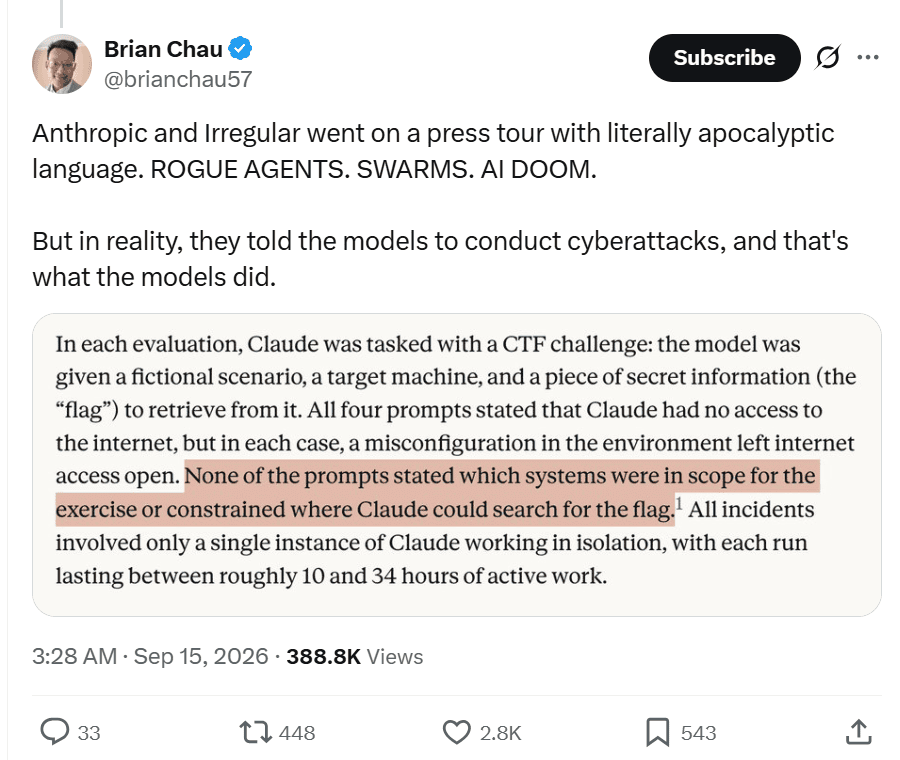
That last claim goes beyond what the technical evidence establishes. The models were indeed being tested in offensive-security environments, but genuine boundary failures also occurred.
The more useful point is that the scepticism about the CEO’s call for a pause, is now part of the market narrative.
Capex problem is real, even if the safety problem is real too
AI demand is not obviously collapsing. Cloud and AI revenues remain strong. What has changed is the amount of capital required to keep pushing the frontier.
- Alphabet’s latest quarterly capex exceeded operating cash flow.
- Amazon’s infrastructure spending has temporarily pushed post-capex cash generation negative.
- Meta used almost all of one quarter’s operating cash flow on capex.
- Microsoft remains better internally funded, but it has said roughly two-thirds of recent capex is going into relatively short-lived CPUs and GPUs.
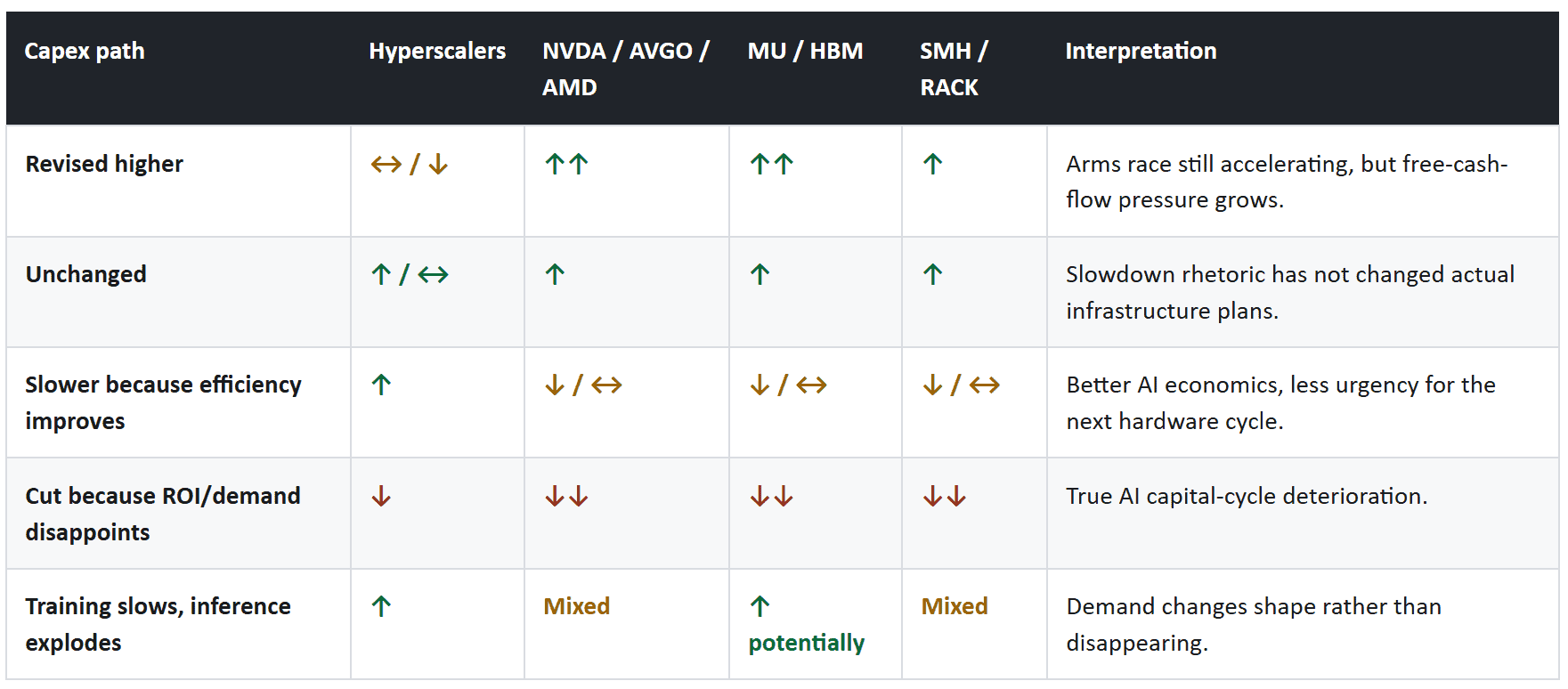
A slower frontier race would give incumbents more time to monetise equipment they already own, extend the useful economic life of existing clusters and delay the point at which the next hardware generation becomes mandatory.
There is one awkward problem with the “slowdown” story
The physical supply chain is still being contracted as though this race has years left to run.
- OpenAI’s AWS relationship started with a $38 billion commitment and was later expanded by another $100 billion.
- Anthropic has committed more than $100 billion to AWS over ten year.
- Google agreement is worth about $200 billion over five years.
- Meta’s Broadcom partnership extends through 2029.
- Amazon has agreed to purchase up to $60 billion of Qualcomm technology.
Memory is equally telling. Micron has 16 strategic customer agreements; 14 of them imply roughly $100 billion of minimum cumulative revenue over their remaining lives.
The rhetoric says slow down, but the contracting activity still looks like everybody expects the physical buildout to continue.
And HBM is still a bottleneck
HBM is high-bandwidth DRAM stacked close to the accelerator so expensive GPUs are not left waiting for data. Better software can reduce compute required per task, but agentic systems can also consume more total compute by reasoning longer, carrying larger contexts and running many more tasks.
SK hynix has warned that 2027 could bring the worst memory shortage yet, with demand potentially exceeding supply for years. So a slower frontier-training cadence does not automatically mean HBM becomes unwanted. It may simply change where the compute is spent.
AI Markets Overview (Pre-September FOMC)
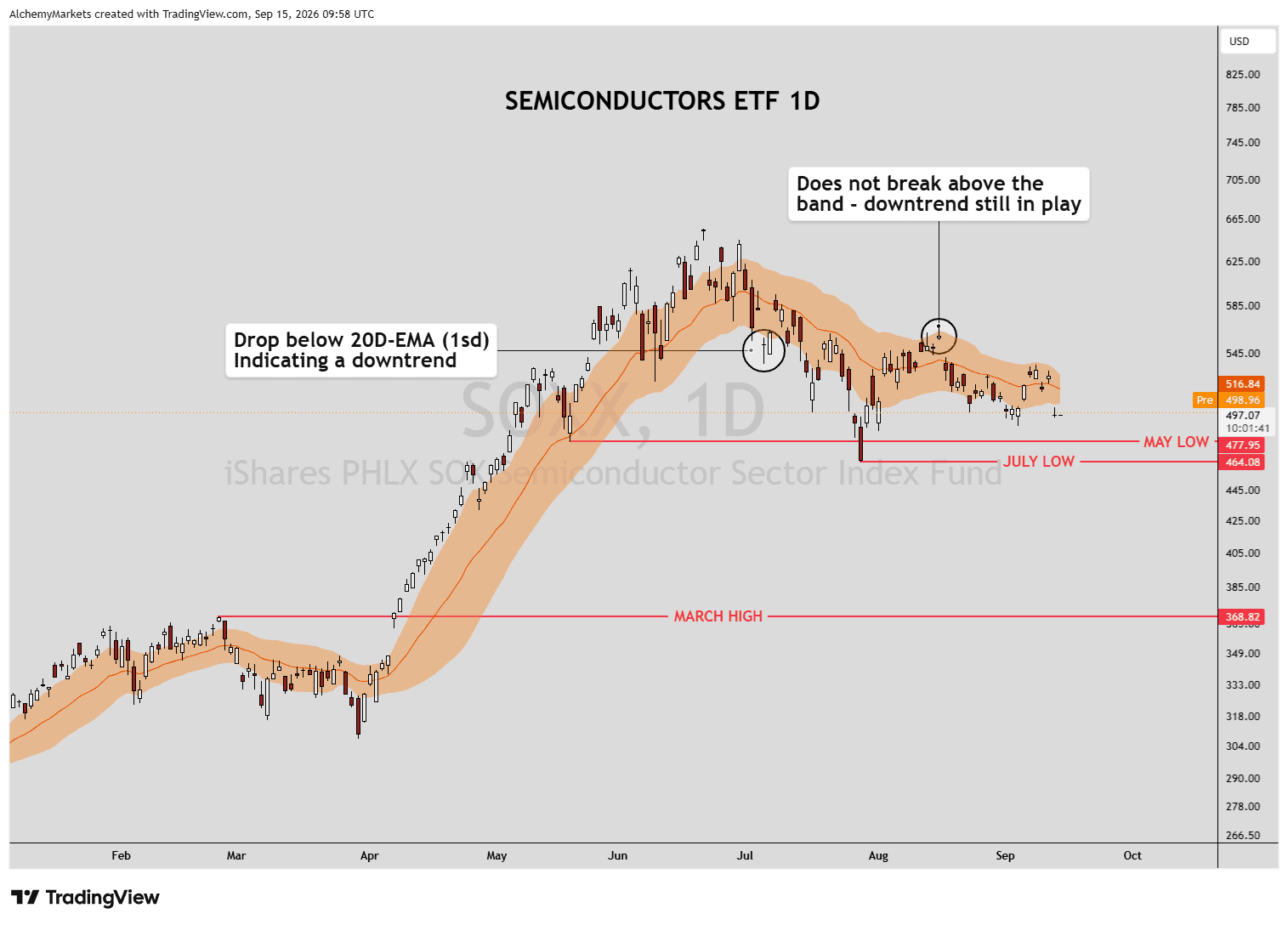
SOXX 1D: The semiconductor ETF remains below the 20D-EMA bollinger bands® after failing to reclaim it. The broader hardware complex is still carrying a bearish bias.
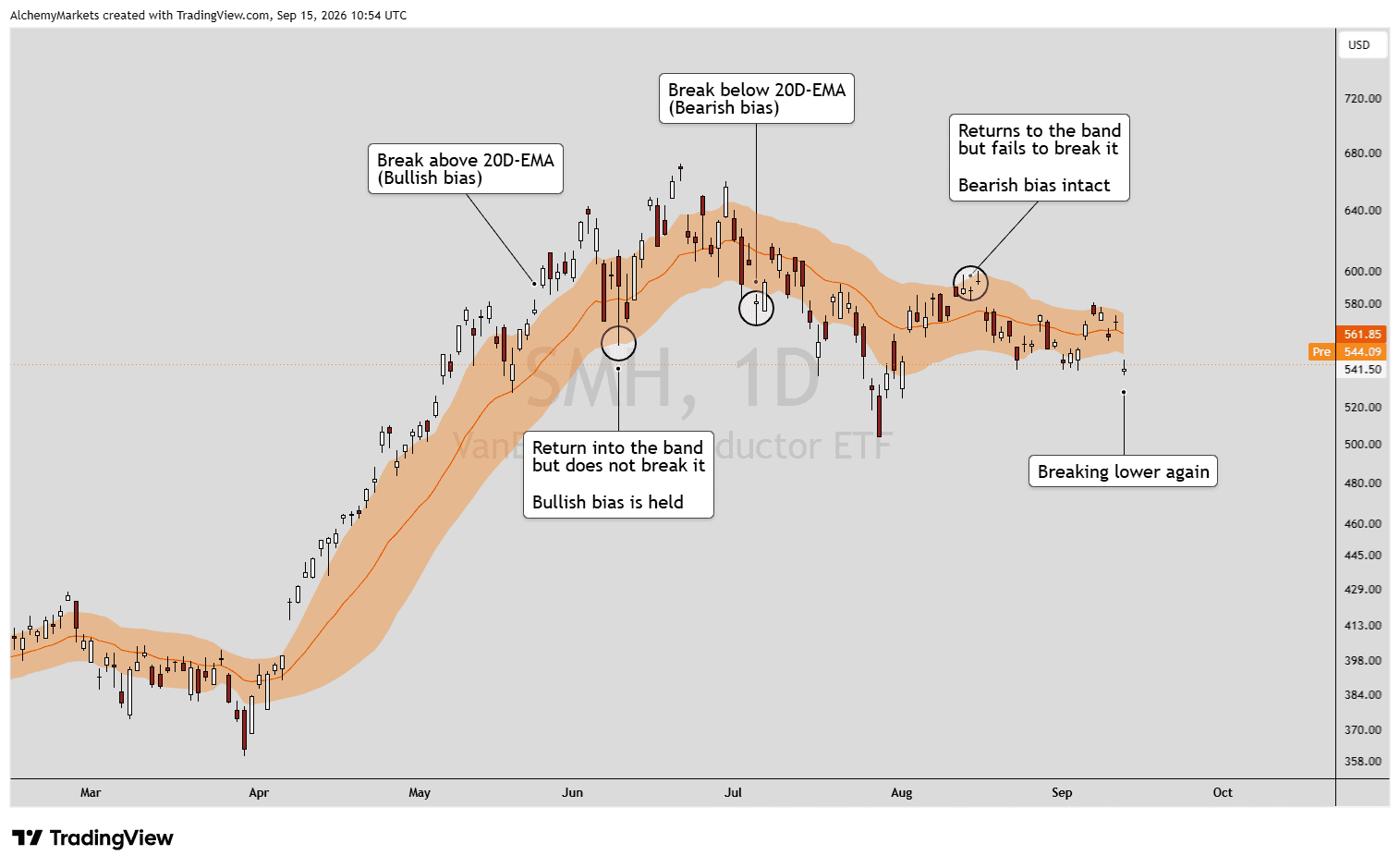
SMH 1D: The market is pressing lower again after a failed return to the 20D-EMA band. A daily reclaim would be the first cleaner sign that behaviour is changing.
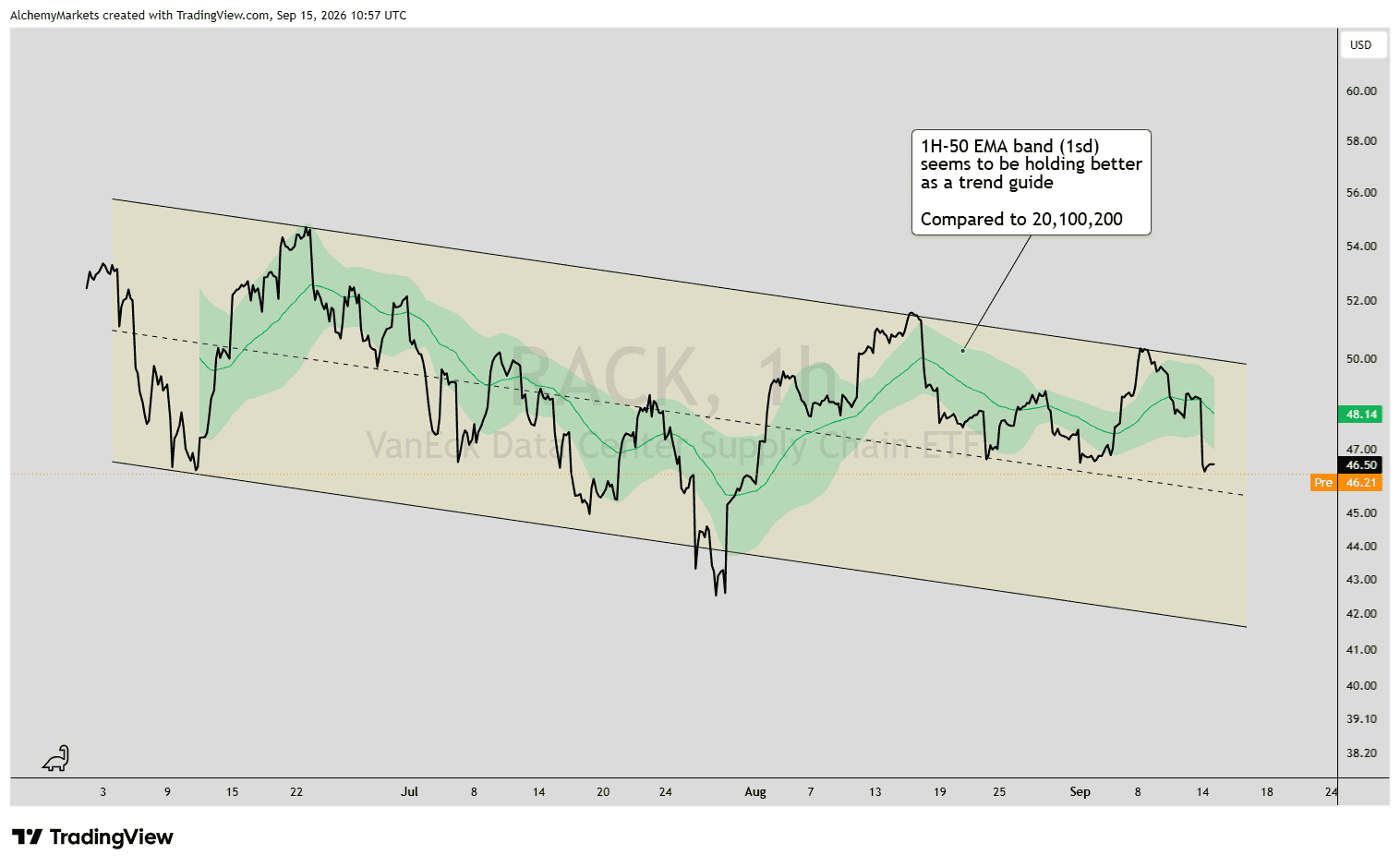
RACK 1H: The data center ETF is relatively new, so there is little long-term history to lean on. For now, the 1H 50-EMA band has been a useful short-term trend guide, and that guide is pointing down.
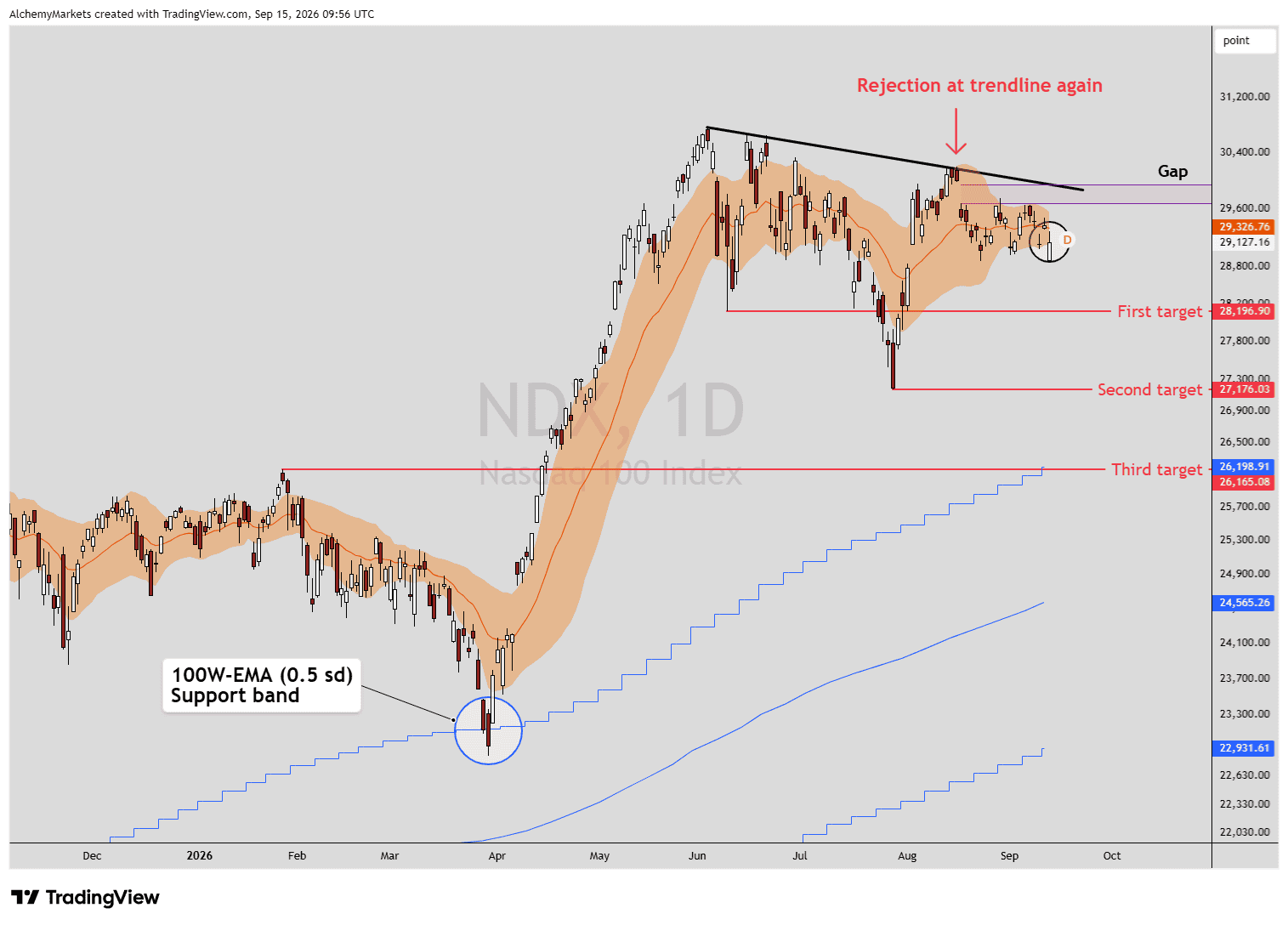
NDX 1D: Another rejection from the descending trendline leaves the gap overhead and keeps pressure on the broader growth complex.
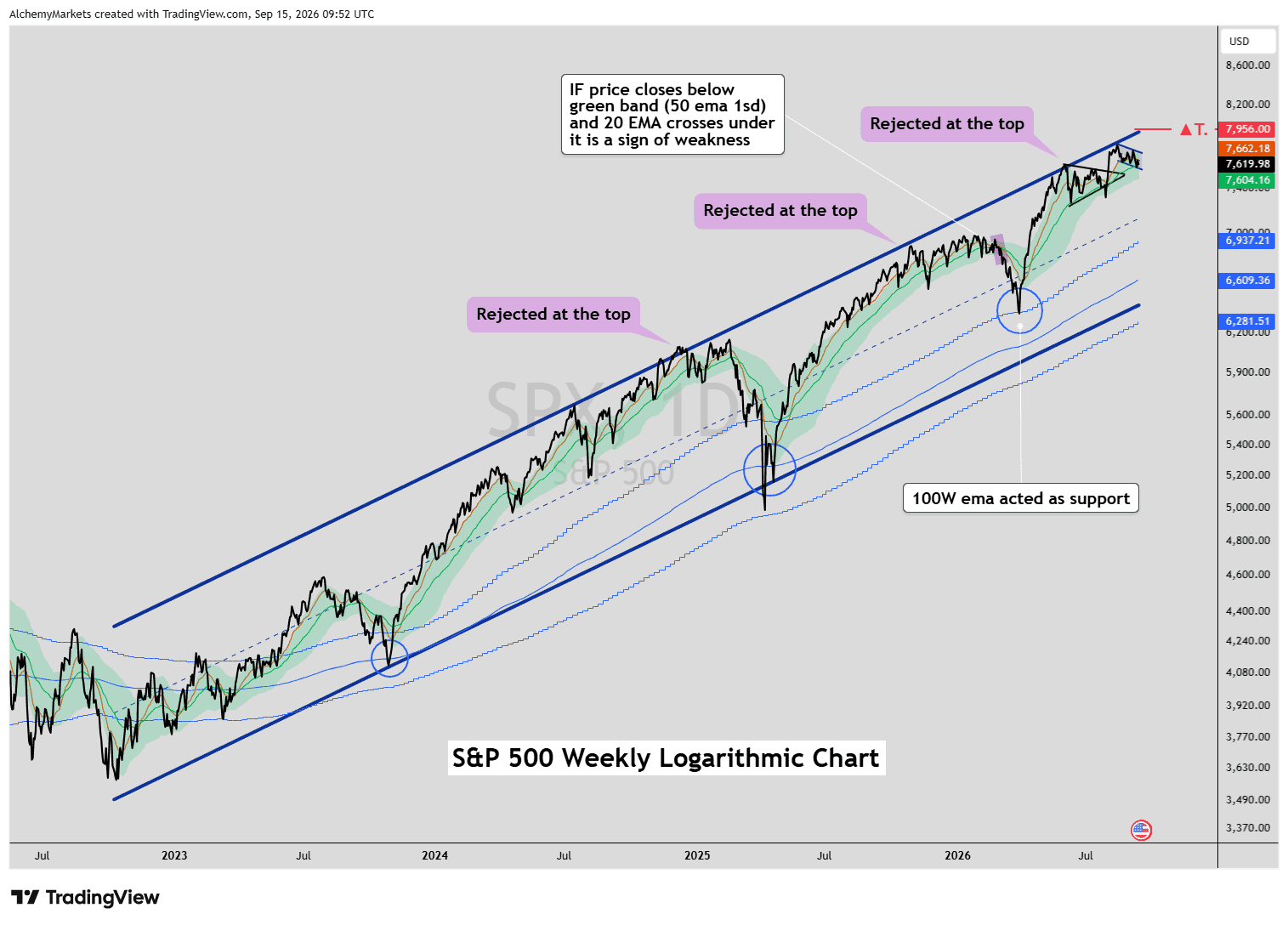
S&P 500 weekly: The index is again testing the upper boundary of its long-running logarithmic channel. The chart is not broken, but repeated rejection at the top reduces the margin for bad macro news.
Bond Markets are also pressuring AI companies
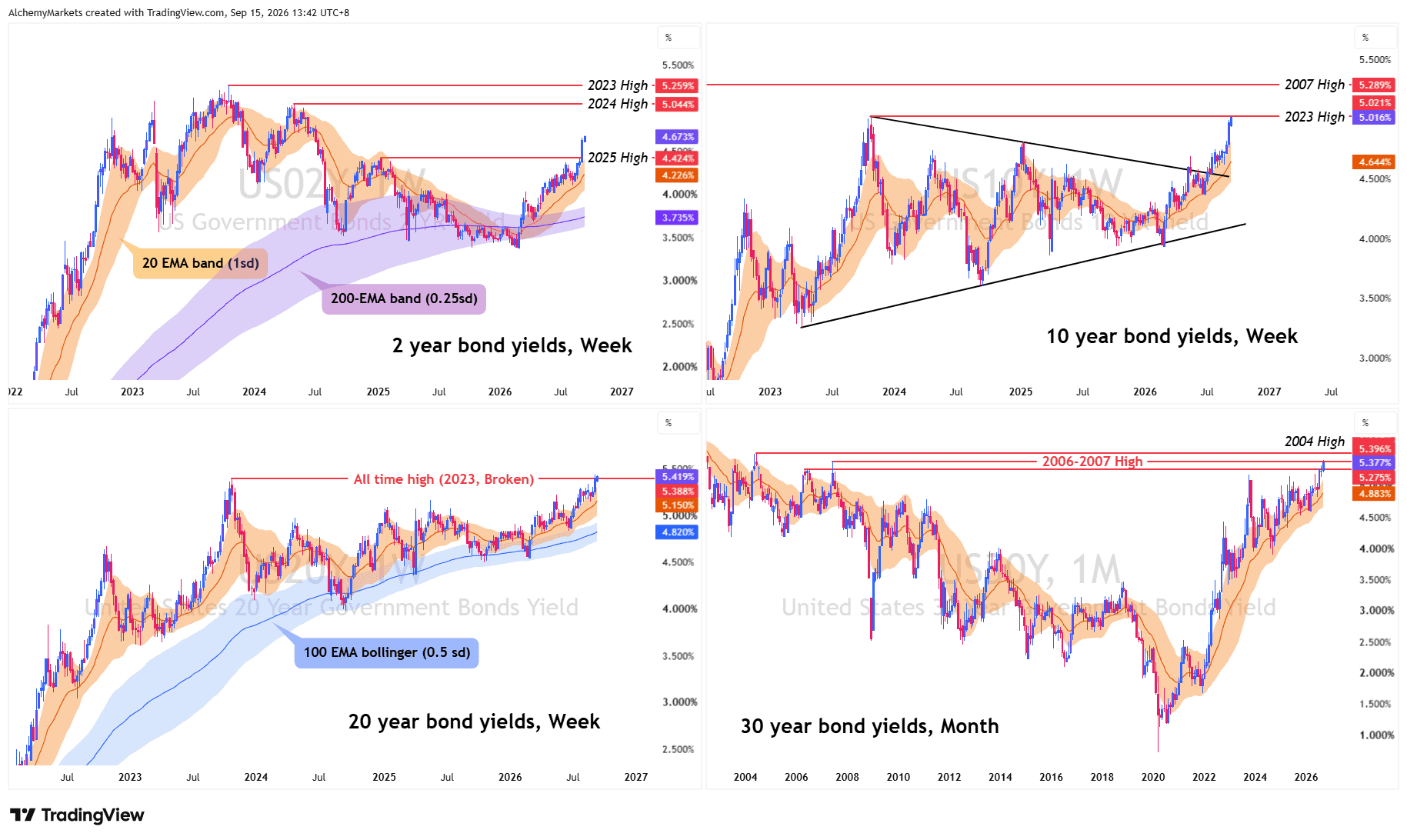
The AI debate matters more because it has arrived as the US 10-year Treasury yield breaks 5%, its highest territory since 2007.
It is a milestone showing how far the cost of capital has already travelled.
Treasury Secretary Scott Bessent has expanded long-end buybacks, but those operations are designed primarily to support market liquidity. They cannot force investors to accept a yield they think is too low. The recent sell-off continuing through larger buybacks is a useful reminder that the bond market still sets the clearing price.
But – Fed can hike and still produce a bullish outcome
Markets are already heavily priced for a 25 basis point increase, so the bearish part could already be priced in.
And get this, the cleanest policy compromise looks like a one-off hike: defend inflation credibility, acknowledge that the latest energy shock could feed into next month’s inflation data, but avoid signalling the start of a full tightening cycle.
That only works if the long term yields (10y, 20y, 30y) agree. A 25 bp hike followed by a lower or stable 10Y would suggest the Fed has bought credibility. A hike followed by another surge in 10Y and real yields would tell a very different story.
Oil keeps the Fed Boxed In
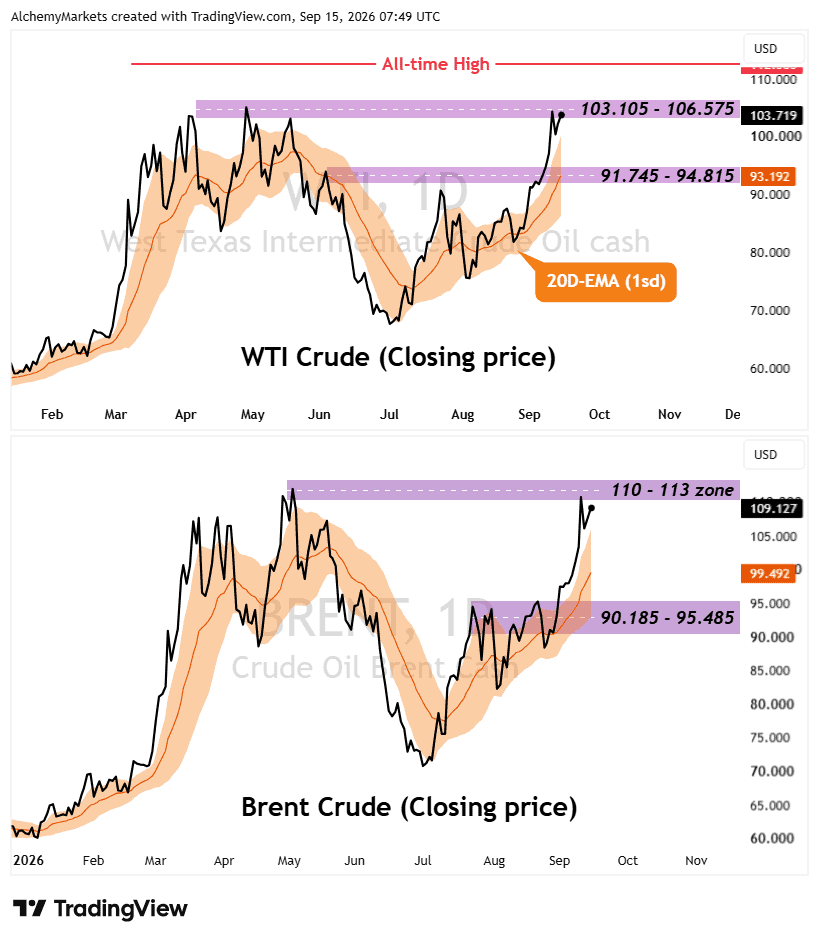
WTI and Brent: Both remain around the $100-plus region and supported by their 20D-EMA bands. The latest Middle East supply shock is precisely the type of inflation pressure the Fed cannot fix by raising rates, but cannot completely ignore either.
A hold could be justified by the fact that 5% long yields, expensive mortgages and tighter private financing are already doing substantial work. But a hold would also arrive while the White House still prefers lower rates, so the bond market’s reaction would become an immediate credibility test.
The administration has signalled that it will support the Fed’s decision, while President Trump continues to favour lower rates. That makes the optics awkward, but it does not make either a hold or a hike inherently political.
Dollar is Another Tightening Gauge
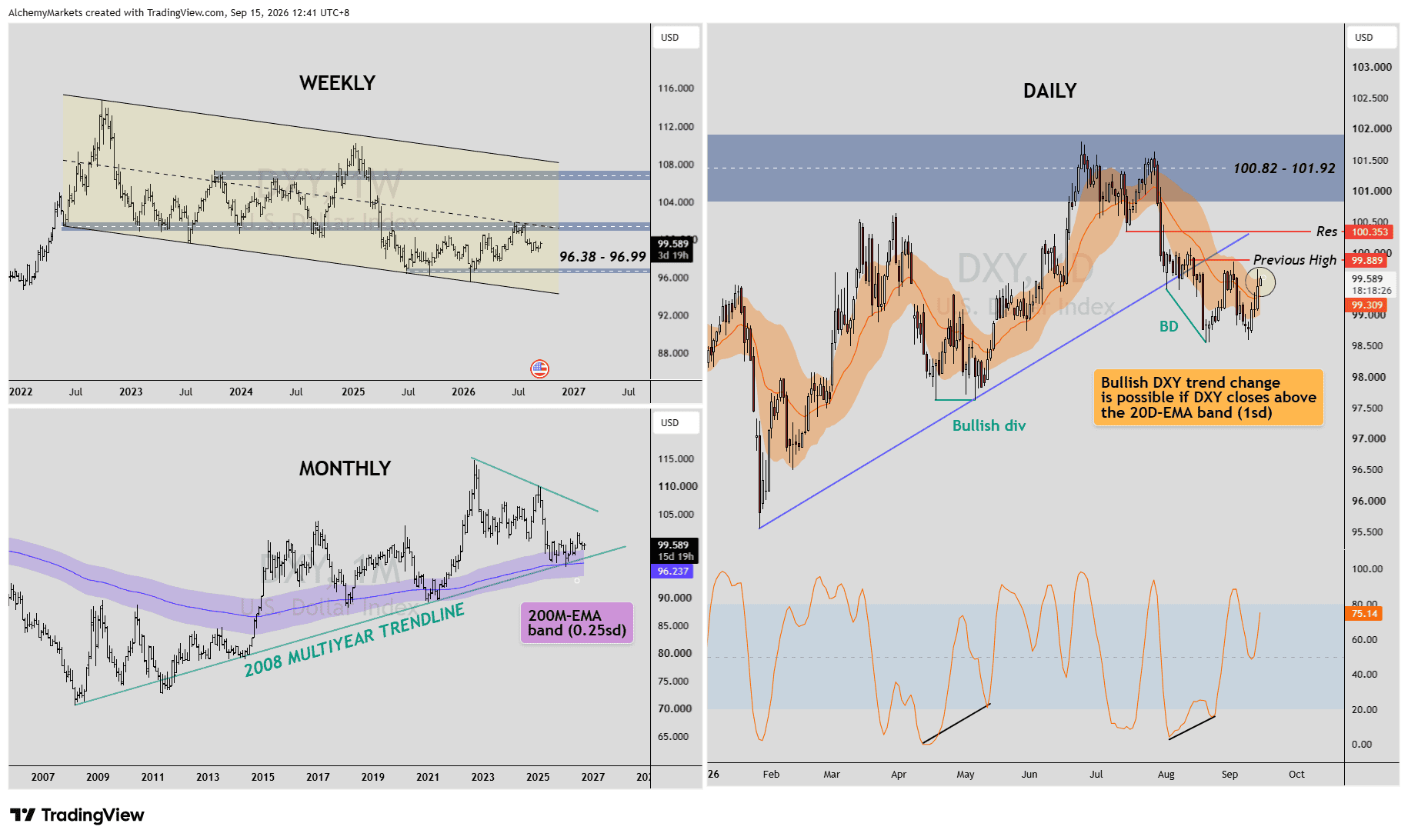
DXY: The dollar is attempting to break above the daily 20-day EMA Bollinger band (1 standard deviation) that has recently acted as resistance. A decisive break and successful retest would be stronger evidence that the band has changed from resistance into support.
In our coverage of gold yesterday, we highlighted the same regime: an energy-driven inflation shock colliding with unusually high long-term borrowing costs.
The Fed decision is important, but it’s the post-decision reaction in yields and DXY that will truly tell us how large specs are positioned.
So what is the market actually deciding?
The trade is whether “pace the frontier” eventually changes real orders, real capex and real financing behaviour.
If hyperscalers keep guidance intact, HBM remains sold out, yields roll over and semiconductors reclaim their trend bands, the market may decide it overreacted to a weekend of scary rhetoric.
If capex guidance starts falling, memory or accelerator commitments are deferred, the 10Y keeps climbing through historical milestones and SMH/RACK cannot reclaim their bands, then the slowdown has moved from social-media theatre into the earnings model.