Written by:


- Opening Bell
- September 3, 2026
- 6 min read
Yen Surge Puts USD/JPY Intervention Risk Back in Focus
USD/JPY has started September under heavy pressure, with the yen extending Wednesday’s sharp rally and pushing the pair towards the mid-156s. The move has revived speculation that Japanese authorities may once again be active in the currency market, but the evidence so far suggests the latest decline is more likely being driven by intervention risk and a repricing of Bank of Japan policy than confirmed direct yen buying.
The distinction matters. Japan has already shown that it is willing to defend the currency aggressively. Ministry of Finance data confirmed that Japan spent a record ¥15.4 trillion, or roughly $96.5 billion, supporting the yen between 30 July and 26 August, including a rare coordinated intervention with the United States at the end of July.
That intervention followed USD/JPY reaching almost 164, its weakest yen level in around four decades. The pair subsequently fell as low as roughly 155 before recovering towards 160 through August. In other words, a large part of the original intervention move had already been unwound before this week’s renewed decline.
Was Wednesday another intervention?
The near-1% fall in USD/JPY on Wednesday was certainly large enough to get traders’ attention. However, there has been no confirmation that Japanese or US authorities actually entered the market again.
Instead, analysts have suggested that authorities may have conducted a rate check — effectively asking banks for live USD/JPY prices. These checks are sometimes used as a warning shot because they signal that intervention could be approaching without authorities actually buying yen. Reuters cited Daiwa Capital Markets’ Chris Scicluna saying the move looked more consistent with a rate check than another attempt to force the currency into a completely new trend.
That makes sense when looking at the wider market. The yen move has not happened in isolation. Expectations for Japanese interest rates have also shifted materially.
Bank of Japan Governor Kazuo Ueda said this week that policymakers will assess whether growing inflation risks warrant another rate increase at the 17–18 September meeting, while board member Hajime Takata argued that the Bank should be willing to raise rates more flexibly rather than following a predictable schedule.
There is also unusual pressure coming from Washington. US Treasury Secretary Scott Bessent has publicly backed Japan taking decisive steps to address the yen’s weakness and has specifically highlighted the inflationary consequences of an undervalued currency.
So even without another confirmed intervention, authorities have achieved something important: yen-funded carry traders now know that both monetary tightening and direct intervention are live risks.
The problem for yen bulls: the Fed
There is still an important counterweight.
US monetary policy remains restrictive, and markets continue to price a meaningful probability of another Federal Reserve rate increase at the 15–16 September FOMC meeting. After Kevin Warsh’s hawkish Jackson Hole speech, expectations for a September hike moved sharply higher, with Reuters reporting probabilities around 60–65% earlier this week.
Those odds have become more fluid today. Governor Christopher Waller said he would support keeping rates unchanged if August inflation shows continued progress towards 2%, although he would consider a hike if inflation surprises higher. Markets subsequently trimmed the probability of tightening to only slightly above even odds.
This leaves USD/JPY caught between two opposing forces.
On the Japanese side:
BOJ tightening expectations + intervention risk → stronger yen.
On the US side:
persistent inflation + possible Fed hike → higher US yields → stronger dollar.
That interest-rate differential is why it is difficult to argue that intervention alone can create a sustainable USD/JPY downtrend. Japan demonstrated this in July: almost $100 billion of intervention produced a powerful initial move, but USD/JPY subsequently retraced a substantial part of it.
For the yen rally to become more durable, markets probably need to see the underlying rate differential begin closing rather than simply another round of official dollar selling.
USD/JPY technical picture
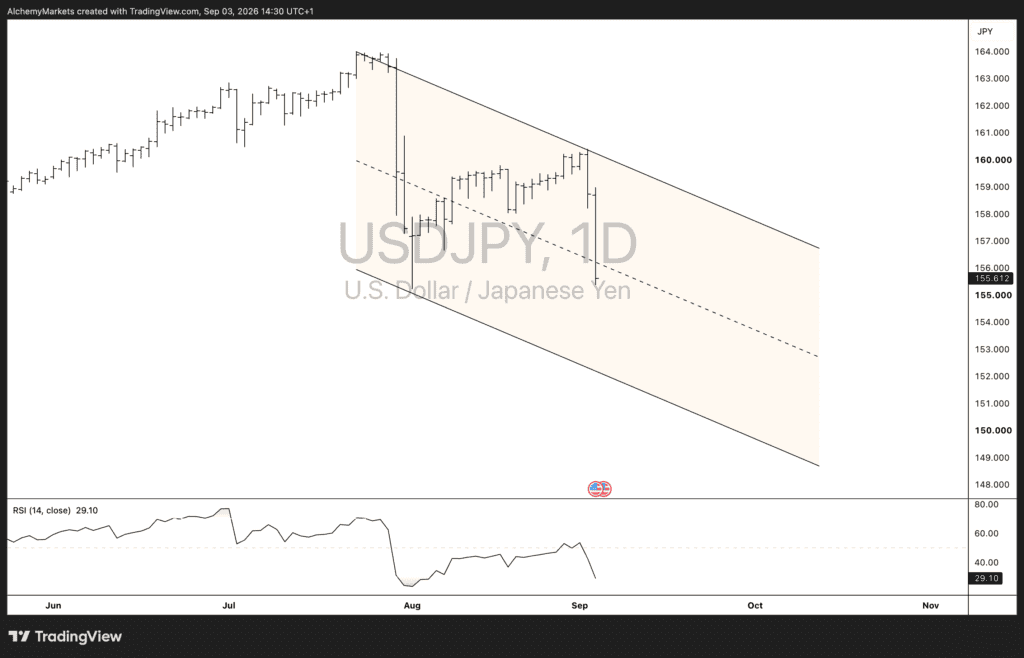
The daily chart is beginning to reflect that change in narrative.
USD/JPY remains inside the broader descending channel that has developed since the July peak, but the latest sell-off has pushed price back towards the 155–156 area, while daily RSI has fallen towards 29, putting the pair into technically oversold territory.
That makes the current area important.
A sustained break below roughly 155 would strengthen the bearish structure and suggest the market is beginning to price something more persistent than another intervention scare. From there, the lower portion of the channel leaves room towards the 153 area, with 150 becoming the larger psychological level if the rate differential begins moving decisively in Japan’s favour.
However, oversold conditions also increase the risk of a sharp rebound. If USD/JPY stabilises around 155–156 while expectations for a September Fed hike recover, the pair could attempt to retrace towards the upper part of the channel.
The larger resistance area remains around 159–160. That is now more than a technical level. It is also becoming a policy level where traders know Japanese and US officials are increasingly uncomfortable with renewed yen weakness.
What traders should watch next
Friday’s US payrolls report is the immediate macro catalyst, but the more important question is what the data does to September Fed pricing. Weak employment combined with contained wage growth would reduce the case for another Fed hike and reinforce the yen rally. A strong labour-market report, particularly alongside firm wages, would rebuild the US yield advantage and could give USD/JPY room to bounce.
After that, attention turns to US inflation data and then the back-to-back central-bank meetings: the Fed on 15–16 September and the Bank of Japan on 17–18 September.
That creates an unusually clean policy setup for USD/JPY.
The intervention story may have triggered the market’s attention, but the sustainable move will ultimately be decided by rates.
For now, USD/JPY remains technically bearish below the descending-channel resistance, but with RSI already oversold, chasing the latest drop carries poor asymmetry. The more important signal would be whether rallies now fail below 159–160 and whether the Fed-BoJ policy gap genuinely begins to narrow.
The chart supplied above shows the pair trading within that descending structure.