Written by:

- Opening Bell
- August 28, 2026
- 4 min read
Salesforce Earnings Shock: Is it time for Software stocks to make a return?
Salesforce’s earnings shock has reopened a question:
What if AI does not replace software but makes the strongest platforms more valuable?
Software stocks have spent much of the AI boom on the wrong side of the trade, from 2025 – 2026.
Clearly, markets were favouring the fresh and new technology hitting the markets.
Many software companies were discounted on the fear that AI agents would eventually bypass their interfaces, reduce seat counts and weaken the economics of traditional SaaS.
As a result, S&P 500 Software & Services index fell more than 33% from its October 2025 peak to April 2026 as the market wrestled with AI disruption (as reported by Reuters). But the latest earnings cycle is starting to complicate that story.
Salesforce just gave the market a different answer
Salesforce just shocked the markets with its recent earnings and guidance.
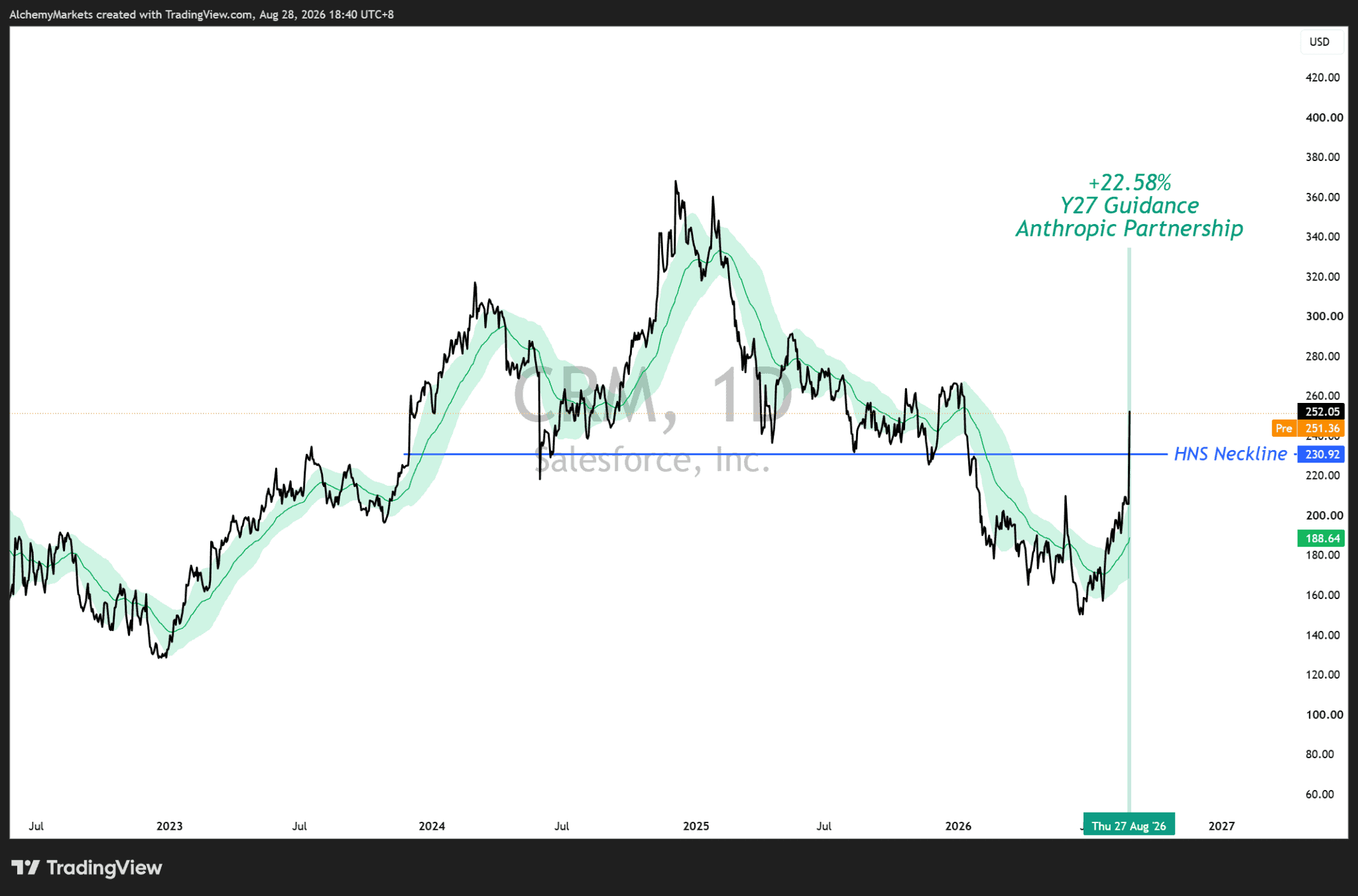
Following a blowout earnings, Salesforce also raised full-year FY27 revenue guidance to $46.1–46.4 billion.
In a single day, the stock’s ticker (CRM) jumped about 22.6% after its fiscal Q2 results, and the most interesting part is that software companies like CRM was now integrating AI to strengthen their services.
…Rather than trying to outdo artificial intelligence.

Their latest partnership involves Anthropic, which allows them to deliver a new product: Claudeforce.
This puts Claude’s reasoning on top of Salesforce data, workflows, business rules and permissions. The first Salesforce-in-Claude plugin launches with 37 prebuilt sales skills.
The bigger signal is the basket, not one stock
Salesforce matters because it may be part of a broader rotation.
IGV, the iShares Expanded Tech-Software Sector ETF, holds 106 stocks, with names such as CrowdStrike, Salesforce, ServiceNow and Adobe among its largest positions.
When compared to SOXX, the semiconductor ETF, you’ll see an interesting trend change…
Software underperformed for more than 374 days before the ratio finally began turning higher. On 27 July, the ratio broke back above its 50-EMA band, and the recovery has continued into late August.
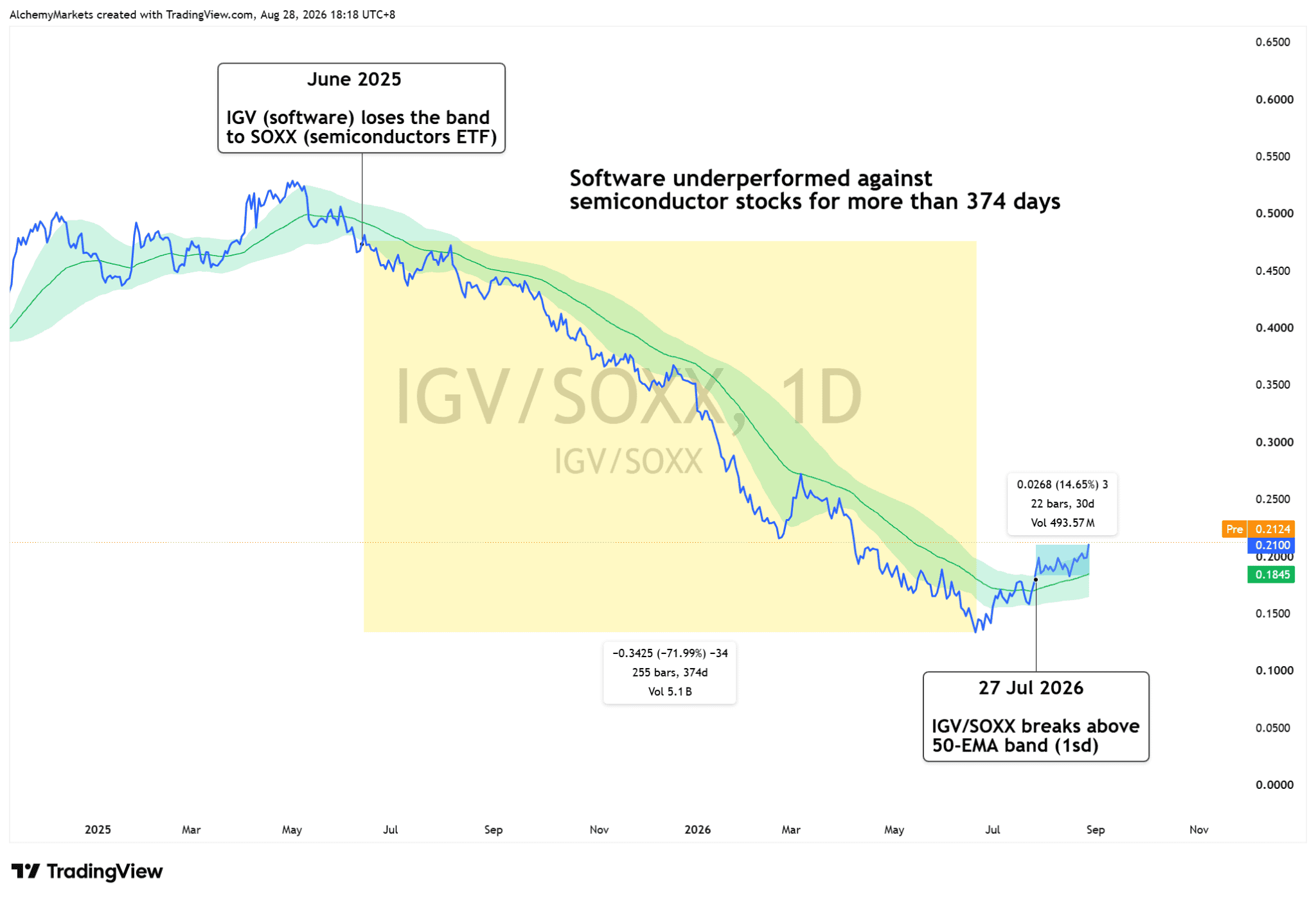
If IGV/SOXX keeps climbing, software is outperforming semiconductors even if the broader market becomes volatile.
As long as that 50-EMA Band (marked by the green zone) is not lost as the relative price continues to climb, the core idea of rotation into Software stocks is still valid.
Note the EMA Band is simply the Bollinger bands® indicator with a 50 EMA basis line, and 1 standard deviation. A break beyond that standard deviation implies a “more than regular” price change.
AI is becoming revenue, security and governance
The earnings evidence is also broadening. CrowdStrike reported Q2 revenue of $1.47 billion, up 26%, while record net-new ARR reached $333 million, up 51%. Okta’s revenue rose 11%, with CEO Todd McKinnon explicitly arguing that every AI agent needs a trusted identity and controls around what it can access and do.
Workday may be the most useful supporting example: management said AI drove more than 25% of new ACV in Q2, while more than 5,500 customers now use at least one of its organic agents.
ServiceNow has already crossed $1 billion in AI annual contract value, and Adobe says its AI-first ARR has more than tripled year on year to above $500 million.
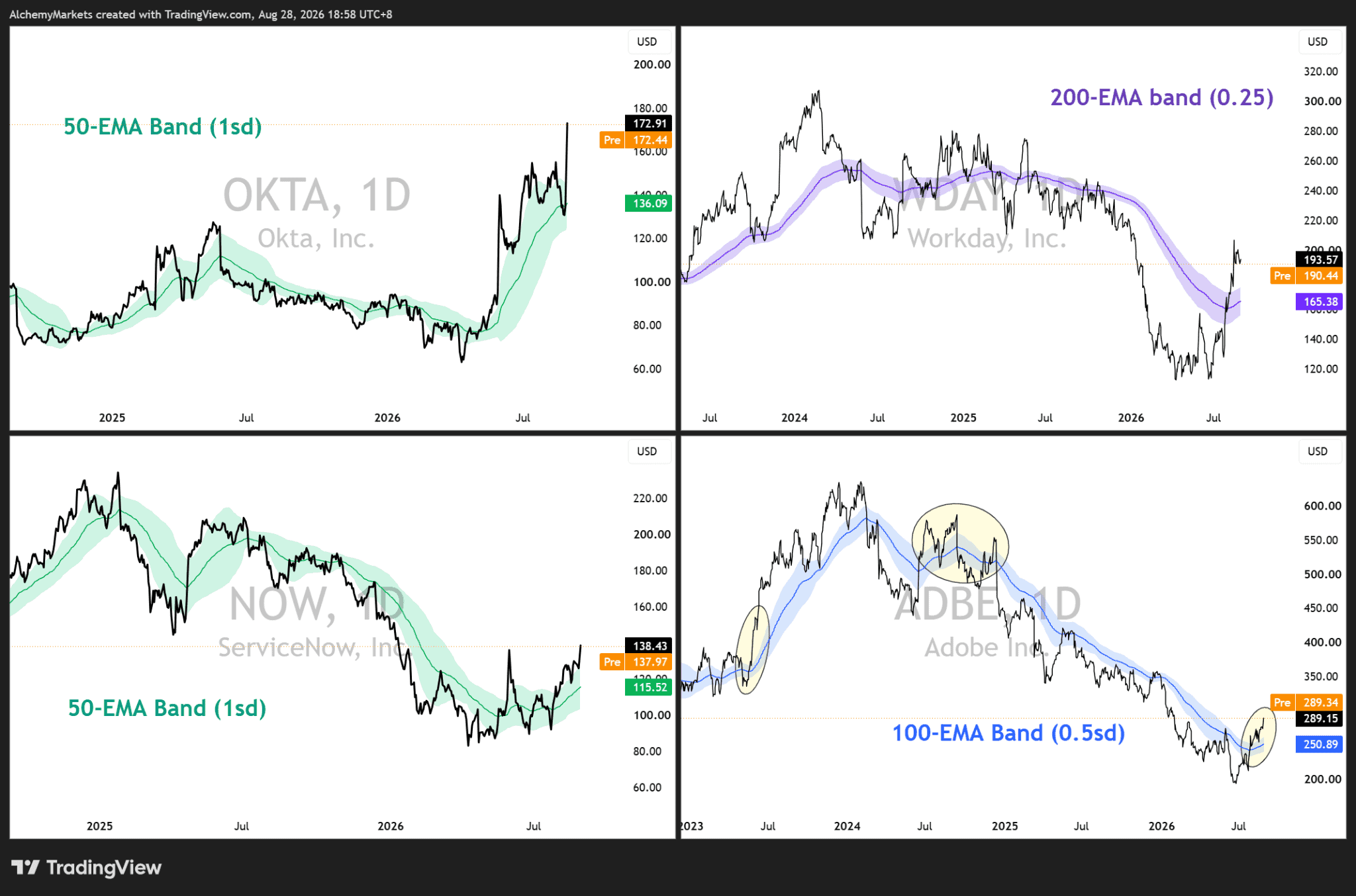
The key takeaway is this:
Several beaten-down software names are starting to hold above the zones that had previously contained them.
But now, they are finding new niches with the emergence of AI, rather than fighting against.
Okta and ServiceNow are trading above green 50-EMA bands, Workday has reclaimed its slower purple 200-EMA band after a major drawdown, and Adobe has moved back above its blue 100-EMA band.
What would prove this is a real rotation?
There is still a strong counter-case. One earnings-driven squeeze can look like a regime change before fading, and software remains sensitive to bond yields. IGV also trades at a relatively rich valuation.
Its official portfolio data showed a P/E around 37 as of 26 August, so a fresh rise in long-term yields can quickly challenge the move.
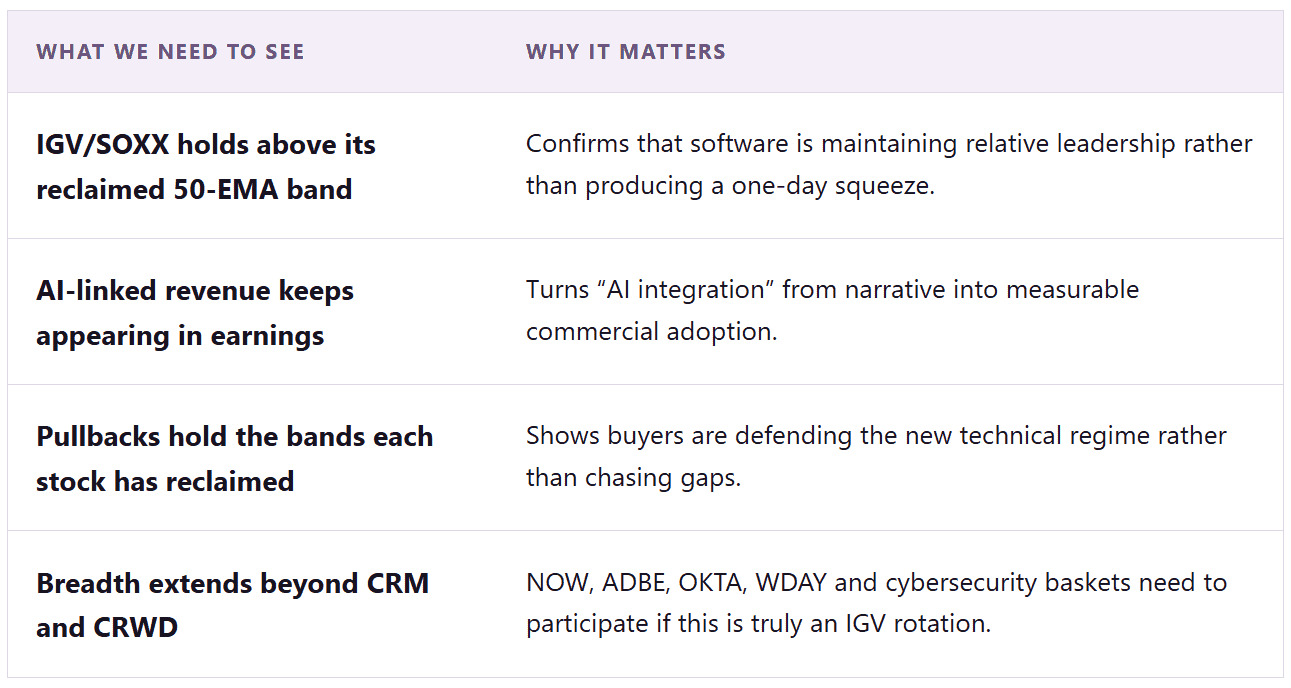
Bottom Line
Recent earnings suggest the next leg does not have to come from chips alone. The companies that own enterprise data, permissions, security and workflows are beginning to show that AI can increase the value of their platforms rather than simply replace them. CRM is the headline. IGV/SOXX is the scoreboard.