Written by:

- Opening Bell
- September 2, 2026
- 4 min read
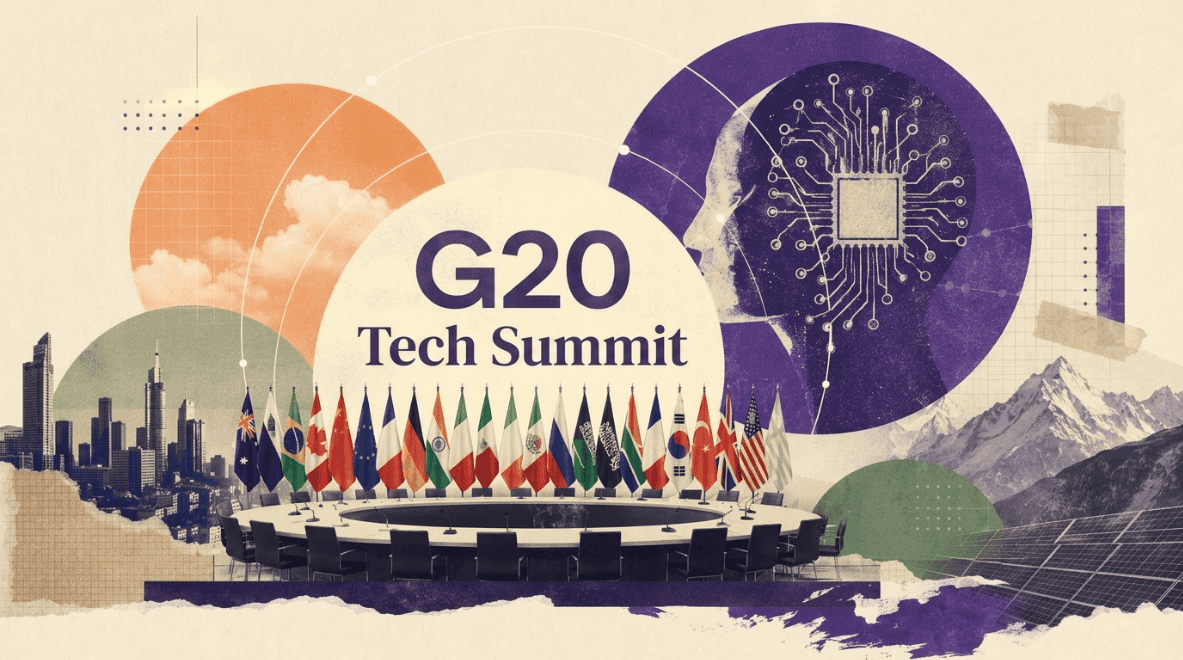
G20 Tech Summit Proposes an Innovation-First Policy Towards AI
At the G20 tech summit in Chapel Hill, the United States pitched the “Carolina Principles” as a starting point for how countries could regulate AI.
The idea is simple: no blanket rulebook over AI as a whole. Rely on existing sector rules where they already work, then step in case by case basis when a specific AI tool creates a genuinely new risk.
China backed those principles as well. And that makes two of the world’s largest AI powers agreeing on the same page that the first move should be to leave room for innovation, not regulate the industry into a corner.
| Less regulation = Less paperwork to worry about = More potential breakthroughs |
AI’s Bottleneck is Energy, Says Musk
Elon Musk used the same meeting to warn about a coming “crisis of power” as AI and robotics consume more electricity.
For example, a newly announced Anthropic data-centre in Texas is expected to support around 350 MW of operational capacity. That is equal to powering around 300,000 standard American households.
Beyond that, AI projects on a large scale require grid connections, transformers, cooling and a huge amount of electricity. The question is how can they get access to these infrastructures, which are limited in quantity and expensive to build.
This brings up an interesting idea to pay attention to – how leadership may change within the AI space.
For now, the major ETFs of AIQ, ARTY, CHAT and BOTZ are still broadly moving together, so there is no clean rotation between broad AI, infrastructure, generative AI and robotics yet.
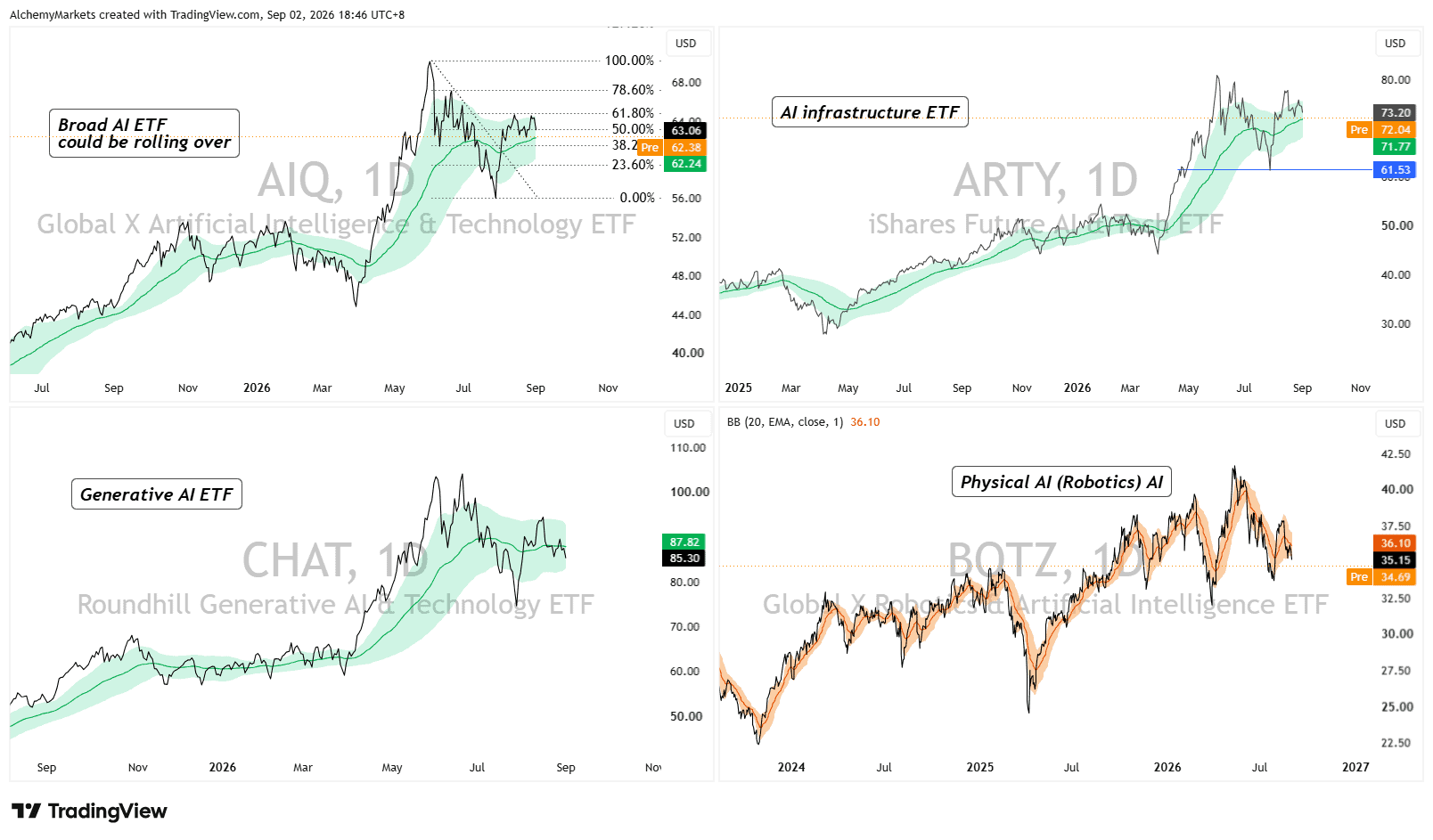
Nevertheless, this could be an interesting development to watch as AI continues to mature as an industry.
Currently, each subsector looks like they are cooling off, but ARTY may have a clearer Bull Flag Pattern in development, and that lines up well with where Musk said the biggest bottleneck could be in the future.
So, Is Energy the Next AI Play?
Musk’s warning naturally puts energy stocks under the spotlight.
Nuclear is the obvious long-term candidate. If AI needs far more electricity, nuclear power offers reliable baseload power without the intermittency problem of wind and solar.
But that is not where the market is showing the most strength right now.
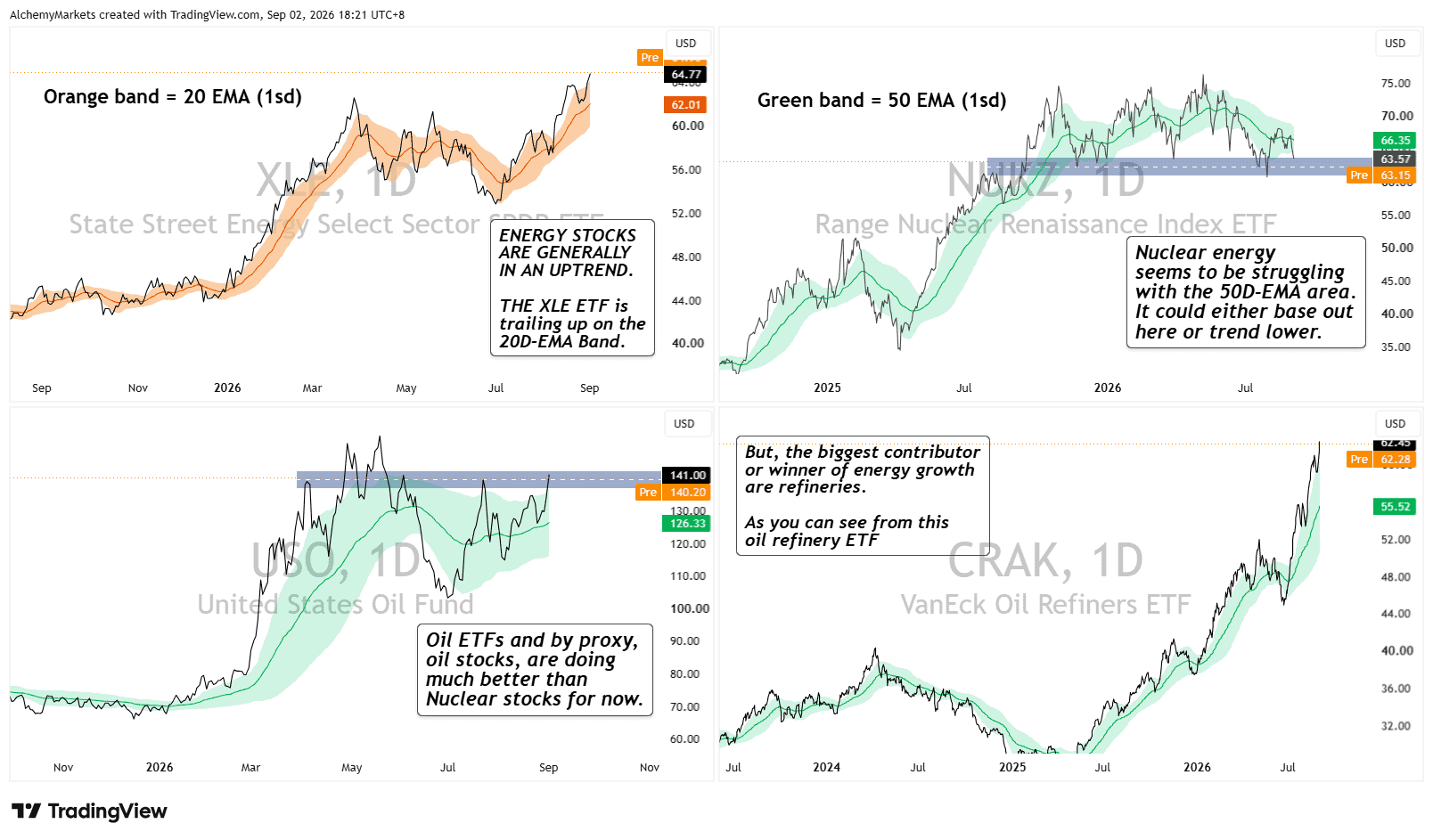
Look beneath the energy rally and the clear winners are oil and refiners.
With the US-Iran conflict escalating again and crude prices pushing higher, refined fuels and oil stocks are getting the stronger bid for now.
CRAK (refined fuels) has been in a strong uptrend as crack spreads widen, showing that the pressure is increasing in refined fuels such as diesel and petrol. And in August, diesel cracks already surged above $100 a barrel.
USO (Oil stocks ETF) is also recovering and is now testing a potential W-shaped reversal.
NUKZ, by comparison, is still moving sideways around support and remains capped by its 50-day EMA band.
That doesn’t kill AI’s long-term demand for nuclear power. It just shows that for now, markets are rewarding today’s energy shortage much more aggressively.
Why that matters for AI
Higher energy prices do not stay inside the energy sector. Petrol, diesel and crude feed into transport, manufacturing and consumer costs.
That keeps inflation risk alive, which makes it harder for the Fed to turn dovish and keeps pressure on Treasury yields.
The 2-year yield is around 4.40%, the 5-year around 4.56%, the 10-year near 4.81% and the 30-year around 5.28%.
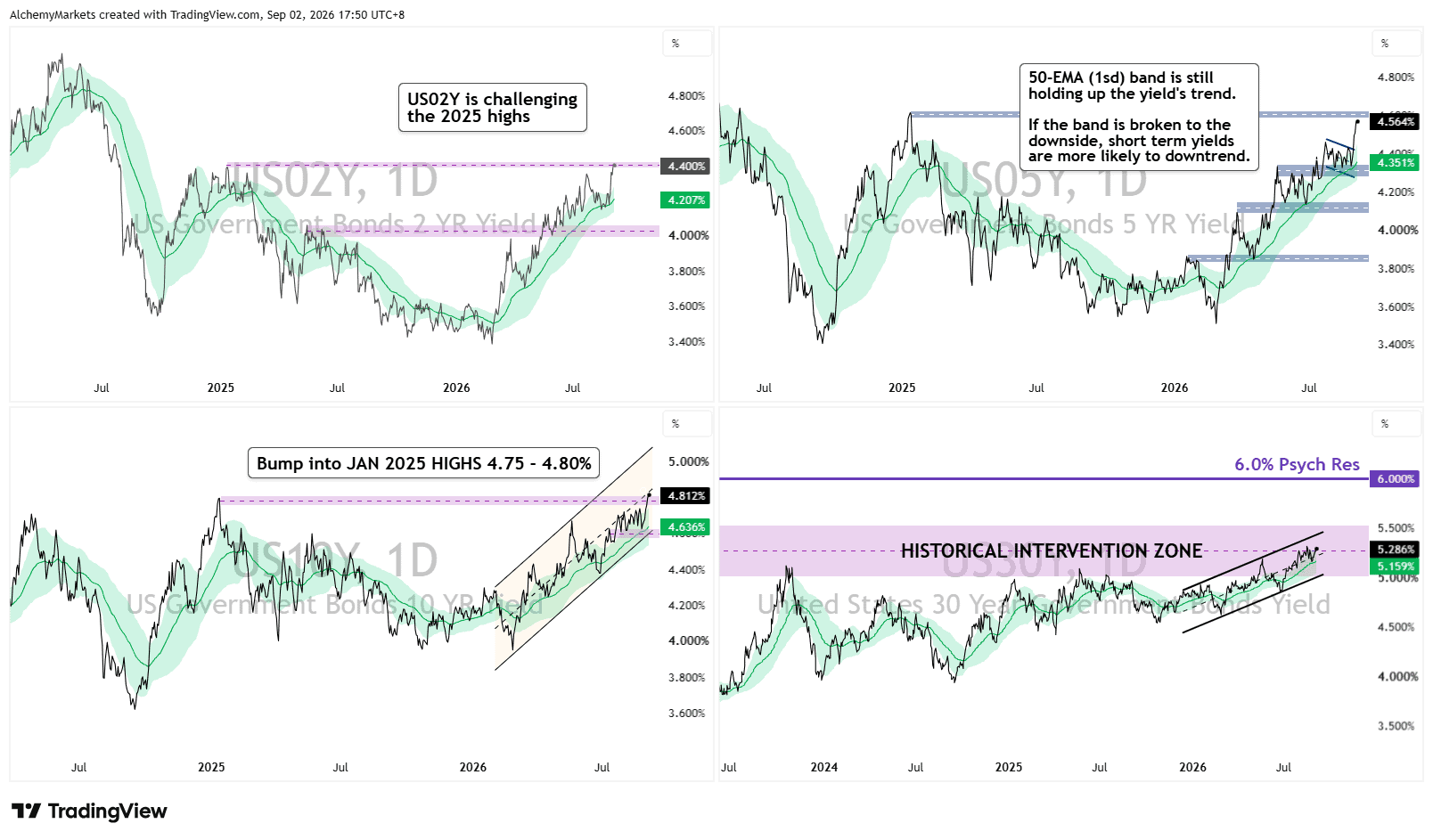
That continues the bond-market pressure we highlighted after Jackson Hole.
For AI, this is the real macro squeeze. The industry needs more electricity at a time when energy is getting more expensive, and it needs huge amounts of capital for chips, data centres and power infrastructure at a time when capital is getting more expensive too.
The Carolina Principles can remove one pressure point: regulation. But it can’t magically create new infrastructure or lower the cost of oil, gasoline and diesel.
What Comes Next?
The G20 tech summit was positive for the AI industry.
Markets are just too caught up in worrying about inflation, interest rates and energy costs.
The next few weeks are basically a test of whether this backdrop gets easier or worse.
| 4 Sep: U.S. Nonfarm Payrolls 10 Sep: U.S. PPI 11 Sep: U.S. CPI 15–16 Sep: Federal Reserve 17–18 Sep: Bank of Japan |
NFP sets the tone for Fed expectations. PPI and CPI show whether inflation is cooling or energy costs are starting to stick.
The Fed follows on September 15–16, then the BoJ on September 17–18.
A hawkish Fed keeps borrowing costs high and the U.S. dollar strong, which remains a headwind for AI stocks. A hawkish BoJ could add pressure through the yen and carry trades.
If inflation, energy prices and bond yields stay high, equities and metals may struggle to move much higher.