Written by:


- Chart of the Day
- July 20, 2026
- 2 min read
WTI’s Bullish Count Faces Its First Test
WTI has pulled back toward $82 after rallying from approximately $68 to $85. My bias remains slightly bullish, although the next move should determine whether this was the start of a larger advance or only a corrective rally.
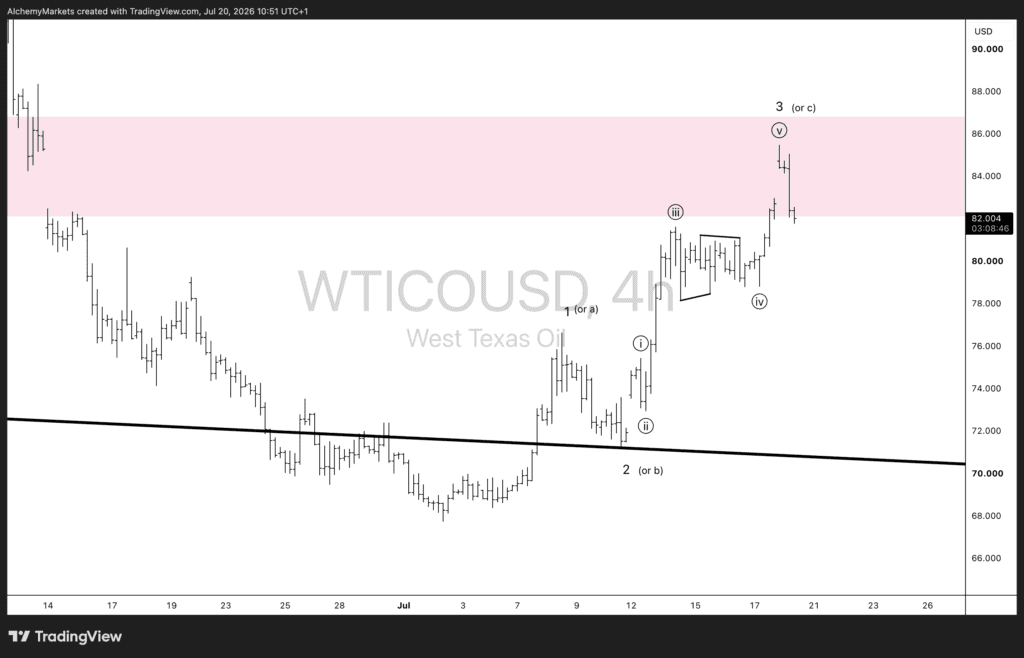
The primary Elliott Wave count treats the rise to $76 as wave one, the decline to $71 as wave two, and the strong five-wave advance toward $85 as wave three. On this interpretation, the current weakness is a normal wave-four pullback before a potential fifth wave higher.
The first support is $81.50–82. A deeper retracement into the previous $79–80.50 consolidation would still fit the bullish count. If buyers defend this area, WTI could retest $85–86.50, with $88–90 possible following a confirmed breakout.
Fundamentals provide some support. US commercial crude inventories are around 3% below last year, gasoline stocks are nearly 10% lower, and refineries are operating above 96% utilisation. Global inventories are also expected to continue drawing during the third quarter, while uncertainty around Middle East supply and Strait of Hormuz traffic maintains a risk premium.
The alternative bearish count views the same move as an A–B–C correction: the rallies to $76 and $85 represent waves A and C, separated by wave B near $71. Under this interpretation, the recovery has finished and the larger downtrend is resuming.
A break below $81.50 would raise that risk, while losing $79 would provide stronger bearish confirmation. The bullish impulse is structurally invalidated below approximately $75.50–76.
The bearish case would also be supported by normalising Middle East exports, additional OPEC+ supply and weak US fuel demand.
For now, the five-wave advance keeps me slightly bullish. But buyers need to defend $79–82. Holding that zone favours another move through $85; losing it would shift the advantage toward the corrective bear count.