Written by:

Reviewed by:


Bearish
Bullish
- March 2, 2026
- 27 min read
Change of Character (CHoCH) Explained
Have you ever wondered how to clearly recognise when the market is changing trend?
Markets move in cycles, alternating between upward and downward phases. What separates strong traders from average ones is the ability to recognise when the market may be transitioning from one phase to another, rather than reacting late once the move is already obvious.
Identifying these shifts helps traders align with the right direction, manage risk more effectively, and avoid being caught on the wrong side of the market. One of the most reliable ways to do this is through market structure. Break of Structure highlights trend continuation, while Change of Character acts as an early signal that the current trend may be weakening or transitioning.
In this guide, you will learn how Change of Character works, how to identify it on a chart, and how traders use it as an early warning of potential reversals, often in combination with Break of Structure for clearer trade execution.
What are CHoCH
A Change of Character, commonly shortened to CHoCH, is a Smart Money Concept that highlights when price behaviour starts to change within an uptrend or downtrend. It acts as an early warning that the current trend is weakening and may be losing control.
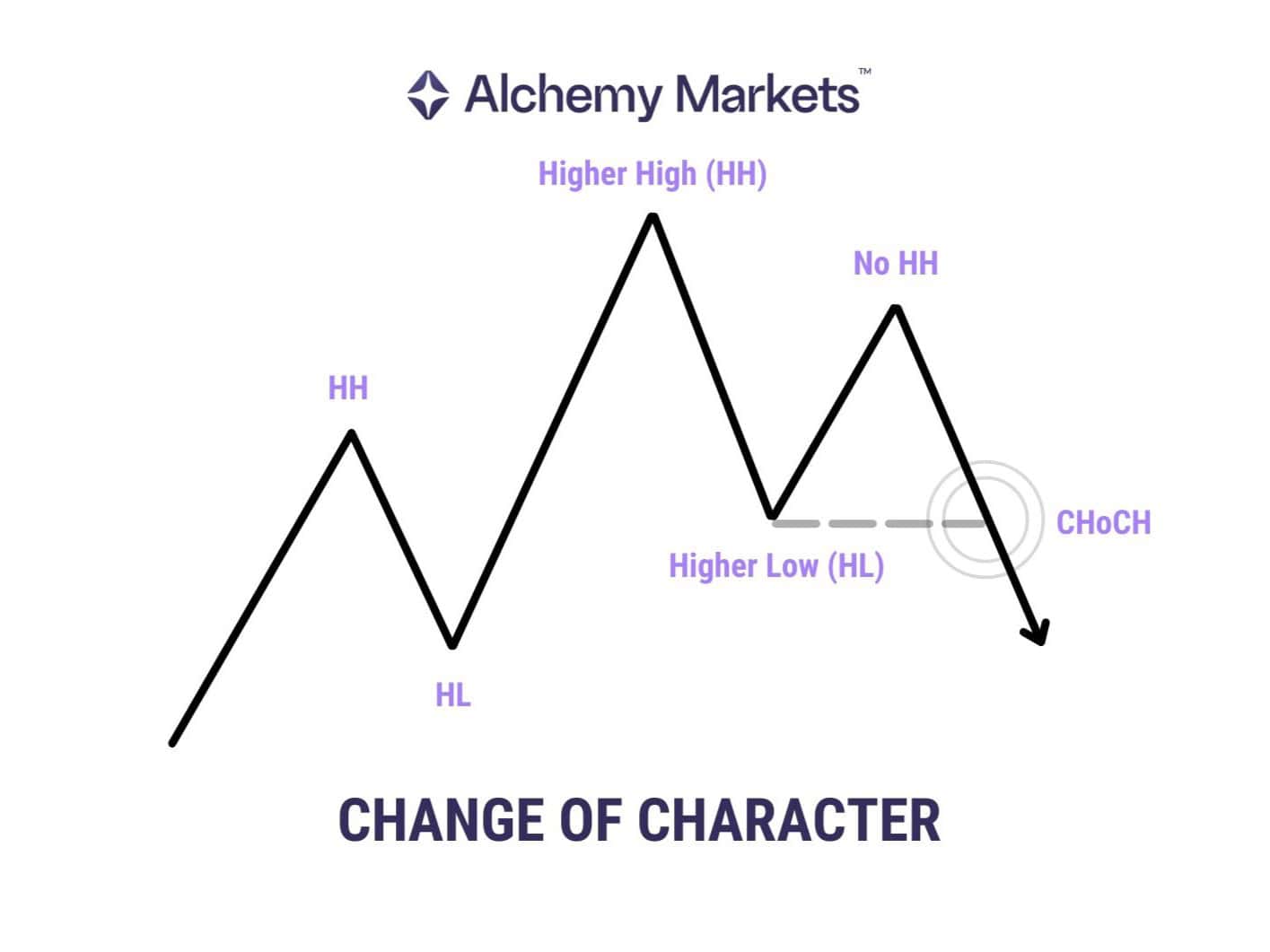
In an uptrend, price makes higher highs (HH). After each pullback, it forms a higher low (HL), then pushes up to make another HH, showing buyers are in control. A CHoCH happens when this breaks: price fails to make a new high and drops below the last higher low (HL).
This is the first sign that buyers may be losing control and an early warning that the trend may be changing.
In a downtrend scenario, it’s the opposite: price stops making new lows and breaks above the most recent pullback high, showing selling pressure may be weakening and a potential uptrend reversal may happen.
Smart Money Concept traders pay attention to CHoCH because it is a simple observation of price action changing behaviour. Price stops respecting the prior structure and begins to move differently, offering an early clue that market conditions may be shifting.
How to Identify CHoCH
Identifying a valid CHoCH requires understanding how the market behaves around key structural points.
Although the concept is simple, traders often misread CHoCH signals because they ignore context. Below are the four essential components to analyse before identifying a CHoCH.
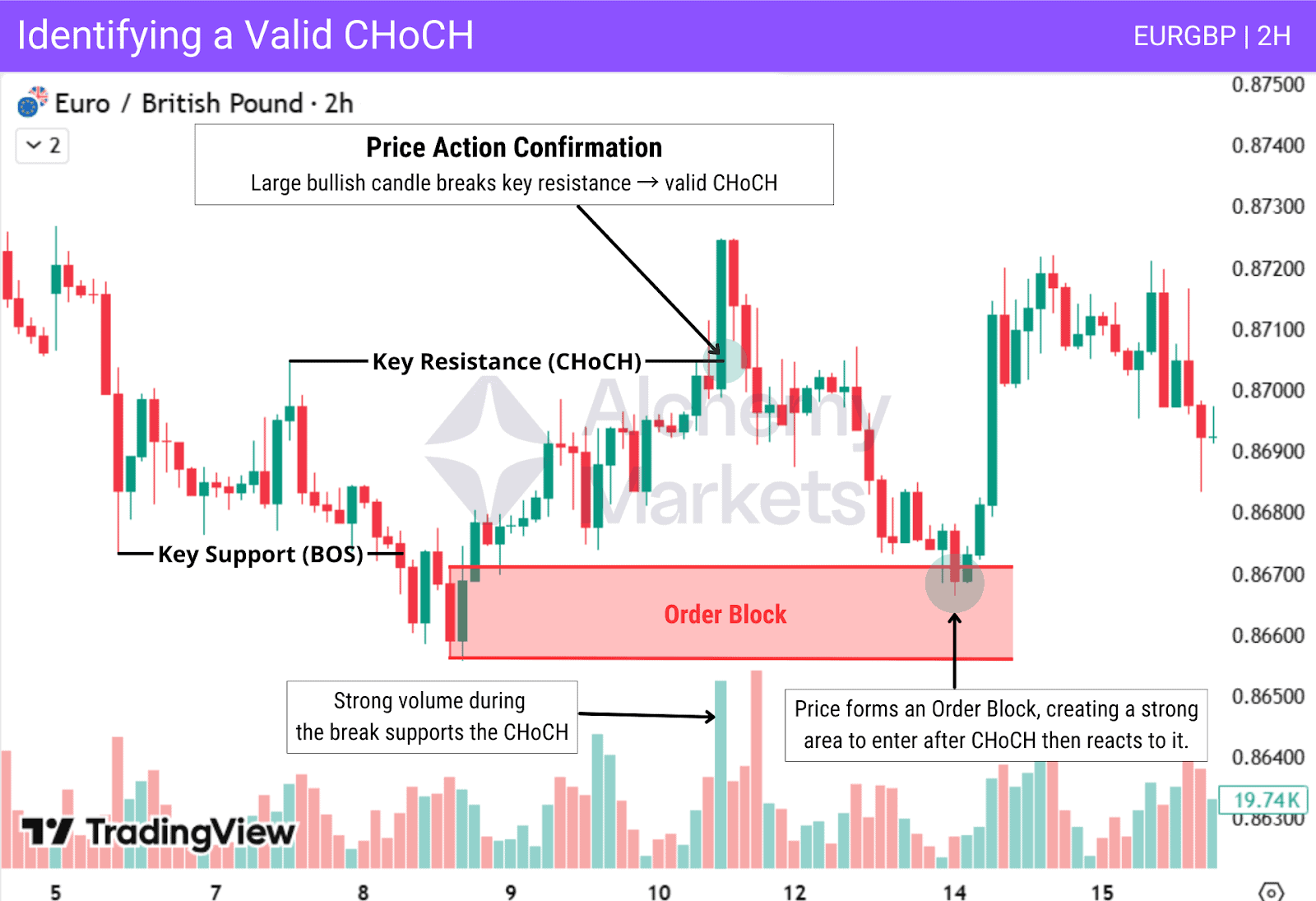
Price Action Analysis
When identifying a CHoCH, the most important thing to focus on is price action, meaning how price is behaving, especially around swing points.
Price action shows whether the market is still respecting its previous structure. In an uptrend, price forms higher highs and higher lows, while in a downtrend it forms lower highs and lower lows.
A CHoCH appears when that price action changes and this sequence is broken.
Price moves through a key swing high or low, often with strong displacement, suggesting that the current trend may be starting to shift.
This change in price action helps traders distinguish between normal pullbacks and situations where the market may be transitioning into a different direction.
Support and Resistance Levels
When analysing CHoCH, it is important to distinguish between internal and external swing highs and lows. Internal swings reflect smaller movements within a trend, while external swings define the broader market structure and therefore carry more importance.
A CHoCH breaking an external swing becomes more meaningful when that level is also aligned with a major support or resistance zone, as it signals a stronger shift in market behaviour.
Where the CHoCH occurs adds context. A CHoCH at support or resistance aligned with an external swing provides a different indication than one forming at an internal level.
Volume Indicators
Volume can help confirm the conviction of a Change of Character (CHoCH), but this is nuanced.
Volume can increase before, right at, or after price breaks a key support or resistance level. It is only a rough measure of conviction, but when spotted, can be very effective in highlighting a strong CHoCH.
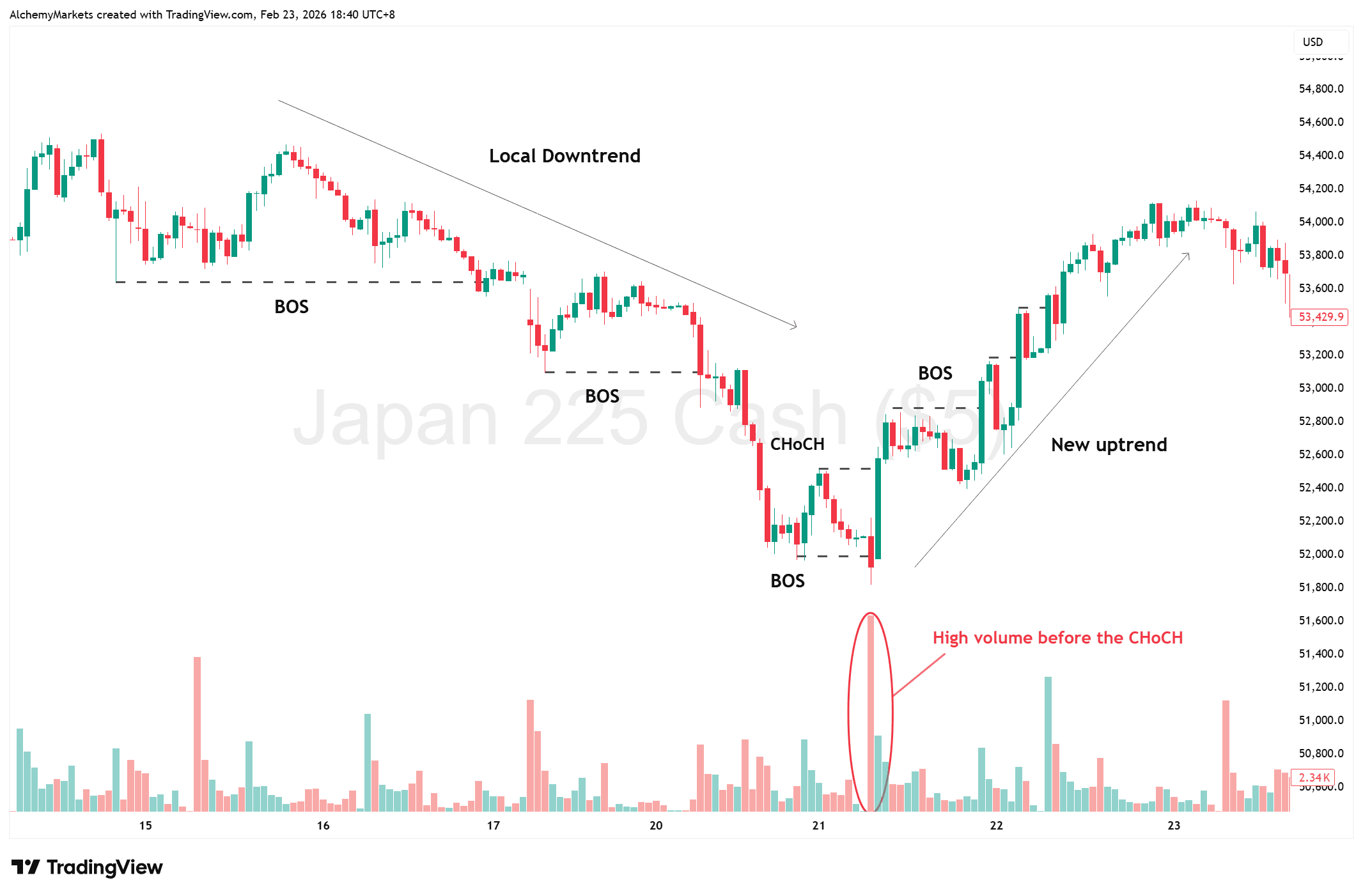
When a CHoCH first forms, such as the first candle closing above a swing high, patience is key. Watch how price behaves after the break:
- If price continues to drive in the new direction and volume increases, the CHoCH carries stronger conviction.
- This allows traders to wait for a retracement and look for cleaner entries.
If price fails to drive further, caution is required:
- A small break followed by a sharp snap-back with high volume often signals a fakeout.
- A slow grind with low volume keeps the CHoCH unproven until a BOS forms in the same direction.
As for volume-based indicators, each serves a different purpose. VWAP can act as dynamic support or resistance, while Volume Profile highlights where trading activity was historically high.
Used correctly, they add context to a CHoCH, but the rule remains the same: structure is king, volume is secondary.
Order Blocks and Imbalances
Order blocks and imbalances are key elements in Smart Money Concepts and work in alignment with CHoCH and BOS as key PD arrays. A CHoCH can leave an order block or imbalance during its formation, and price usually returns to these key zones and reacts, offering more precise entries.
These concepts help identify areas of interest where price is more likely to react, improving both analysis and execution.
Types of CHoCH
There are bullish and bearish CHoCHs, and though that seems obvious at first, it’s important to break down how each of these form so you can correctly identify them.
Understanding the different types helps you filter out noise, recognise when the price is shifting direction and adapt your trading strategy accordingly.
Bullish CHoCH
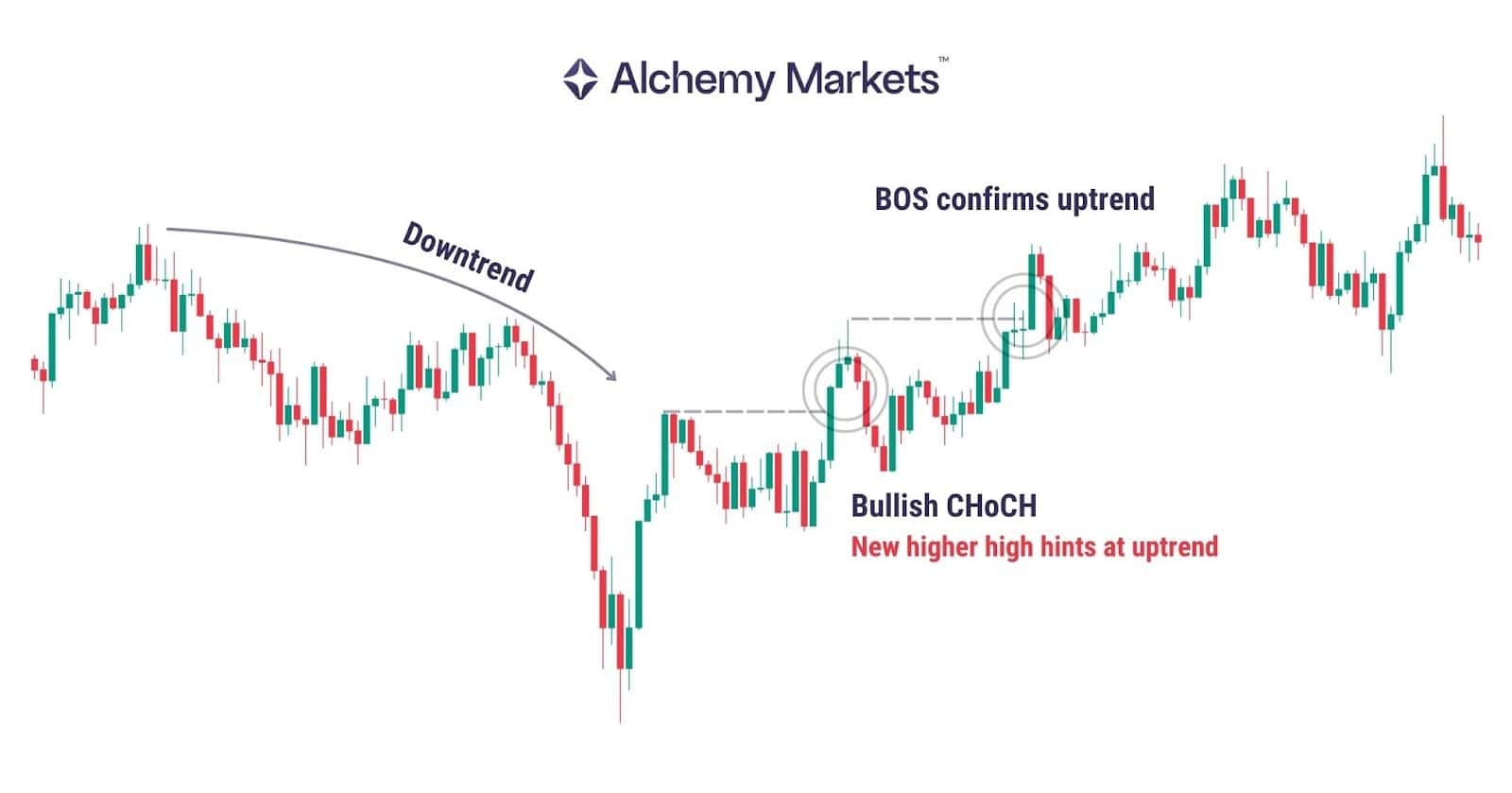
A bullish CHoCH only happens in a downtrend (when price consistently climbs lower), and signals that price may be ready to make a bullish reversal.
The clear cut signal is when a new higher high is created, which is not a characteristic of a strong downtrend — where price makes lower lows and no new higher highs.
Bearish CHoCH
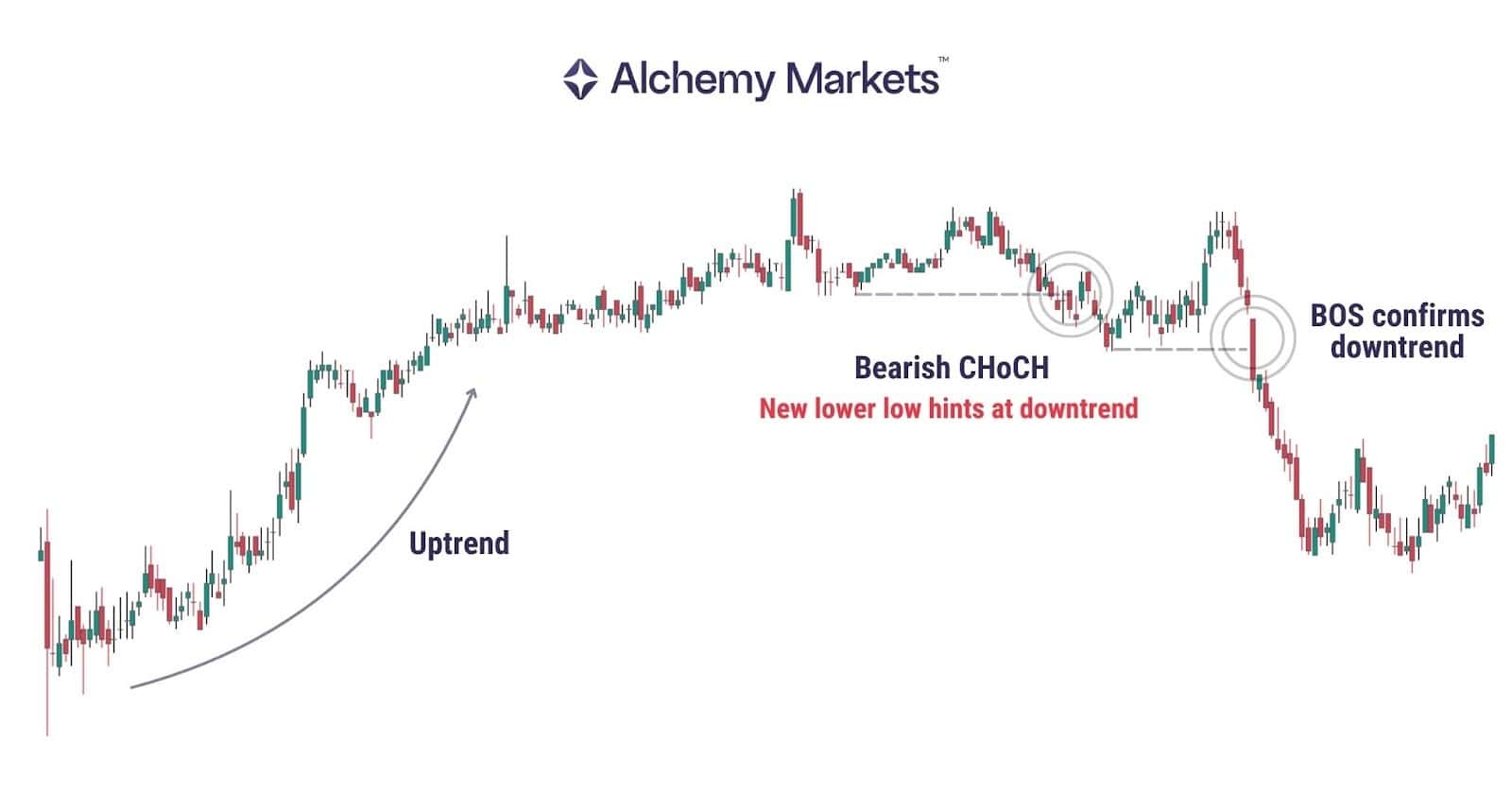
A bearish CHoCH only happens in an uptrend (when price consistently climbs higher), and signals that price may be ready to make a bearish reversal.
The clear cut signal is when a new lower low is created, which is not a characteristic of a strong uptrend — where price makes higher highs and no new lower lows.
Fake-Out CHoCH
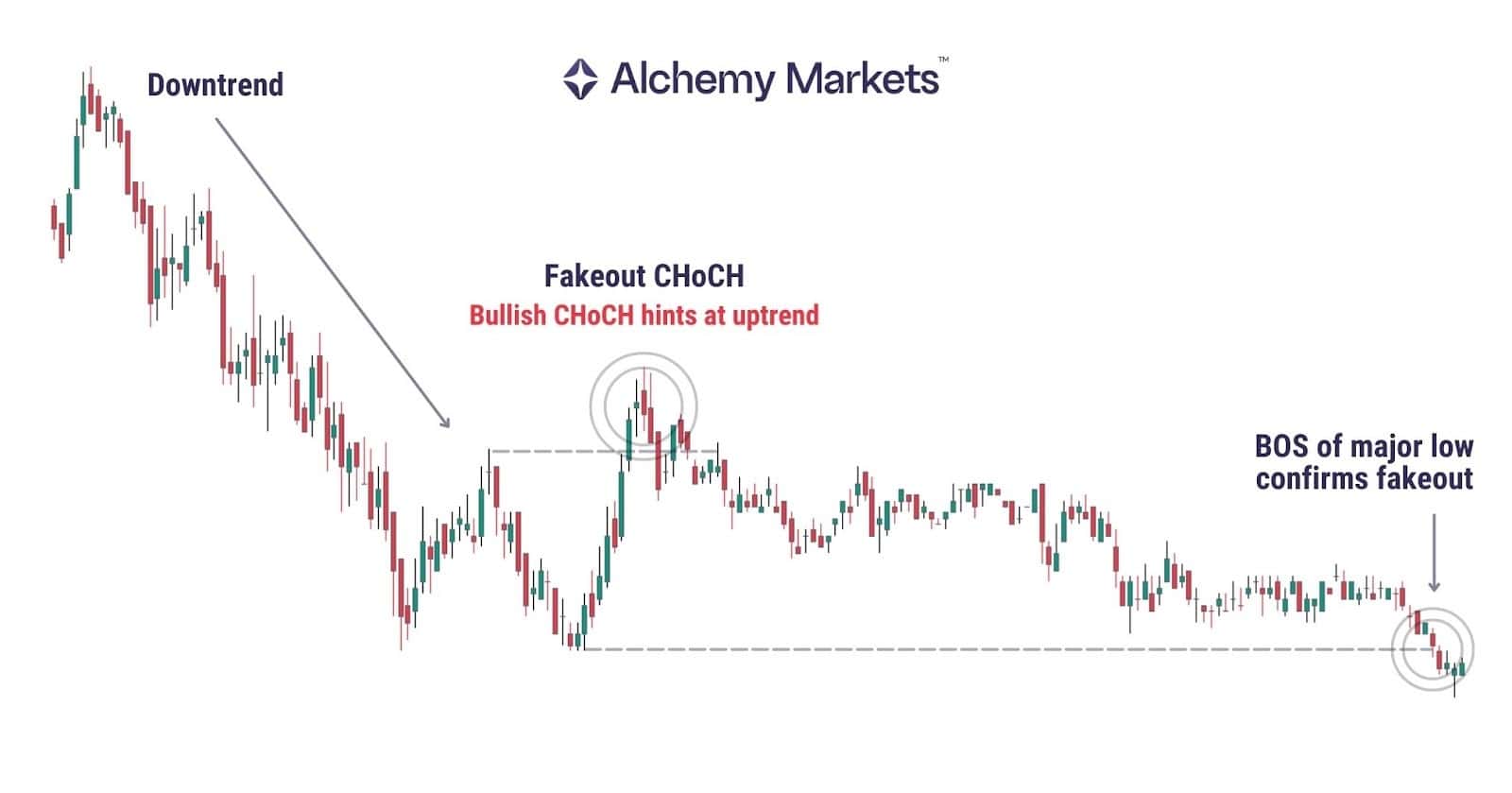
Now comes the kicker: both CHoCHs can experience what’s known as a fakeout, or false signal. Fake-out CHoCH often happens when the price breaks the most recent swing point with a weak push (wick, no clean close beyond it, small candle, or low volume) but then snaps back. This is common around high-impact news releases and is generally treated as a false signal, not a valid CHoCH, because the break lacks momentum, follow-through, and strong participation behind it.
CHoCH Example
Let’s look at a historical example of a CHoCH and apply some psychology to it.
Most of us, especially after a trend has been running for a long time, begin to anticipate a trend reversal. The value of studying the CHoCH framework is that it trains you to stop guessing, and instead wait for clear signs that the trend is beginning to break structure.
In this 4H S&P 500 chart, the market is clearly in an uptrend, defined by consistent higher highs (HH) and higher lows (HL). That structure remains intact until price suddenly prints a lower low (LL).
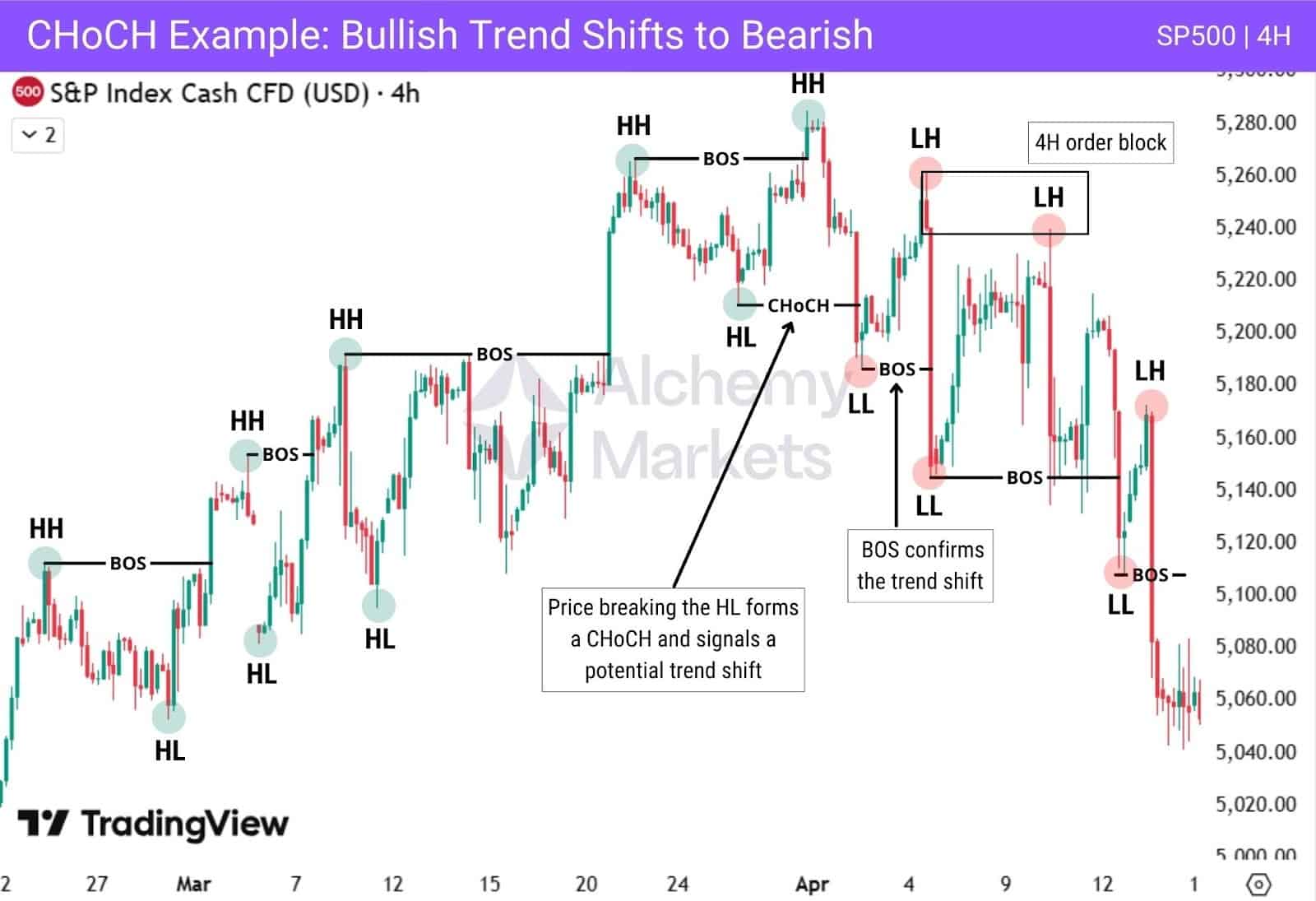
This shift—from protected higher lows to an out-of-place lower low—is the first behavioural change in price. That is the CHoCH. It signals that buyers are no longer in full control, but it does notyet confirm a full trend reversal.
To trade this effectively, patience is required. After the CHoCH, price must retrace and fail to make a new high, forming a lower high (LH). Many SMC traders treat the CHoCH as the first warning of weakness and look to position during the retracement into a key level rather than chasing the initial break.
In this example, a 4H order block around the $5,260 area provided a clean zone for execution. A short taken from that level would offer a favourable risk-to-reward profile while still respecting structure.
The key takeaway is this:
- CHoCH is an early signal that structure is weakening.
- CHoCH offers better risk-to-reward and higher uncertainty; but can be traded nonetheless.
Knowing the difference prevents emotional top-calling and forces you to trade what price is actually doing, and not what you feel should happen.
CHoCH Strategies
The Change of Character concept becomes truly powerful when integrated into a structured trading strategy.
While CHoCH identifies the first shift in the current market trend, traders improve accuracy by combining it with confluence tools such as Break of Structure (BOS), multiple timeframes, volume and clear risk parameters. Below are some of the most practical CHoCH strategies traders commonly use.
Multi-Timeframe CHoCH Analysis
Multi-Timeframe CHoCH Analysis focuses on combining higher and lower timeframes to identify clearer, more reliable setups. The higher timeframe is used to define the directional bias (CHoCH, BOS) and key PD arrays (Order Blocks, Fair Value Gaps, Supply/Demand Zones) that price may react to.
Meanwhile, the lower timeframe is used for confirmation and more precise entries. When both timeframes align, that’s your signal to fire a trade.
Now let’s look at this example on Ethereum to see how multi-timeframe analysis works in practice:
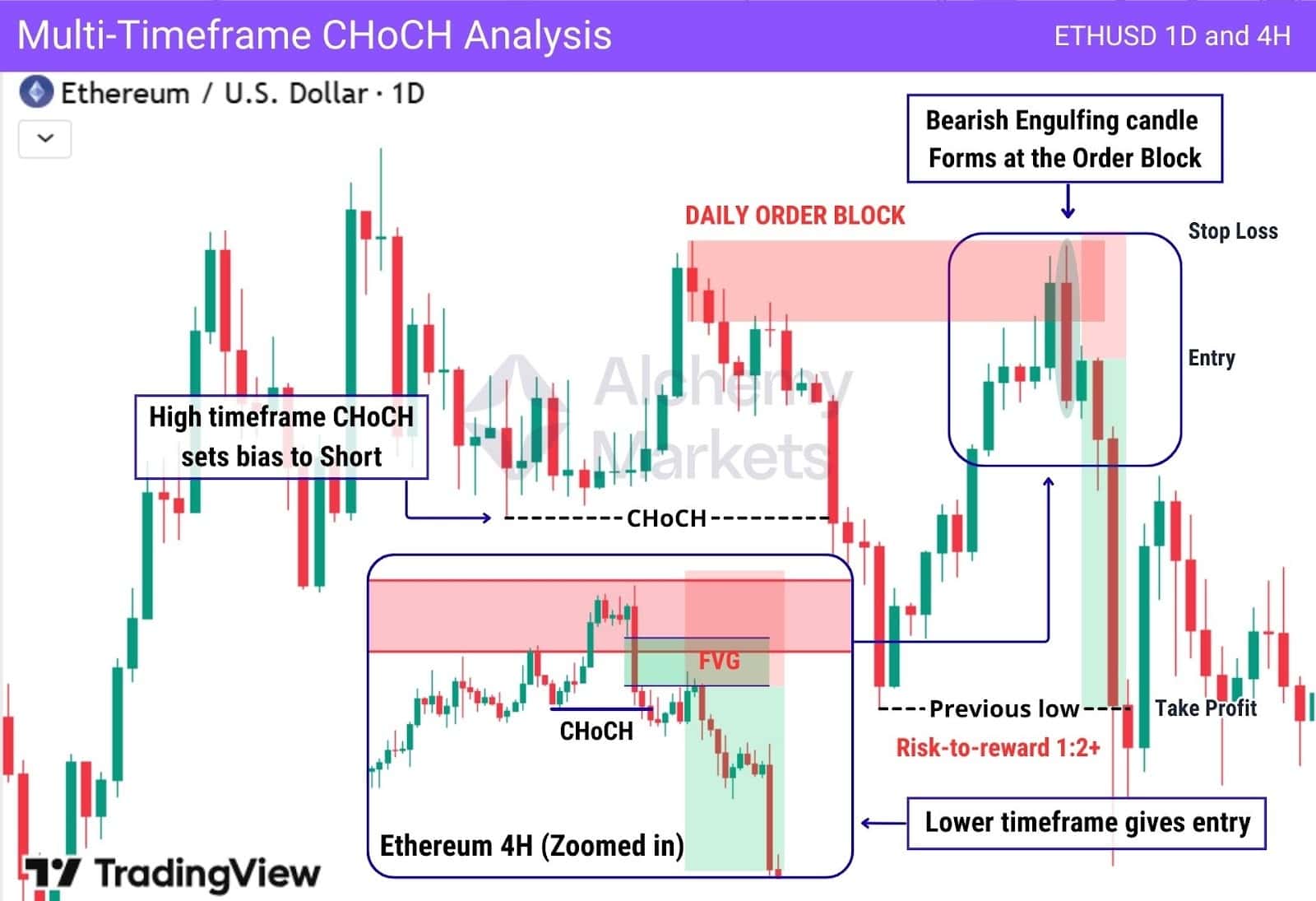
On the daily timeframe, price forms a bearish order block and then retraces into it, creating a bearish engulfing candle, which indicates increasing selling pressure and signals a potential downside continuation rather than an immediate reversal.
When we zoom into the 4H timeframe, price action becomes clearer. Price forms a CHoCH and leaves behind a clear fair value gap (FVG). This provides additional confirmation for a potential entry, with both timeframes aligned in the same bearish direction.
| Entry: Enter after price retraces into the 4H fair value gap (FVG). |
| Stop Loss: Place the stop loss just above the daily order block to provide better safety and a clear invalidation point. |
| Take Profit: Target the previous low aiming for 1:2+ risk to reward ratio. |
Combination of Timeframes on Forex
Now let’s see the same strategy in the Forex market, where liquidity is most robust and where SMC is theoretically most effective.
Here, we have an Australian Dollar vs US Dollar pair. This time, we’re using the 4-hour as the high timeframe (HTF), and 1-hour as the low timeframe (LTF):
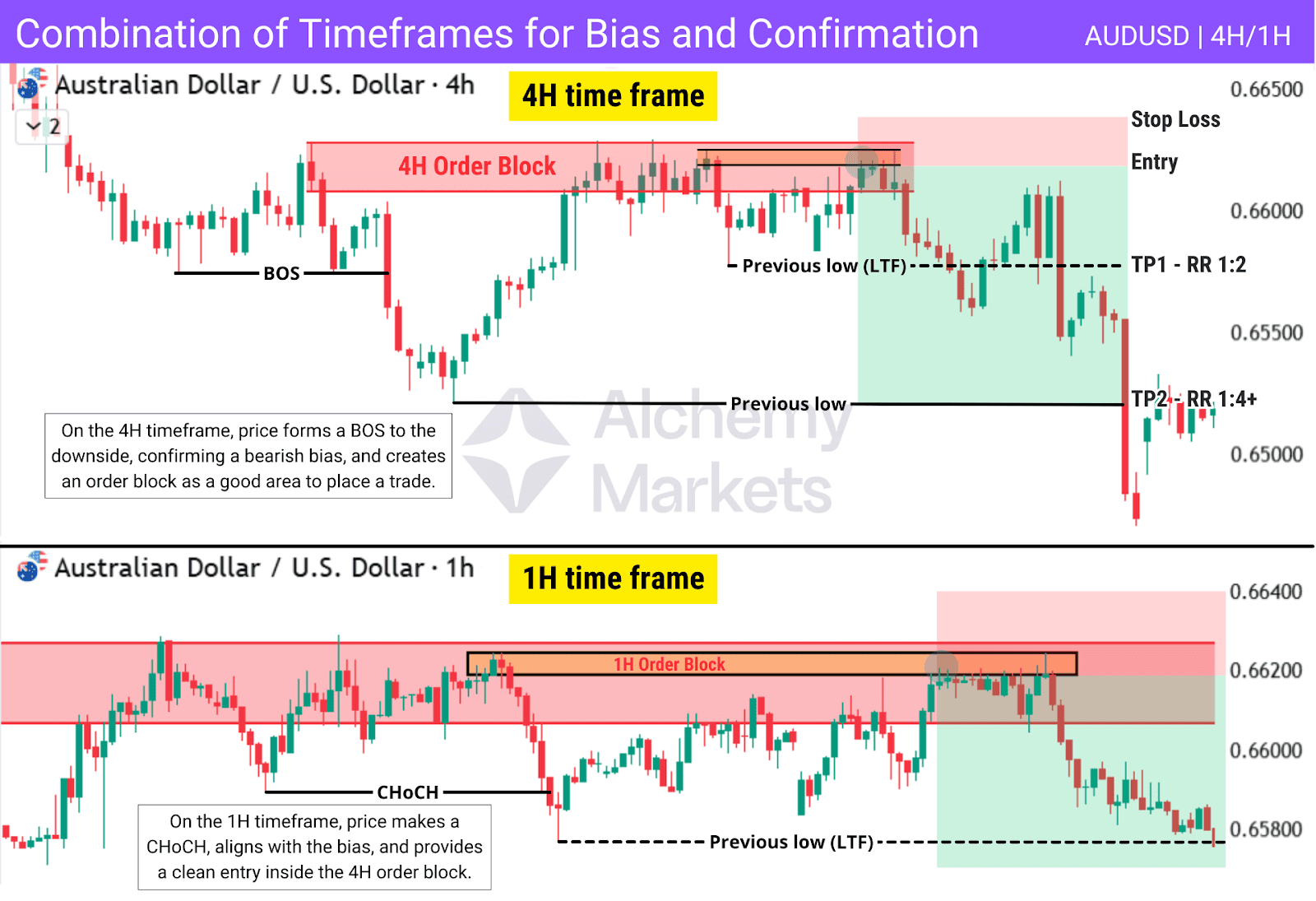
Notice that this time, we’re using the BOS (Break of Structure) in the 4-hour timeframe’s prevailing downtrend, to set our bias. While the HTF (4H) does not form a strong CHoCH, where the clear pivot low was broken, a more significant CHoCH is noticeable on the LTF (1H).
Combining the bias of the HTF (BOS-downtrend), and the LTF (CHoCH-downtrend), we get a clear signal to look for shorts. When the price returns to the 1-hour which lies within the 4-hour resistance, we get a strong short signal.
| Entry: Enter at the lower timeframe PD array after a clean CHoCH forms inside the higher timeframe PD array. |
| Stop Loss: Place the stop loss beyond the lower timeframe PD array or for more safety beyond the recent high on the higher timeframe. |
| Take Profit: Target the low formed after the CHoCH as TP1 and the previous low on the higher timeframe as TP2. |
| Note: PD arrays are points of interest where price is more likely to react. They include areas such as order blocks, breaker blocks, Fair Value Gaps, and inversion fair value gaps. |
Combining CHoCH with Volume Analysis
Combining CHoCH with volume analysis helps confirm whether a structural break is supported by real market participation:
- A CHoCH with low volume and a small candle during the break often signals a weak move.
- A CHoCH with strong volume and a large candle indicates stronger conviction behind the shift.
Using volume as an extra filter makes CHoCH setups more reliable and reduces the risk of reacting to fake signals. Volume also helps confirm the entry after price retraces into a PD array.
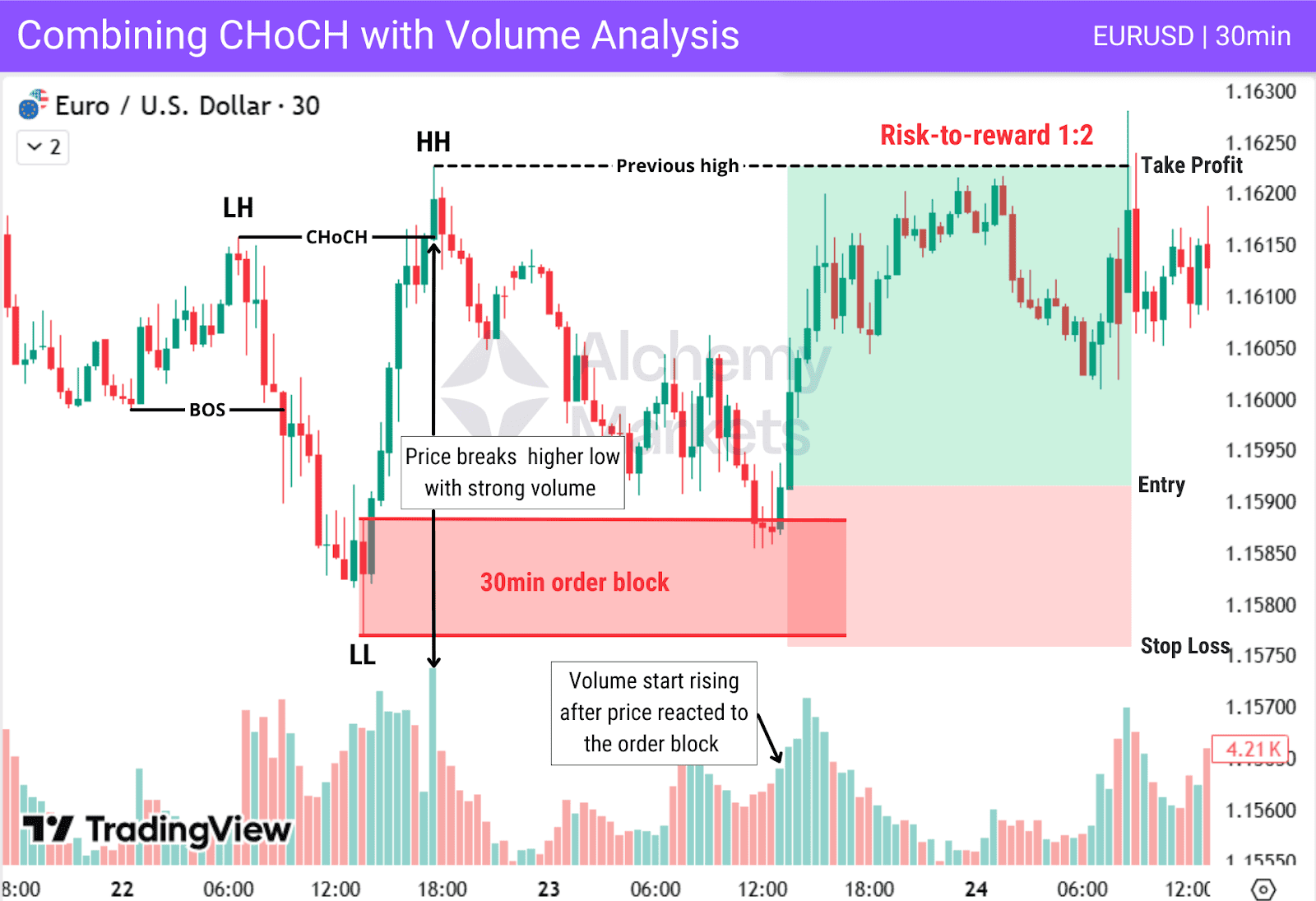
In this example, price forms a clear CHoCH and breaks the previous higher low with strong volume and a large bullish candle, signalling that buyers are strong enough to shift the market. When price retraces into the 30-minute bullish order block, it rejects the zone with an opposite candle while volume begins rising again, supporting the trade idea.
| Entry: Enter at the retest of the 30-minute order block formed after the CHoCH, or wait for price to reject the zone with rising volume. |
| Stop Loss: Place the stop loss below the order block or below the previous low. |
| Take Profit: Target the previous high. |
Using CHoCH for Position Sizing
Not all CHoCH signals are equal. Some form with minimal confirmation, while others align with multiple factors such as higher-timeframe bias alignment, clear confirmation of the structure shift, and formation at a higher-timeframe key PD array.
By looking at how reliable a CHoCH is and the confirmations around it, traders can adjust their position size accordingly, keeping risk per trade smaller for weaker setups and increasing it only when conditions are clearly aligned.
Low-Conviction CHoCH Setup: CHoCH + Order Block + Rejection
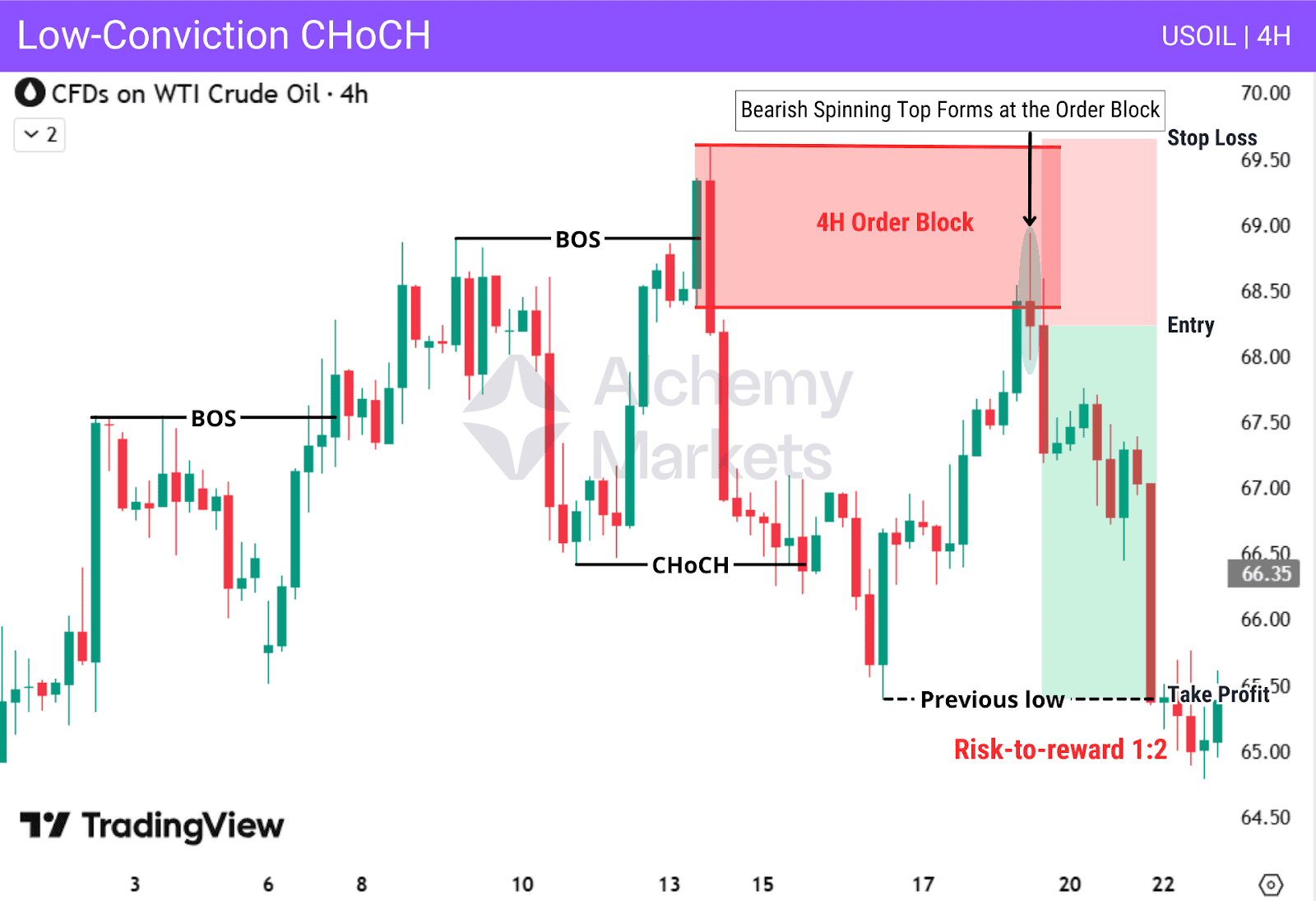
The trade idea is based only on the CHoCH and a rejection from the formed order block, with no additional confirmations or higher-timeframe alignment. For this reason, risk should be kept as low as possible, typically around 0.5% per trade.
Medium-Conviction CHoCH Setup: CHoCH + BOS + Order Block + Rejection
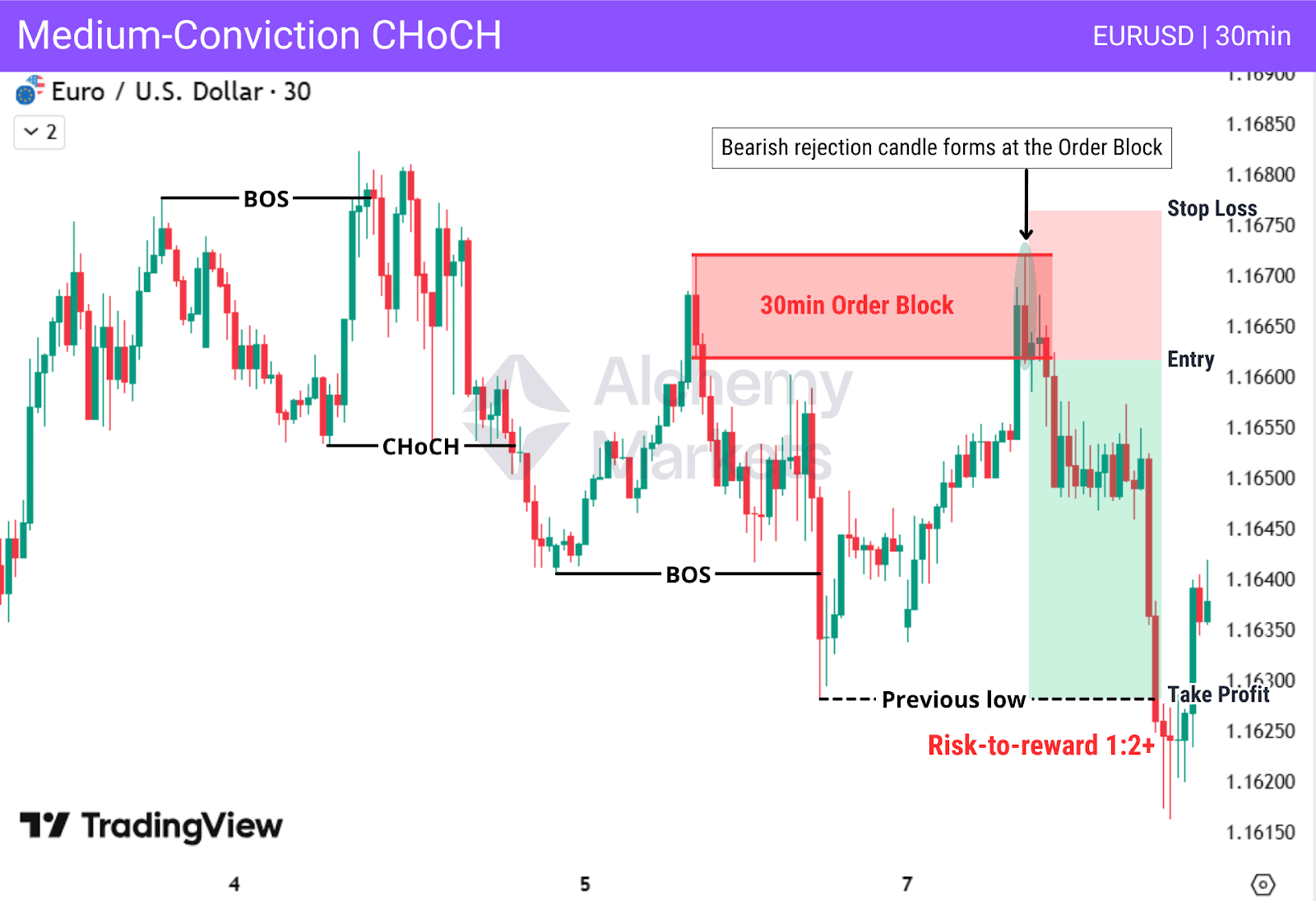
The trade idea is based on a CHoCH followed by a BOS, confirming that market structure has shifted to the downside. The BOS provides additional confirmation and leaves behind an order block, which offers an ideal area to execute the trade.
At this medium-conviction level, risk can be elevated slightly, typically around 0.75–1% per trade.
High-Conviction CHoCH Setup: Multi-Timeframe Alignment + CHoCH + BOS + Order Block + Rejection
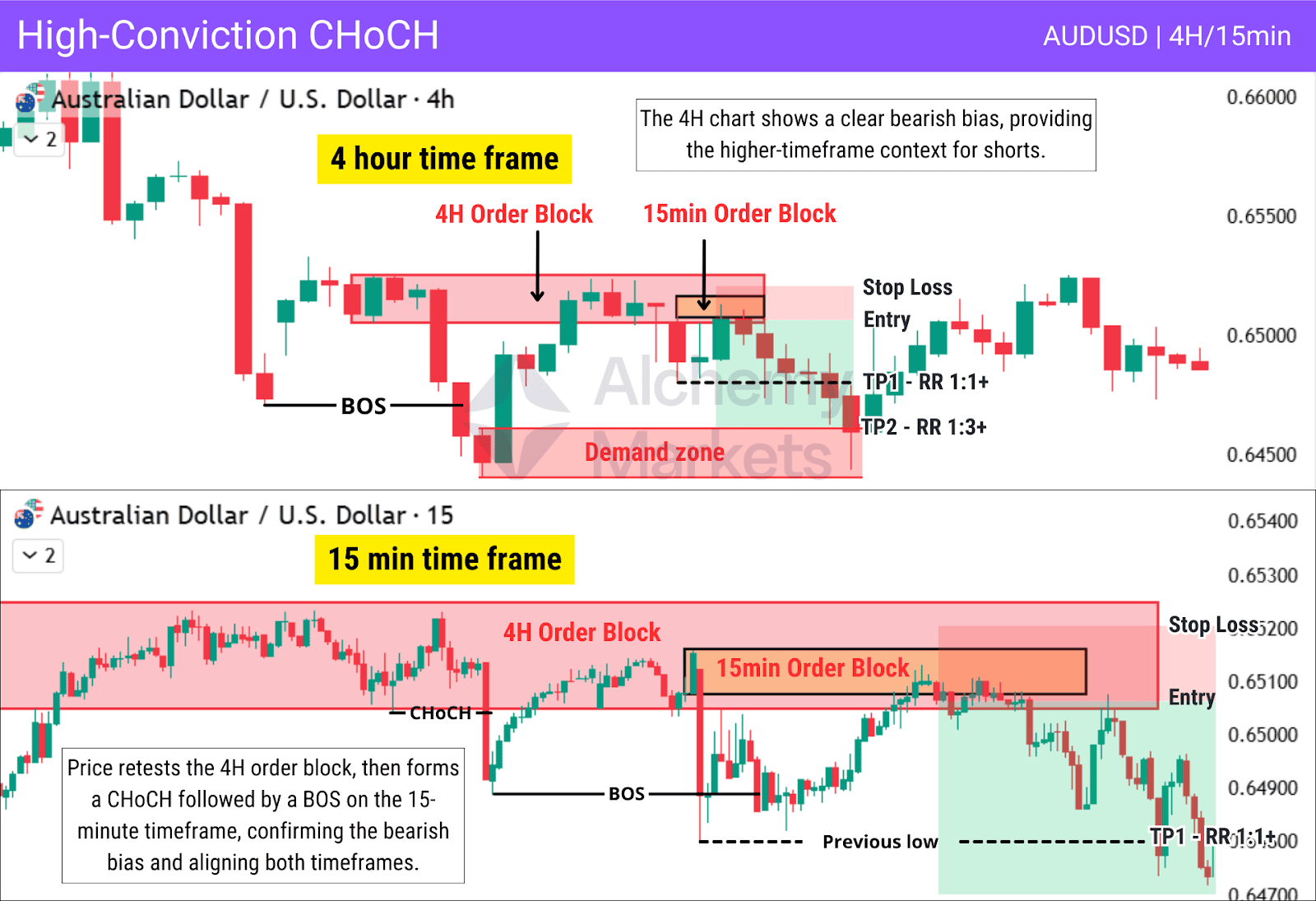
In this example, the trade is based on multiple confirmations across timeframes. First, the higher timeframe (4H) shows a clear bearish bias, with a break of structure to the downside and the formation of an order block.
On the lower timeframe (15-minute), price then retests this higher-timeframe order block and forms a CHoCH followed by a BOS, leaving behind a lower-timeframe order block and confirming the bearish bias. At this point, both timeframes are aligned.
The entry is taken on the retest of the 15-minute BOS after price shows a clear rejection. TP1 is set at the recent lower-timeframe swing low, while TP2 targets the higher-timeframe demand zone. With higher- and lower-timeframe conditions fully aligned, this high-conviction setup justifies using full planned risk, typically around 1–2% per trade.
Advantages of CHoCH
Change of Character (CHoCH) can be very helpful for traders, as it detects early signs of potential reversals, supports entry decisions, and helps guide exit points. Here are the key advantages of CHoCH:
| Advantage | Explanation |
| Early Reversal Detection | CHoCH is one of the earliest structural signals that momentum is shifting. It appears before a full Break of Structure, giving traders an advanced indication that the current trend may be weakening and allowing earlier positioning for potential reversals. |
| Works Across Markets | CHoCH is a universal price-action concept that applies to forex, indices, commodities, and crypto, with CHoCH crypto setups often forming faster due to higher volatility and leverage. |
| Flexible Across All Timeframes | CHoCH can be used on all timeframes, but higher-timeframe CHoCH signals are more significant. Traders typically use higher timeframes to define bias and lower timeframes to confirm entries, helping align structure across multiple chart perspectives. |
| Enhances Risk Management | CHoCH provides clear invalidation levels by identifying where price stops respecting the prior trend. This allows for more objective stop-loss placement and improved trade management, especially when combined with protected swing points or trailing stops. |
Disadvantages of CHoCH
CHoCH is a useful tool, but it has drawbacks. It is essential to understand these limitations for effective trading decisions:
| Disadvantages | Explanation |
| False Signals | CHoCH often appears in ranging or choppy markets, where breaks in structure do not lead to genuine reversals. Without higher-timeframe context or confirmation, these signals can result in false entries and frequent stop-outs. |
| Lagging Confirmation | Although CHoCH is considered an early signal, it still forms after price has already moved to break a swing point. This means part of the initial momentum may be missed, sometimes reducing overall reward potential. |
| Requires Experience | Identifying a valid CHoCH depends on correctly marking meaningful swing points. This process can be subjective, and without sufficient experience, traders may misread structure and take low-quality setups. |
| Increased Risk in Lower Timeframes | CHoCH appears more frequently on lower timeframes, increasing the risk of overtrading. Unless aligned with higher-timeframe bias, these signals tend to be weaker and often lead to poor risk-to-reward outcomes. |
Success Rate of CHoCH
The success rate of a Change of Character (CHoCH) depends largely on context rather than frequency. On its own, CHoCH is not a predictive signal but an early structural warning that market behaviour may be shifting.
Its reliability increases significantly when aligned with broader market structure, confirmation tools such as Break of Structure (BOS), higher-timeframe bias, and fundamental drivers.
Traders who treat CHoCH as a standalone reversal signal often experience inconsistency, while those who combine it with technical and macro context achieve more stable results.
Factors That Affect Success Rates
Market Context (Trend vs Range)
CHoCH performs best in trending environments where price respects clear structural sequences. In ranging or low-conviction markets, frequent minor structure breaks increase the likelihood of false CHoCH signals.
Higher-Timeframe Structure Alignment
CHoCH signals that align with the higher-timeframe directional bias carry significantly more weight. Lower-timeframe CHoCH signals against dominant structure tend to have lower follow-through probability.
Break of Structure (BOS) Confirmation
A CHoCH followed by a BOS confirms that the shift in market behaviour is accepted by participants. Without BOS confirmation, CHoCH should be treated as an early warning rather than a confirmed trend change.
Key Structural Location
CHoCH forming near major order blocks, premium or discount zones, and areas of imbalance is more reliable than CHoCH appearing in the middle of a range.
Clarity of Price Structure
Clean, well-defined highs and lows produce more reliable CHoCH signals. Choppy or compressed price action reduces structural validity and increases false signals.
Fundamental & Macro Drivers
Fundamental factors such as interest rate expectations, central bank monetary policy, inflation data, and the broader macroeconomic outlook can significantly affect whether a CHoCH leads to a real market reversal or results in a false signal. CHoCH signals that align with shifts in monetary policy or changes in interest rate expectations are more likely to develop into genuine market reversals, while those that lack fundamental backing often result in short-term reactions or failed follow-through.
In practice, CHoCH shows its highest reliability when technical structure aligns with higher-timeframe bias and supportive fundamental conditions, rather than being used as a standalone reversal signal.
Smart Money and CHoCH: Following the Big Players
Smart Money concept helps explain the logic behind CHoCH by focusing on changes in order-flow behaviour, not random price patterns. Institutional participants operate around liquidity and positioning, and CHoCH reflects the moment price stops respecting the previous structural sequence. Rather than predicting reversals, CHoCH signals a shift in market behaviour, allowing traders to interpret early signs of potential trend change.
Order Blocks
Order blocks represent areas where significant buying or selling previously occurred, often linked to institutional participation. These zones frequently act as important reaction points because price may revisit them as liquidity and positioning rebalance.
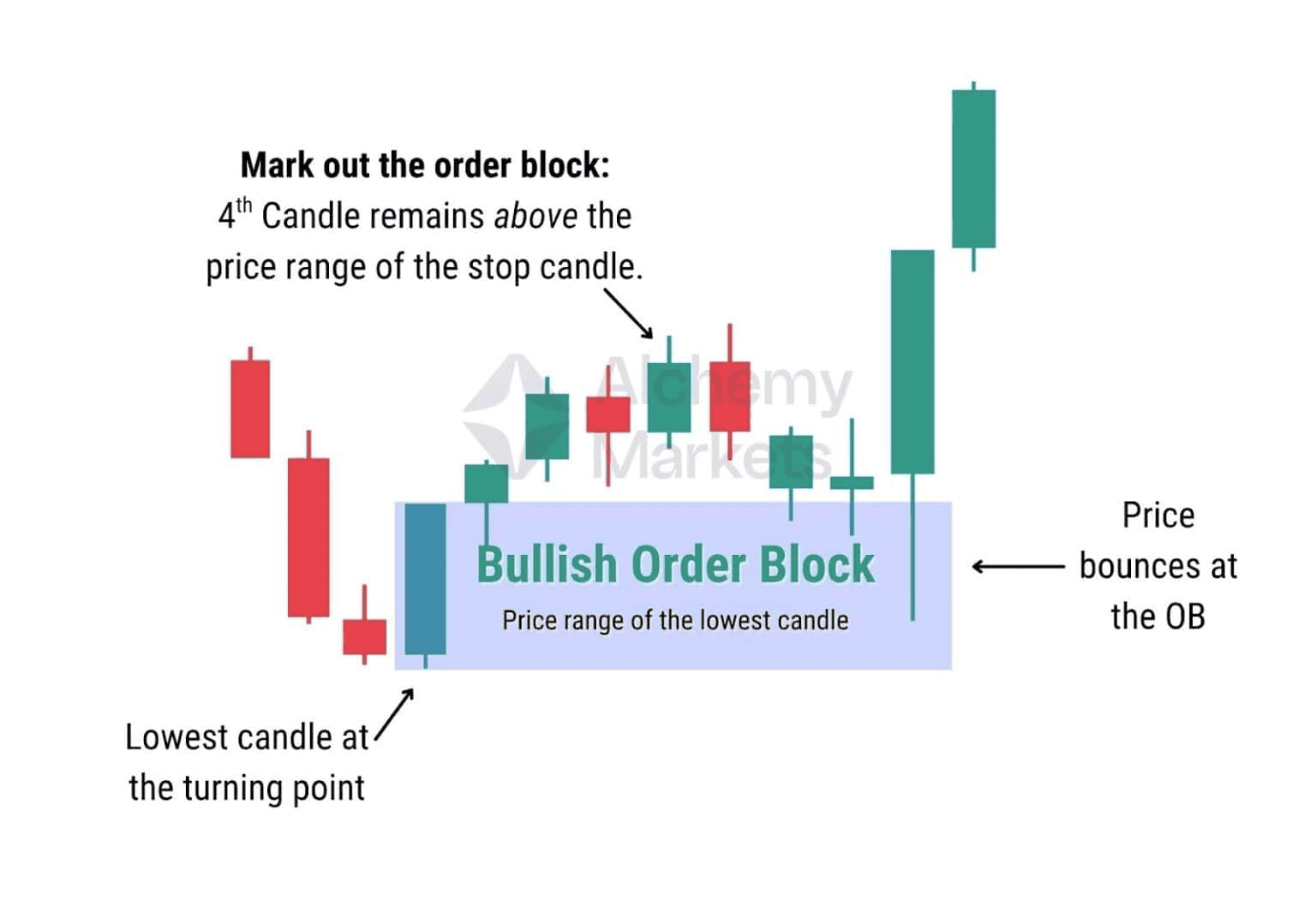
A CHoCH forming near an order block carries more significance than one appearing mid-range, as it suggests a structural response at a meaningful price level rather than random volatility.
Liquidity Grabs
Liquidity is essential for large market participants, and price often trades beyond obvious highs or lows where stop orders are concentrated.
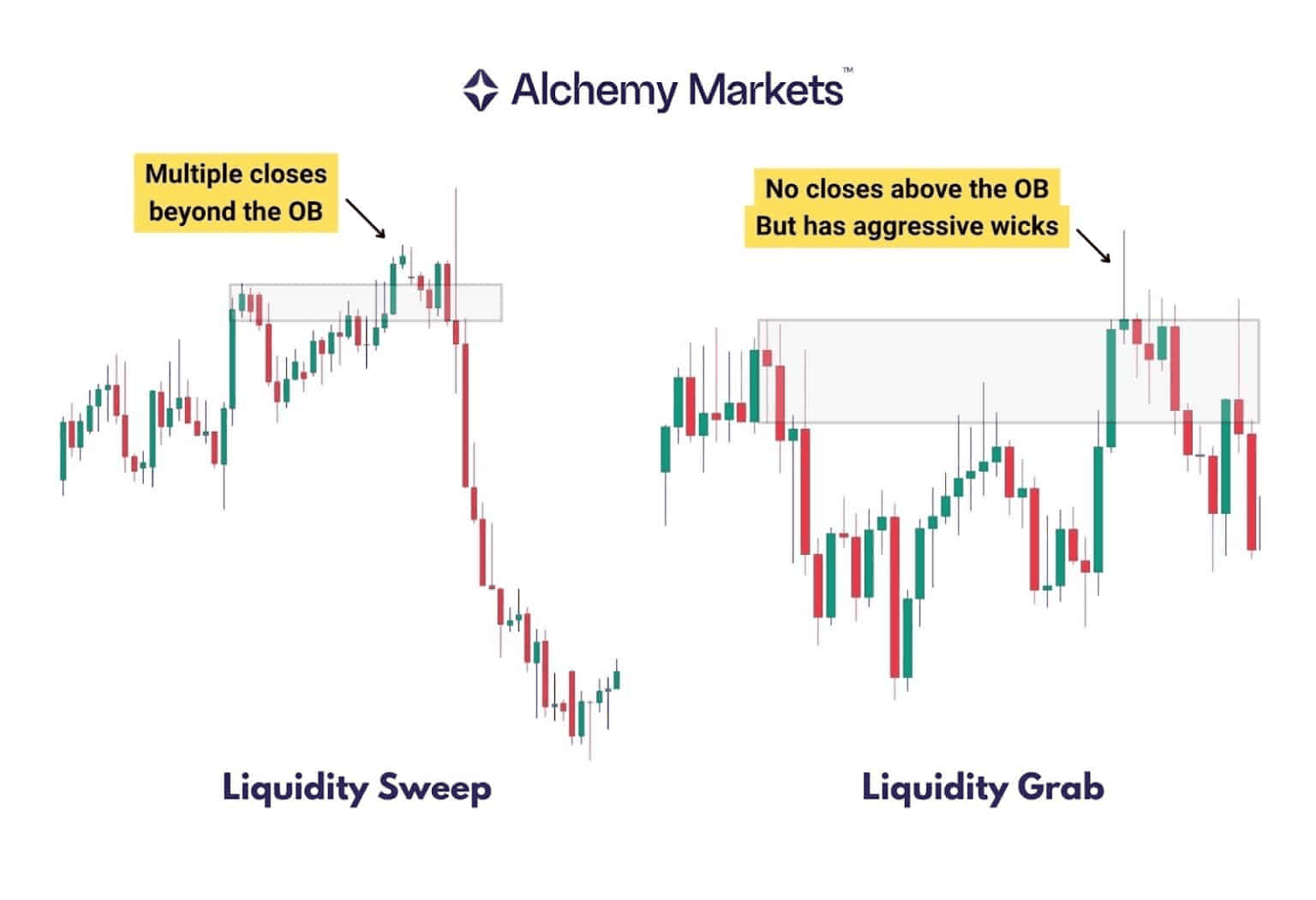
CHoCH frequently appears after these liquidity sweep or grab events, as price fails to continue in the original direction. When structure breaks after liquidity is taken, it signals that the prior trend is losing strength and that market behaviour may be shifting.
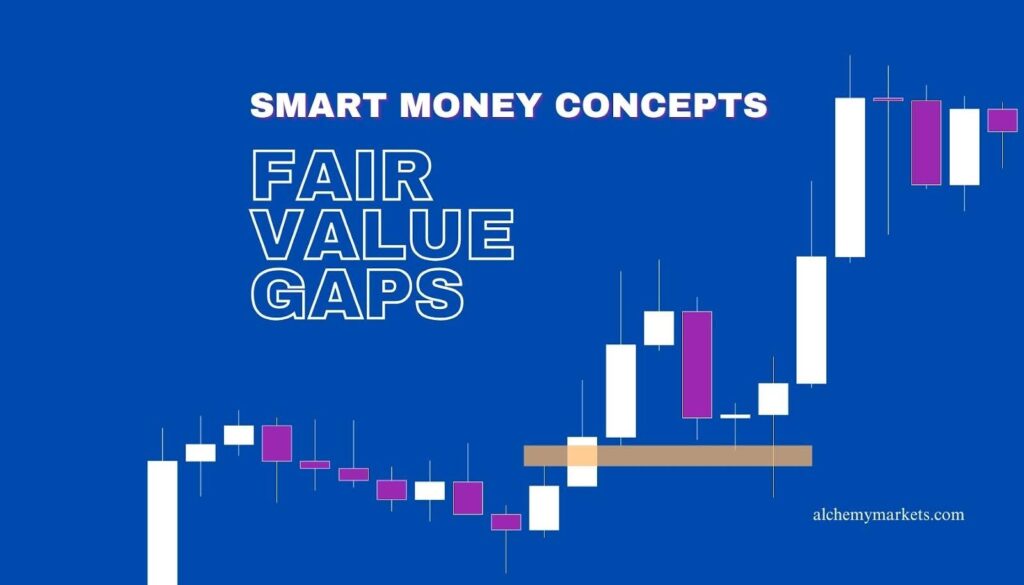
Fair Value Gaps
Fair value gaps highlight price inefficiencies created by strong directional moves. These areas often act as points of interest where price may return to rebalance before choosing direction.
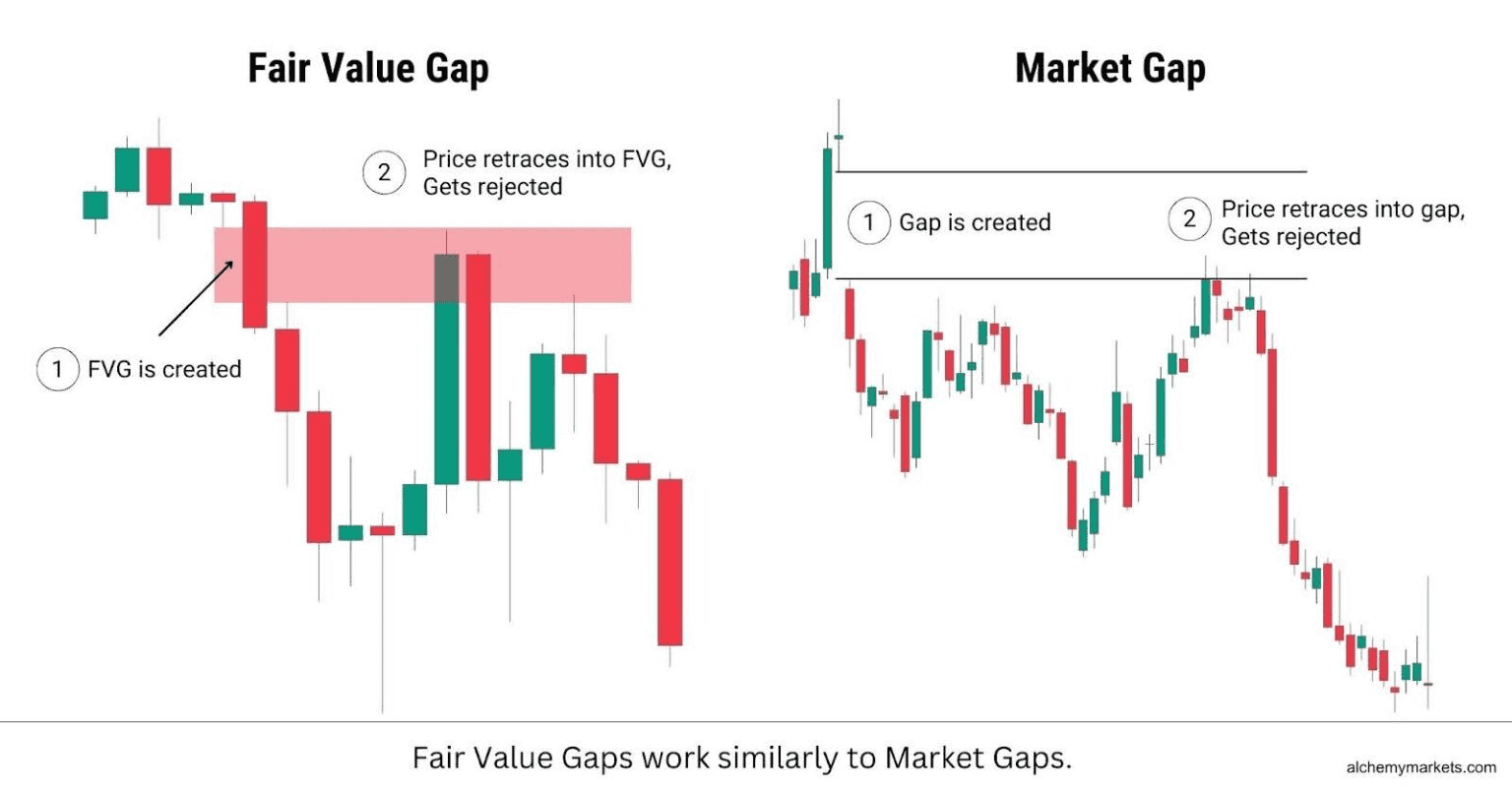
A CHoCH forming near or inside a fair value gap adds confluence, as it combines structural change with a prior imbalance, improving the quality of reversal analysis.
Why Most Traders Miss CHoCH Opportunities
Despite its simplicity, many traders struggle to recognise a Change of Character in real time. The issue is rarely the concept itself, but rather how traders interpret price, manage psychology, and process information. The most common reasons fall into three areas.
Fear of Missing Out (FOMO)
FOMO often pushes traders to act before structure is confirmed. Instead of waiting for a clear break in behaviour, they enter on minor pullbacks or single candles, mistaking normal retracements for CHoCH. This leads to early entries and frequent stop-outs.
Confirmation Bias
Many traders become emotionally attached to an existing trend and subconsciously ignore signals that suggest a shift is forming. When a valid CHoCH appears, they dismiss it as a temporary pullback because it conflicts with their bias. This prevents them from adapting when market conditions change.
Analysis Paralysis
Overloading charts with indicators can obscure what matters most: price structure. Traders focusing on individual candles or indicator signals often miss how price interacts with key swing points, liquidity, and structural zones. As a result, CHoCH signals are either misread or completely overlooked.
Recognising CHoCH consistently requires structural awareness, psychological discipline, and the ability to read price objectively, rather than reacting emotionally or relying on excessive confirmation.
The Future of CHoCH Trading: Where We’re Heading
As markets evolve, CHoCH remains a key tool for identifying early shifts in market structure. However, faster execution, higher volatility, and new technologies are changing how traders interpret and apply CHoCH.
Increased Noise
Modern markets produce more volatility, sharp spikes, and short-term imbalances that can resemble CHoCH without leading to real reversals. This makes false signals more common, especially on lower timeframes. To filter noise, traders must rely on clear structural breaks and confirmation rather than reacting to every minor shift.
Cross-Market Analysis
CHoCH signals are increasingly evaluated alongside related markets to improve reliability. For example, a bullish CHoCH on EURUSD carries more weight when supported by weakness in the US dollar index, while equity indices and commodities often reflect broader risk sentiment. Cross-market alignment helps confirm whether a structural shift is locally isolated or part of a broader move.
AI and Machine Learning
Nowadays, AI and machine learning are widely used in trading to analyse markets, build indicators, and automate strategies.
In Smart Money Concept strategies, these tools help identify swing points, BOS, and CHoCH across multiple timeframes. While automation improves consistency and coverage, CHoCH still requires context such as higher-timeframe bias and structural location, meaning the final decision remains with the trader.
CHoCH vs CHoCH+
CHoCH and CHoCH+ both describe changes in market structure, but CHoCH+ requires a failed continuation before the break. In essence, it is a stronger signal of trend weakness compared to the regular CHoCH.
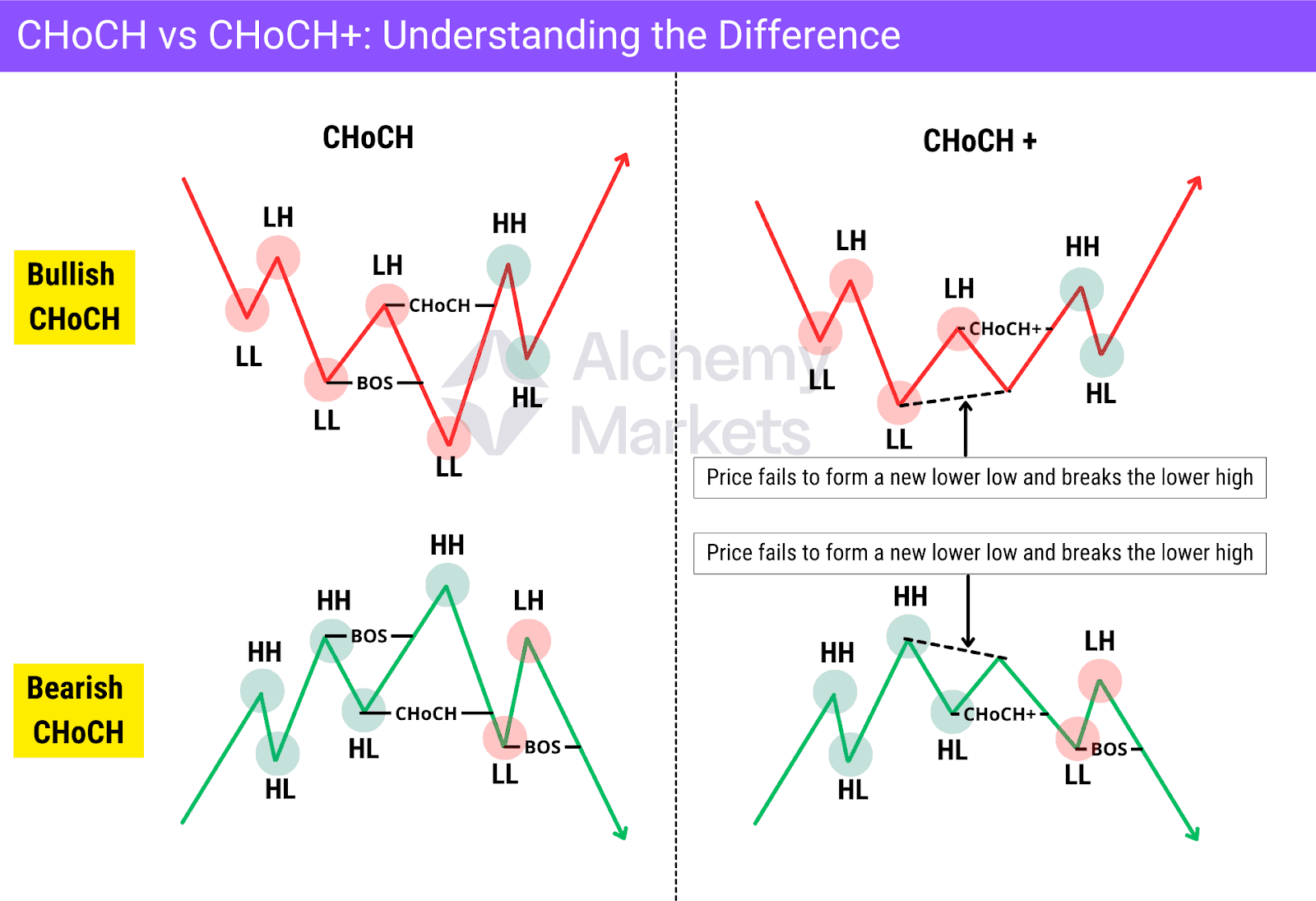
Bullish CHoCH: A bullish CHoCH forms when price breaks the most recent lower high in a downtrend. This signals the first indication that bearish momentum may be weakening.
Bullish CHoCH+: Unlike a normal bullish CHoCH, a bullish CHoCH+ occurs when price first fails to form a new lower low, then breaks the lower high. This shows that bearish continuation was rejected before the structural shift.
Bearish CHoCH: A bearish CHoCH forms when price breaks the most recent higher low in an uptrend. This represents the first sign that bullish momentum may be fading.
Bearish CHoCH+: A bearish CHoCH+ occurs when price fails to form a new higher high before breaking the higher low. This confirms that bullish continuation failed prior to the shift in structure.
This added requirement makes CHoCH+ a cleaner and more reliable signal, showing that the previous trend attempted to continue but could not sustain its structure before shifting.
CHoCH vs Break of Structure (BOS)
Break of Structure (BOS) and Change of Character (CHoCH) are core pillars of market structure analysis and Smart Money Concept. They work in alignment to help traders analyse market conditions, understand whether a trend is attempting to continue or reverse, and make more informed trading decisions, including entries and exits.
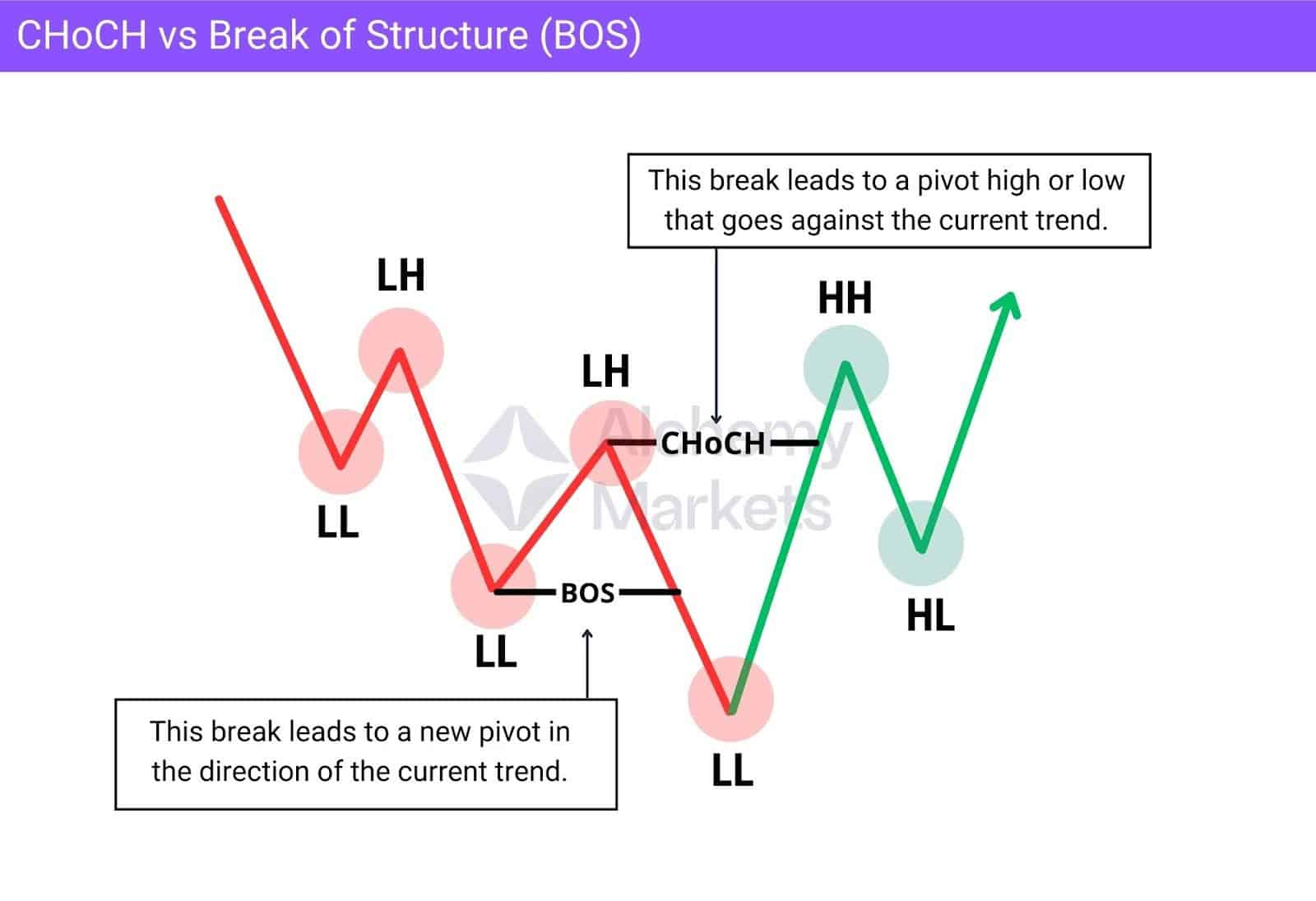
Break of Structure (BOS): A Break of Structure occurs when price breaks a key structural level in the direction of the prevailing or emerging trend. It confirms continuation or acceptance of direction, making it a validation tool rather than an early warning signal.
Change of Character (CHoCH): A Change of Character forms when price breaks internal structure against the current trend. It signals the first shift in market behaviour and warns that the existing trend may be losing strength.
In simple terms, CHoCH asks, “Is market behaviour changing?”, while Break Structure answers, “Has the market accepted the new direction?”. Using both together allows traders to anticipate reversals early while waiting for confirmation before committing fully.
Integrating BOS and CHoCH: The CHoCH and BOS Trading Strategy
A practical way to integrate CHoCH and BOS is to treat them as sequential stages within a single market structure process. CHoCH is used to identify a potential shift in behaviour, signalling that traders should prepare for a possible change in direction.
BOS is then used to confirm that the new bias has been accepted before committing fully to a trade. This approach helps reduce false signals, improves timing, and ensures trades are aligned with confirmed market structure rather than assumptions.
CHoCH vs Market Structure Shift (MSS)
Change of Character (CHoCH) and Market Structure Shift (MSS) describe different stages of structural behaviour, helping traders identify potential reversals, but they are not identical concepts
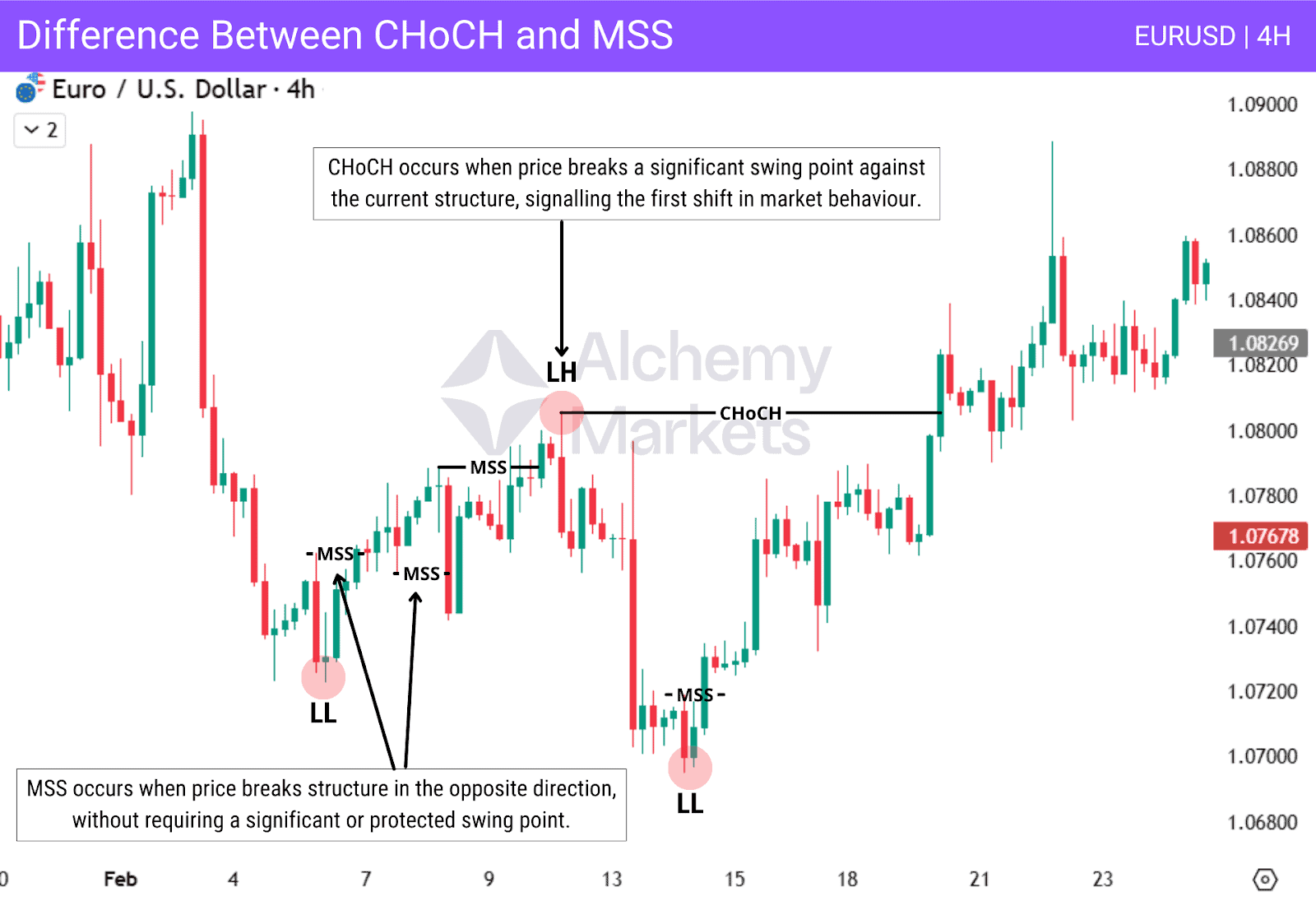
Change of Character (CHoCH): A Change of Character occurs when price breaks a key internal swing point against the prevailing trend, such as a higher low in an uptrend or a lower high in a downtrend. This break signals the first meaningful shift in market behaviour.
CHoCH focuses on critical structural levels, making it a reliable early indication of a potential trend reversal, though it does not provide full confirmation on its own.
Market Structure Shift (MSS): A Market Structure Shift describes broader changes in overall market behaviour, including retracements, corrections, or transitions between market phases. =
MSS looks at the market as a whole and does not always imply a complete trend reversal. Because of its wider scope, MSS is less precise than CHoCH and is best used to understand changing conditions rather than to time reversals.
CHoCH vs Traditional Support and Resistance Breaks
Both CHoCH and support and resistance can involve breakouts, but they evaluate them differently.
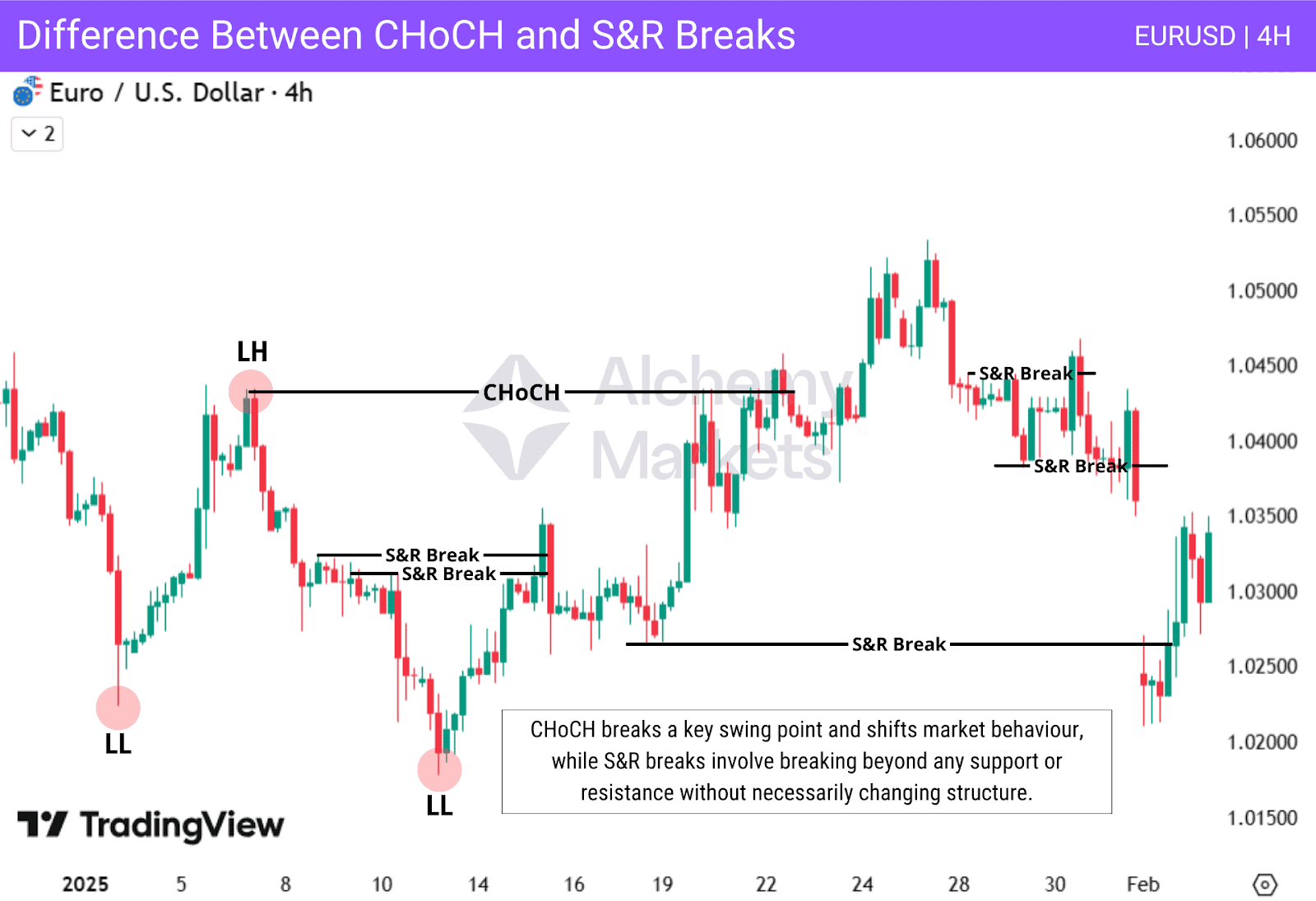
Change of Character (CHoCH): CHoCH is based on valid, well-defined swing points that form market structure. In a bullish market, a CHoCH occurs when price breaks the most recent higher low after a sequence of higher highs and higher lows, signalling that bullish control may be weakening and direction could change.
In a bearish market, CHoCH forms when price breaks the most recent lower high after a sequence of lower highs and lower lows, indicating that sellers may be regaining control and price could move lower.
Support and Resistance Breaks: Traditional support and resistance focus on horizontal price levels that may be significant but are not necessarily structural swing points. Price can break these levels briefly and reverse without altering the underlying sequence of highs and lows, resulting in false breakouts. Because these breaks lack structural confirmation, they do not always indicate a genuine shift in market direction.
FAQ
Why Is It Called a Change of Character?
It is called a Change of Character because price stops respecting the previous structure. The established sequence of highs and lows is broken, signalling that market behaviour has changed rather than simply pulled back.
What Timeframe Is Best for a CHoCH?
CHoCH can be used across all timeframes, but higher-timeframe CHoCH signals are more significant. On higher timeframes, CHoCH is best used to identify market direction and bias. On lower timeframes, CHoCH is mainly used to confirm entries.
What Is the Psychology Behind CHoCH?
CHoCH reflects a shift in control between buyers and sellers. It appears when the side that previously dominated the market begins to lose strength and opposing pressure starts to take control. This transition often marks a change in market sentiment and order flow.
Is CHoCH Applicable to All Trading Markets?
Yes, CHoCH applies to any market, but it works better in efficient markets where price forms clear impulses and retracements, making structure easier to identify. In inefficient markets price behaviour can be choppy and irregular. This makes identifying a clear structure more difficult.
How Reliable Is CHoCH as a Trading Signal?
CHoCH is a high-quality early signal, but it should not be used in isolation. Its reliability improves significantly when aligned with higher-timeframe structure and confirmation tools such as BOS. Used correctly, it helps filter false reversals rather than predict them.
Can Beginners Use CHoCH Effectively?
Beginners can use CHoCH at a basic level by focusing on clear swing points and higher timeframes. However, using CHoCH consistently and avoiding false signals requires experience, as proper context, structure selection, and discipline develop over time.
Common CHoCH Trading Mistakes (And How to Avoid Them)
Even though Change of Character (CHoCH) is a powerful concept, many traders still make mistakes when using it. Most errors come from misreading structure, ignoring context, or reacting too quickly to price movements:
| Common Mistake | Why It’s a Problem | How to Avoid It |
| Treating minor or internal breaks as full CHoCH | Not every high or low is structural. Internal breaks do not signal a true shift in market behaviour. | Use external CHoCH for direction. Use internal CHoCH only for confirmation or entry refinement. |
| Ignoring higher-timeframe structure | A CHoCH on a lower timeframe may only represent a pullback if it goes against the higher-timeframe trend. | Start with the higher timeframe to define directional bias, then wait for lower timeframes to align with that bias before considering taking a trade. |
| Entering before candle close | Wicks often break a swing point temporarily and then return back below or above it, creating false signals. | Wait for a clear candle body close beyond the swing point to reduce the risk of reacting to fake breaks. |
| Trading CHoCH without displacement or strong volume | Weak breaks without momentum can fail more frequently and lack follow-through. | Look for clear displacement and strong momentum as confluence to improve the reliability of the CHoCH. |
| Forgetting liquidity context | Entering directly into unswept liquidity often leads to drawdown or stop-outs. | Check whether liquidity has been swept first. A common high-probability sequence is liquidity grab → CHoCH → BOS → retest. |
Tools and Resources for CHoCH Trading
Effective CHoCH trading requires clean charts and tools that improve clarity rather than add noise. The resources below help traders identify market structure, swing points, and CHoCH levels with greater precision.
Charting Platforms
Platforms such as TradingView and MetaTrader 4/5 provide advanced charting capabilities that support proper market structure analysis. They allow traders to accurately identify swing points, BOS, and CHoCH levels, while offering drawing tools and alerts to track structural changes in real time.
Volume Indicators
Volume can be used as a confirmation tool to assess the strength behind a CHoCH, but it is not required for structural validity.
Common volume-based tools include Volume, Volume Profile, Delta / Order Flow indicators, and OBV (On-Balance Volume). An increase in volume during a CHoCH can add confidence to the move.
Multiple Timeframe Analysis
Analysing CHoCH across multiple timeframes improves reliability.
• Higher timeframes define overall market structure and directional bias.
• Lower timeframes are used for entry confirmation and refinement.
This alignment helps reduce false signals and improves trade execution.
Drawing Tools
Drawing tools help identify PD arrays, liquidity levels, trends, and key price areas that support clear and informed trading decisions.
These tools may include vertical lines and rectangles, channels and trendlines, Fibonacci retracements, session price markers, range tools, and other charting tools.
How does CHoCH work in forex trading?
In forex trading, CHoCH can be particularly effective due to the high liquidity of the FX market. However, during periods of low liquidity, such as outside active trading sessions, CHoCH can produce false signals as price moves are more easily distorted.
For this reason, CHoCH signals are most reliable during the London and New York sessions, where structure breaks are driven by genuine participation and institutional order flow.