Written by:

- Opening Bell
- September 28, 2026
- 3 min read
China’s Memory Push Tests AI’s Scarcity Premium
China’s largest DRAM maker, ChangXin Memory Technologies (CXMT), has moved its fifth-generation memory platform into mass production, claiming roughly 50% more gross dies per wafer.
In plain terms, more memory chips from the same amount of silicon.
This is more important than it sounds. Memory is one of the most profitable bottlenecks in the AI hardware boom, and China is now building enough capacity to challenge the pricing power enjoyed by Micron, Samsung and SK hynix.
The timing matters. Global yields remain high, central banks are still restrictive and equal-weight equities continue to lag. Yet tech-heavy indices have stayed resilient because investors still expect AI earnings growth to outrun the higher cost of capital. That makes this a narrow, AI-led risk-on regime, and leaves the wider market unusually dependent on a small group of winners.
Micron sits directly inside that story. MU has rallied back into the 1,062–1,089 resistance zone, with a larger 1,194–1,237 area above. That makes its next earnings update a useful check on whether tight supply, HBM demand and strong memory margins are still doing enough to support the rally.
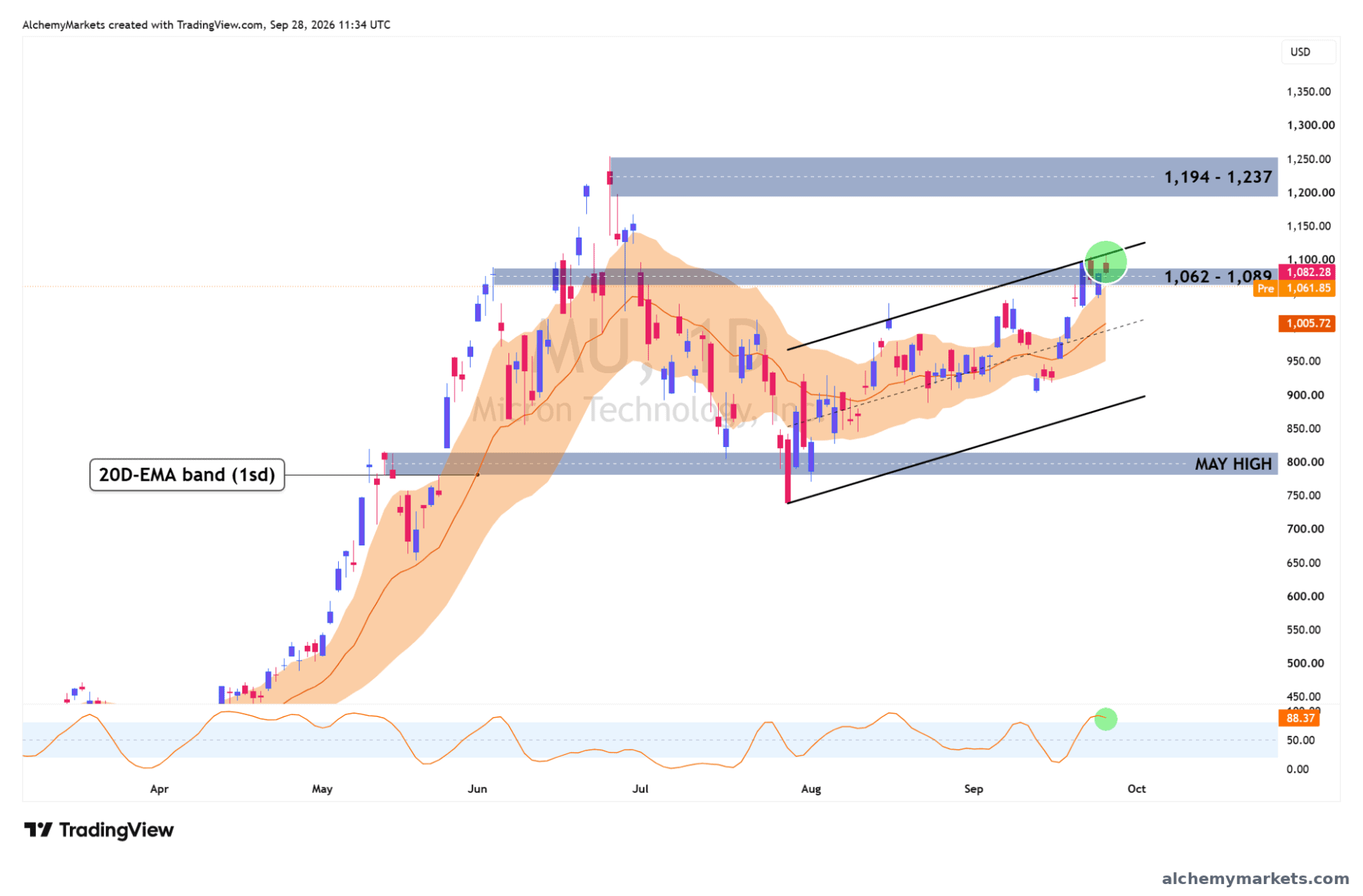
For now, Micron is running into a bear flag‘s resistance and also printing an “overbought” signal in momentum on the Stochastic RSI. While this is not yet confirmed (since there is no lower bound breakdown), MU needs to prove itself by breaking above the channel and holding the 1,062-1,089 zone.
China is moving from buyer to competitor
CXMT is China’s leading producer of DRAM, the working memory used across smartphones, PCs, servers and AI infrastructure. It is not yet a direct substitute for the most advanced HBM used alongside Nvidia and AMD accelerators, but it is becoming large enough to matter in the layers beneath it.
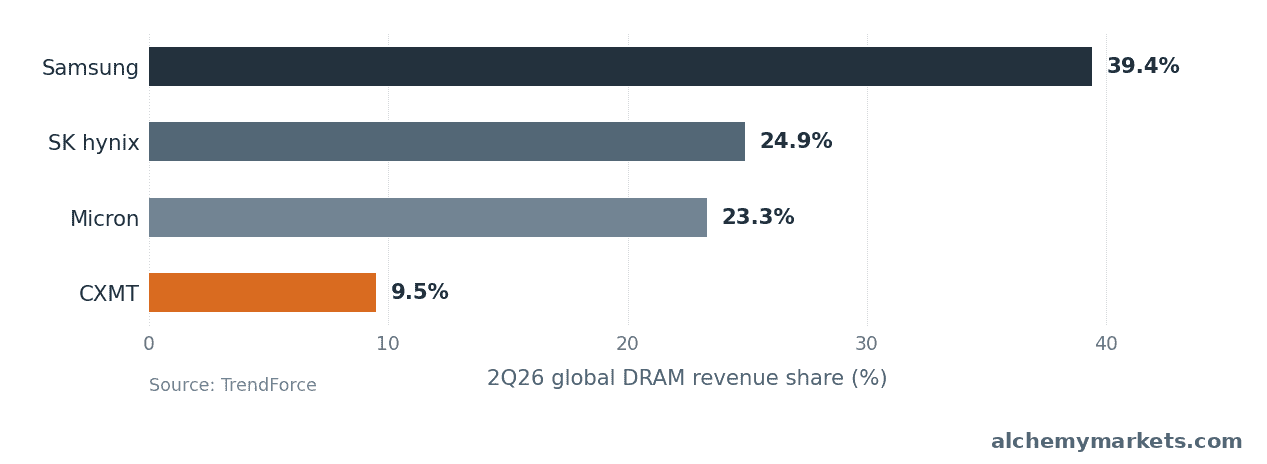
TrendForce’s 2Q26 revenue data puts Samsung at roughly 39.4% of global DRAM revenue, SK hynix at 24.9%, Micron at 23.3% and CXMT at around 9.5%. Micron is the main US-listed memory producer, while Samsung and SK hynix remain the closest direct comparisons because they compete across both standard DRAM and higher-end AI memory.
Why this matters for the AI cycle
The China story is not simply bearish. If CXMT adds enough supply to loosen conventional DRAM, memory manufacturers could lose some pricing power. But cheaper memory also lowers part of the cost of building servers and running AI systems.
So CXMT does not need to beat SK hynix in HBM tomorrow to become important.
The first warning stage is simpler: produce enough conventional DRAM to reduce China’s dependence on imports and put pressure on global pricing.
The second stage would be more serious: moving further into server memory and eventually higher-end AI memory.
The wider market is watching the same thing
The Nasdaq remains constructive because investors are still rewarding AI-linked earnings and supply-chain strength.
That is why the memory story matters beyond Micron: if one of AI hardware’s strongest profit pools starts to weaken, it can change how much investors are willing to pay for the whole theme.
For now, Nasdaq is still posited to reach even 32.5K off the back of a potential bull flag, which is unconfirmed.
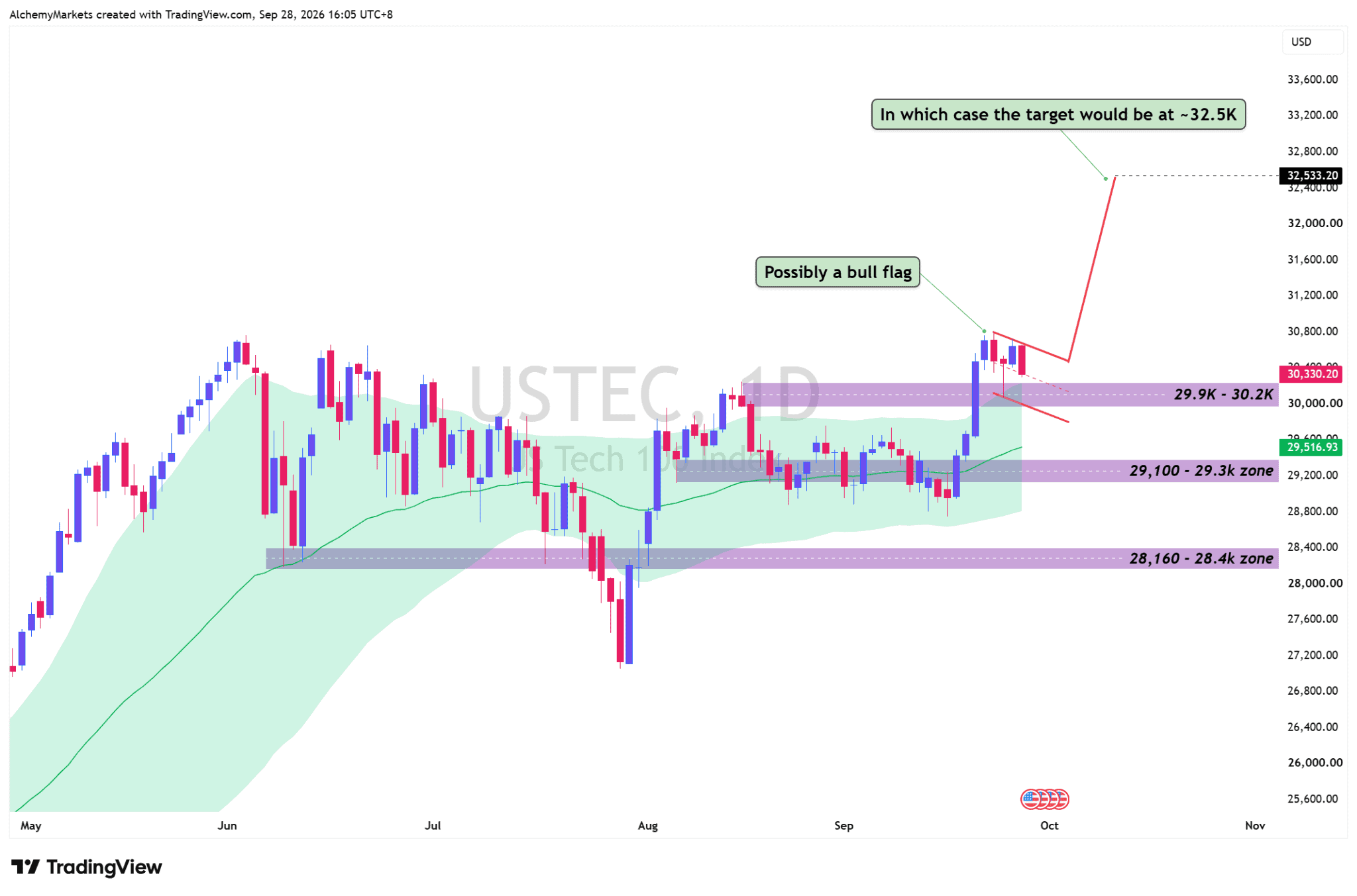
But China is introducing a new risk to that AI leadership. If CXMT starts eroding the memory scarcity supporting Micron and the wider semiconductor cycle, it could take some momentum out of the AI rally; even if cheaper memory ultimately makes AI cheaper to build.