Written by:

- Opening Bell
- November 19, 2026
- 6 min read
AI Stocks Slide as Nvidia Gives Up Gains, Anthropic Bets on a $1.5 Trillion IPO
Wall Street has just put a $1.5 trillion price tag on the company behind Claude AI – Anthropic, less than 24 hours after Nvidia gave up its post-earnings gains.
Nvidia reported a record $115.8 billion in quarterly revenue on Tuesday. The stock initially rallied, but gave those gains back in Wednesday’s cash session.
But this discrepancy is what makes today’s IPO interesting.
Anthropic is scheduled to start trading on the Nasdaq today (19 November). Its IPO was priced at $83 per share, above the proposed 70–78 range, even as semiconductor stocks have been struggling to find a bottom.
Will this be the catalyst that helps tech stocks recover amid this selloff?
Anthropic is the next big test for the AI trade
Nvidia has already shown us how profitable the AI hardware business can be.
Today, investors get to put a public price on the second layer: the actual business behind the AI technology.
At $83 per share, Anthropic’s 980 million-share offering is worth roughly $81.3 billion, making it the largest IPO on record. The pricing implies a fully diluted valuation of approximately $1.5 trillion.
According to Anthropic’s SEC-filed prospectus, seven technology companies have agreed to invest another $26 billion through a concurrent private placement at the IPO price, subject to the offering closing.
Nvidia and Google each account for $10 billion, with Google’s contribution fulfilling part of an existing commitment.
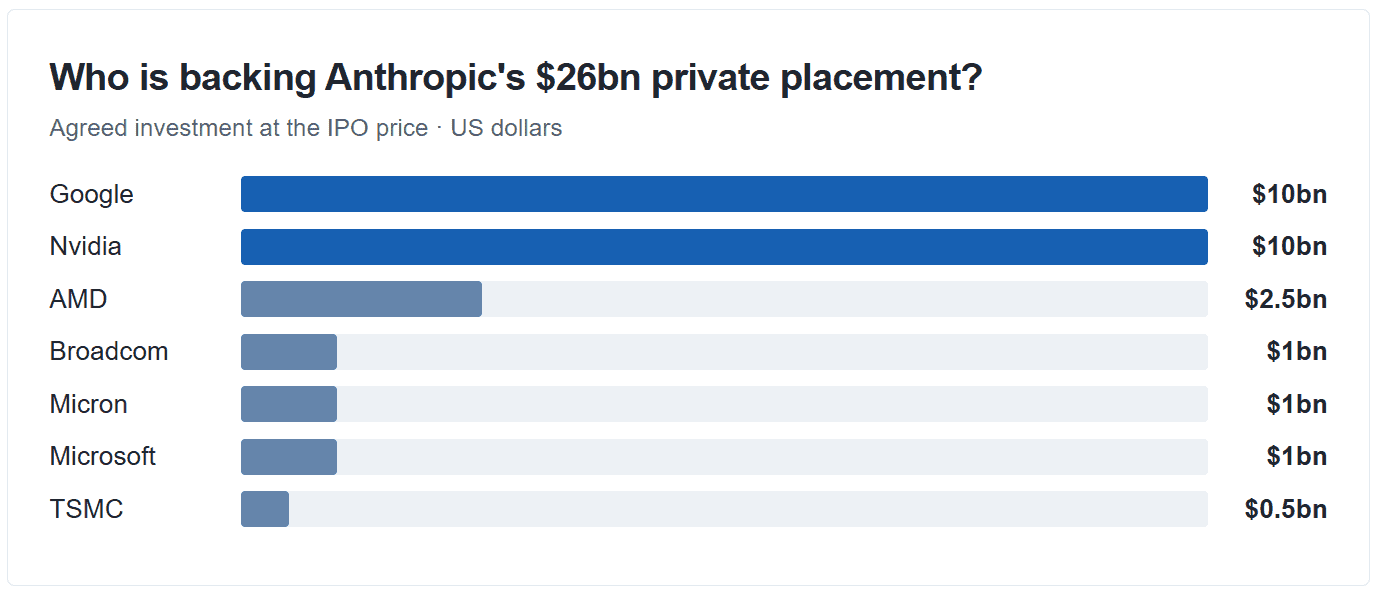
So some of the same companies supplying Anthropic with technology are also helping finance it.
As of 30 September, Anthropic had $313.8 billion in non-cancellable purchase commitments with remaining terms of more than one year, mainly for cloud hosting and infrastructure services. Those payments are due over several years.
So this IPO is quite important, as it gives Anthropic more cash to help meet those commitments. But over time, it needs enough paying customers to cover the cost of all that computing power.
Yesterday, we covered Nvidia’s earnings and Colette Kress’s outlook. Its data centre sales more than doubled year on year, yet the rally still failed.
Today, Anthropic can give the market another reason to reassess the AI trade, particularly if the shares hold above $83 and chip stocks participate in the recovery.
If Anthropic rallies on its own while chip stocks continue to struggle, it would be harder to argue that sentiment has improved across the sector.
Nvidia: Recovery towards 169–180?
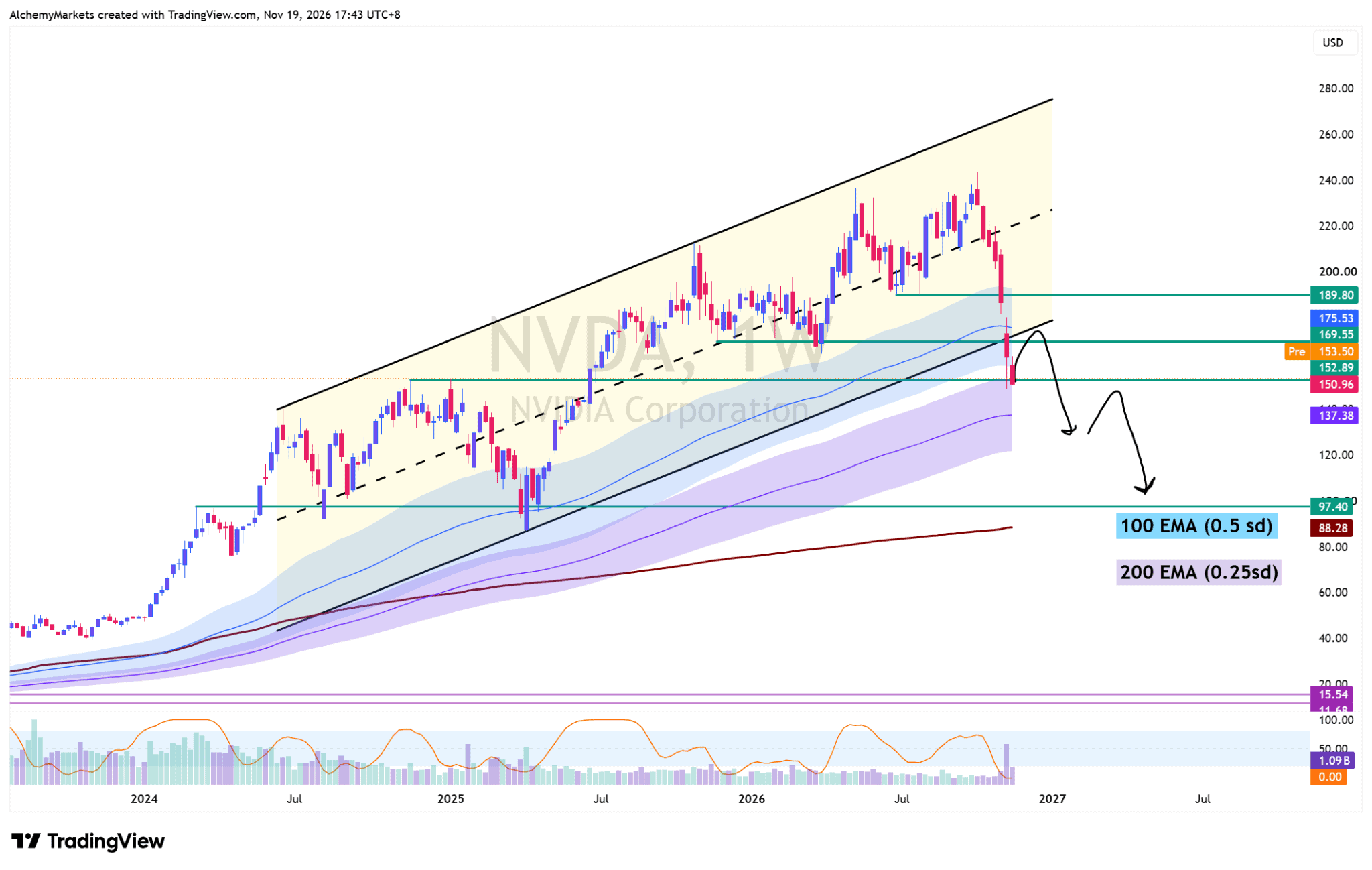
Nvidia has fallen out of its long-term rising channel and below its 200-day exponential moving average (EMA).
On the weekly chart, however, the stock is testing its 200-week EMA band. That gives buyers a reasonable area from which to attempt a recovery.
On a rebound, the first major test is around $169.50, followed by the 175–180 region where the former rising channel and the 100-week EMA band could offer resistance.
Should Nvidia break back into the channel and hold there, that would improve the case for a reversal.
A rejection at the old channel floor, on the other hand, would leave the stock vulnerable to another test of the weekly support band, with its 200-week EMA near $137.
SMH: Semiconductors stage a Double Top
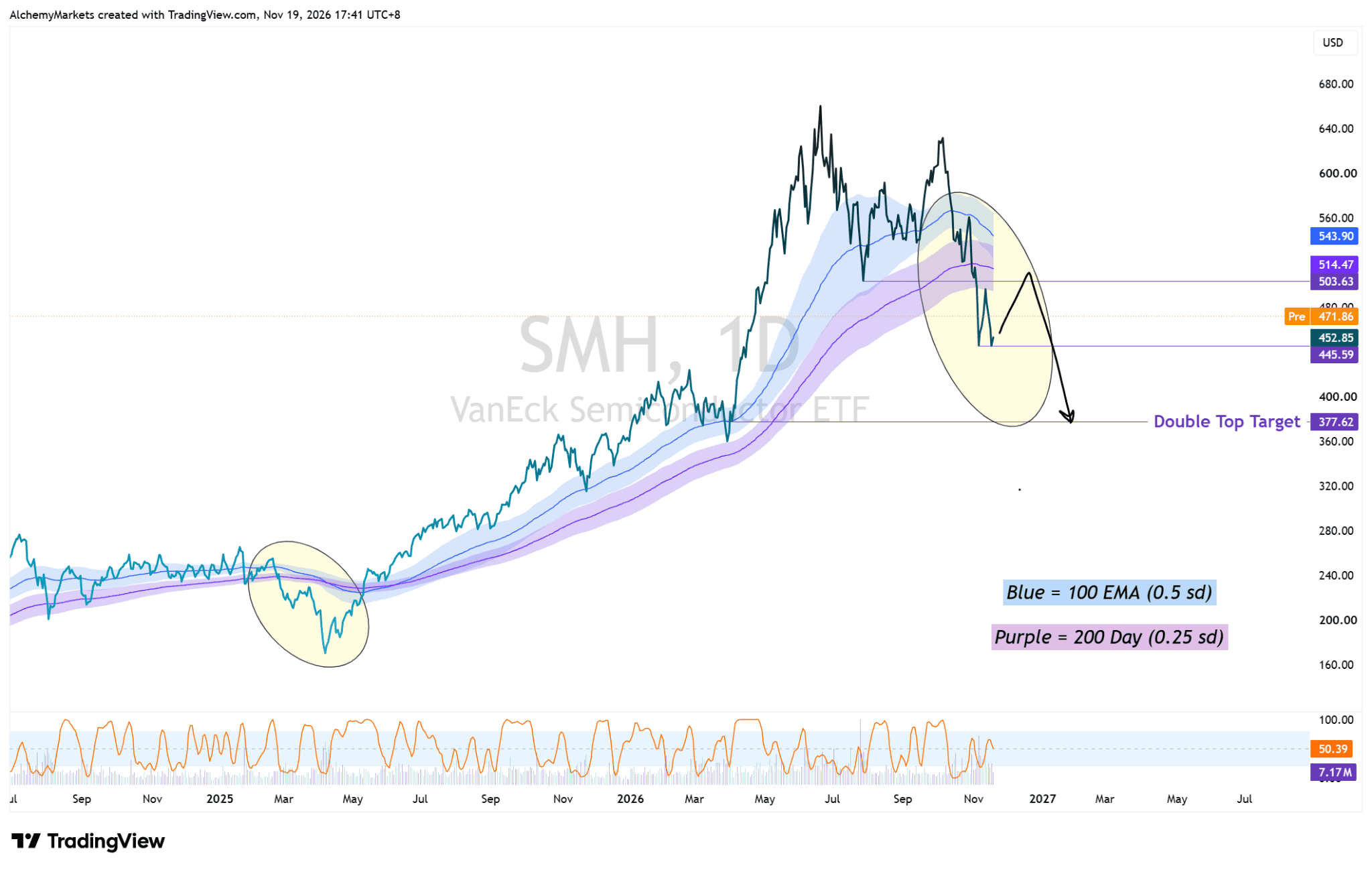
The chart of the VanEck Semiconductor ETF (SMH) is more concerning. It has broken below its 200-day EMA band and is showing a possible double top.
SMH is trying to recover from the 445–453 area. A rebound towards 503–514 would take it back into the broken 200-day EMA region, where sellers could return.
If SMH fails there and subsequently loses the recent lows, the double top projection near $378 becomes a scenario to consider. A sustained recovery above the 200-day band would weaken that bearish projection.
Intel has its own hurdle to clear
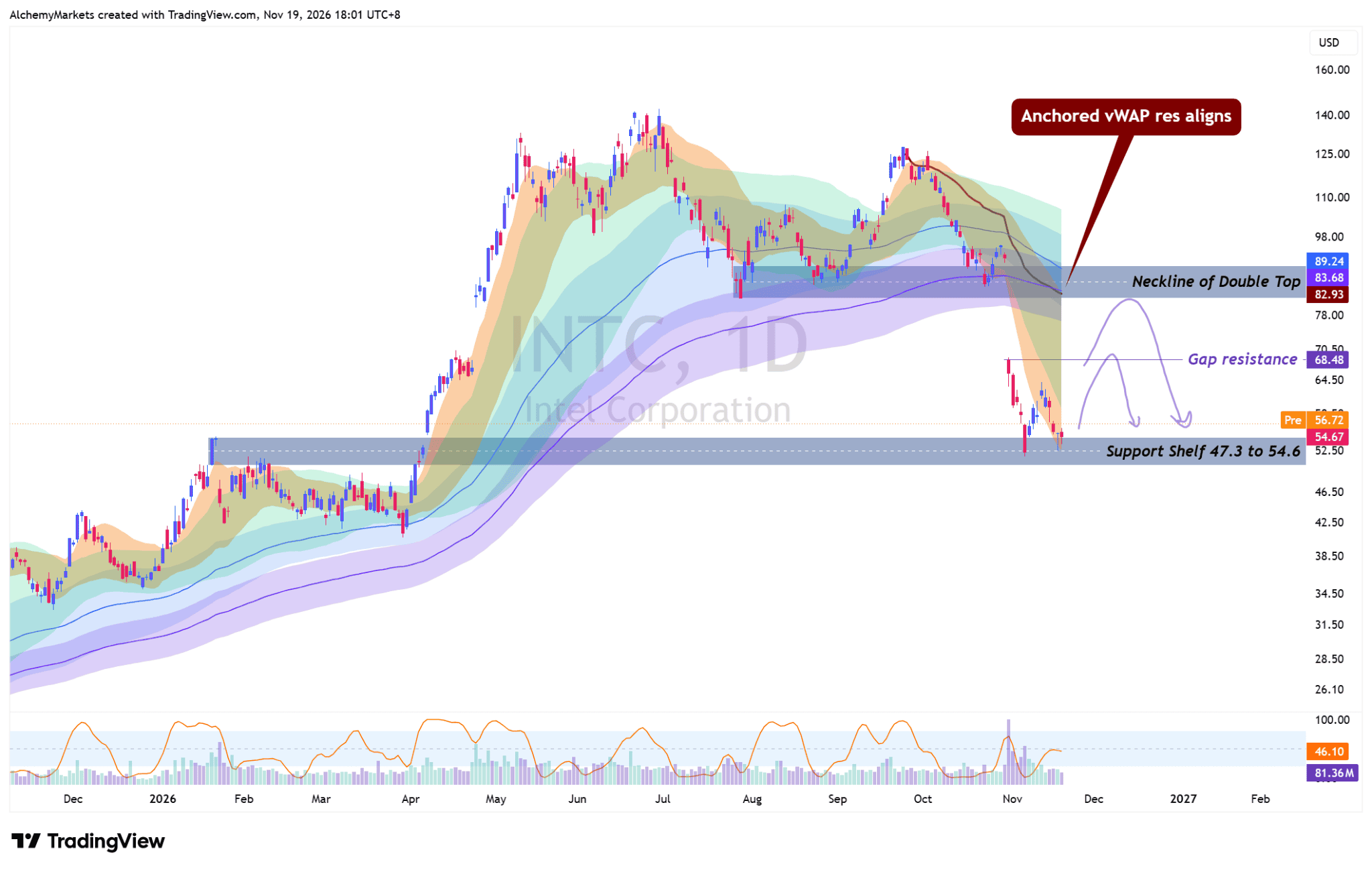
Not everyone in the AI supply chain is enjoying Nvidia’s level of growth.
Intel was positioned to benefit from the AI buildout through its partnership with Nvidia, developing custom processors for data centres.
Yet its $15–16b Q4 revenue forecast disappointed investors in October. Nvidia also reduced its Intel shareholding by 25% between June and September, according to its latest 13F filing.
If Intel holds its 47.30–54.60 support zone, a recovery towards $68.48 could follow. Beyond that, the former double top neckline at 83–89 coincides with anchored VWAP resistance.
A recovery here would offer another indication that investors are regaining confidence in the wider AI supply chain.
Copper is Losing Its Trend, too
Data centres need electricity, and getting that electricity into the building requires a lot of copper.
The International Energy Agency identifies copper as one of the minerals needed in significant quantities for data centre construction. Long-term demand from the AI buildout remains an argument in copper’s favour, alongside power grids and electrification more broadly.
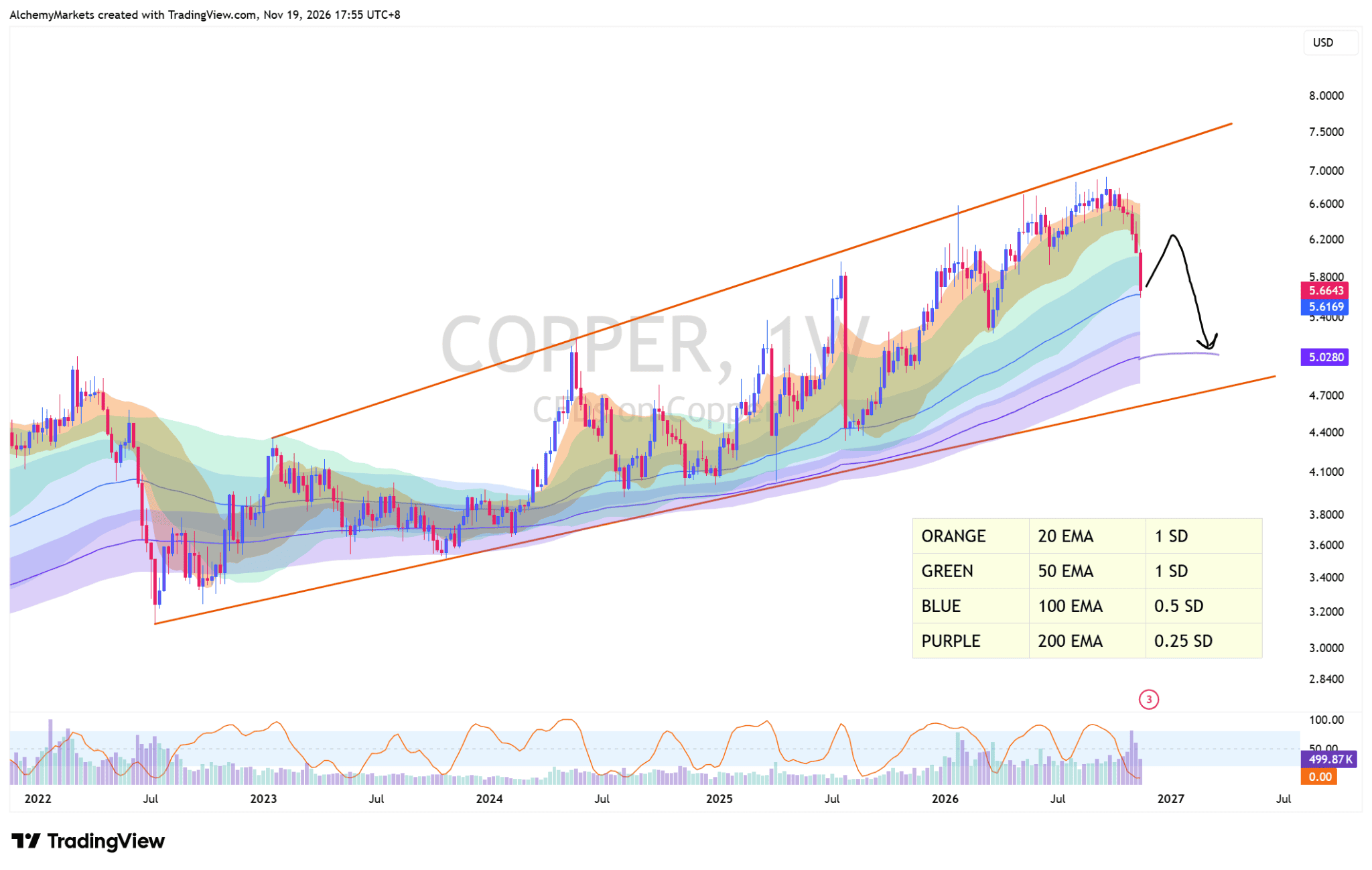
But copper has now broken below both its 20-week and 50-week EMA bands. It had previously respected the 20-week band throughout much of its rise, making a rebound towards $6.30/lb an important test.
If copper is rejected there, the next major moving-average level is around $5.03/lb, at the 200-week EMA. A sustained recovery above the 20-week band, or hold of the 100 EMA band would weaken this bearish outlook.
Copper falling alongside chip stocks suggests there may be more to this sell-off than Nvidia’s leadership problems.
US Dollar & Rates: Feds are Eyeing Rate Hikes
The dollar is also worth watching. The October FOMC minutes, released on Wednesday, showed that almost all participants saw further rate hikes as likely under their baseline outlooks.
Two participants would consider a move larger than 25 basis points at the next meeting if inflation data disappoint.
Higher rates make it more expensive to borrow money and reduce what investors are willing to pay today for profits expected years from now.
That’s a particularly uncomfortable combination for companies borrowing to build expensive AI facilities.
The US dollar has strengthened as investors consider that possibility. A stronger dollar can add to the pressure on dollar-priced commodities, even when longer-term Treasury yields are not rising.
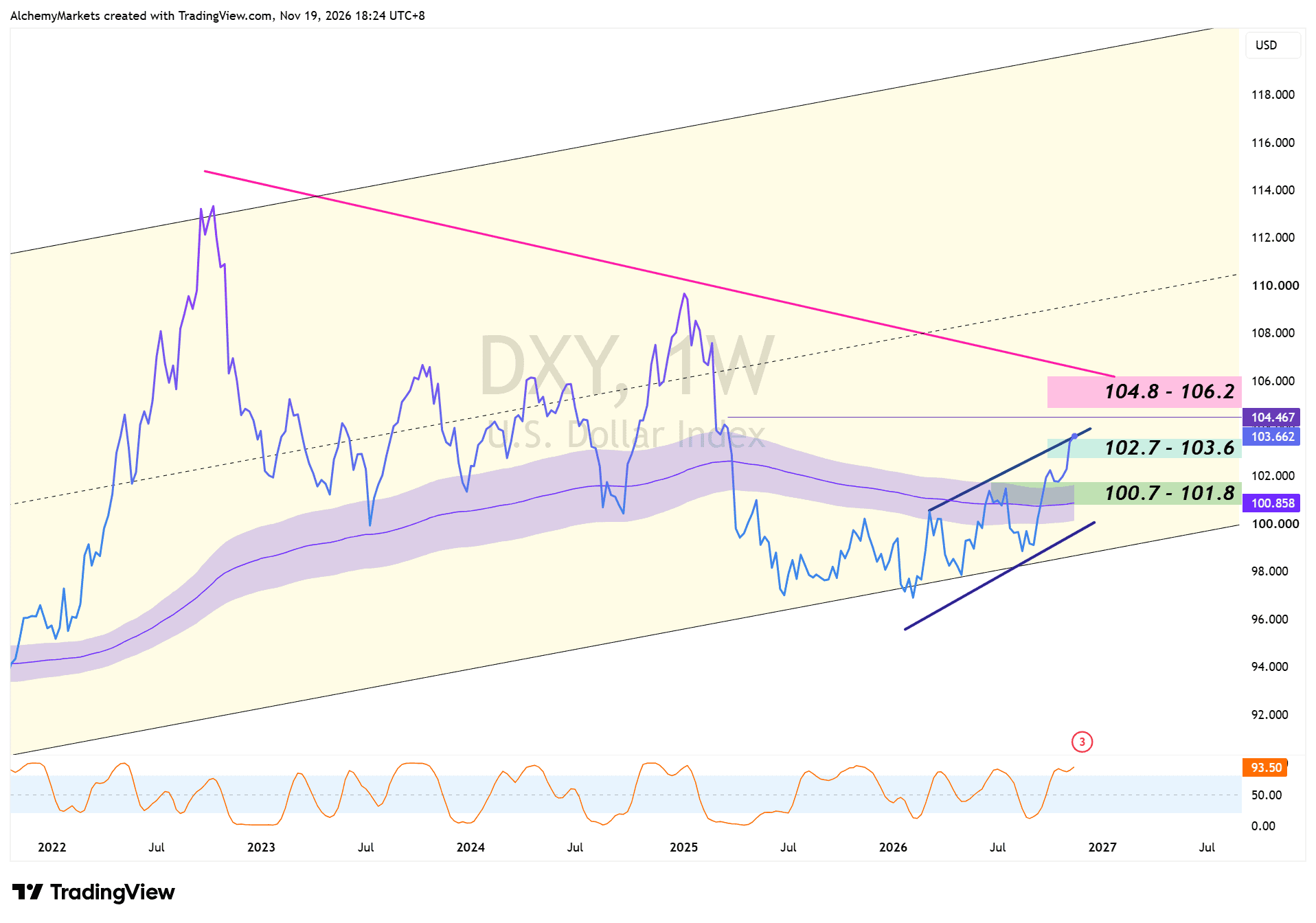
DXY is above its 200-week EMA band and approaching trendline resistance around 104.46. Above that, there is a more substantial resistance zone around 104.8–106.2.
If the dollar starts to reject these levels and loses the 102.7–103.6 region on a sustained basis, it could give commodities and equities some breathing room.
A continued rise would make a recovery in copper and semiconductor stocks harder to sustain.
Bottom line: If Anthropic holds above $83, SMH reclaims its 200-day EMA band and the dollar starts to reject resistance, the AI trade would have a stronger case for a recovery.
Until semiconductor stocks reclaim their broken support levels, any rebound could still be a bounce into resistance.