Written by:

- Opening Bell
- November 18, 2026
- 6 min read
Nvidia’s $130 Billion Promise: Can Colette Kress Deliver?
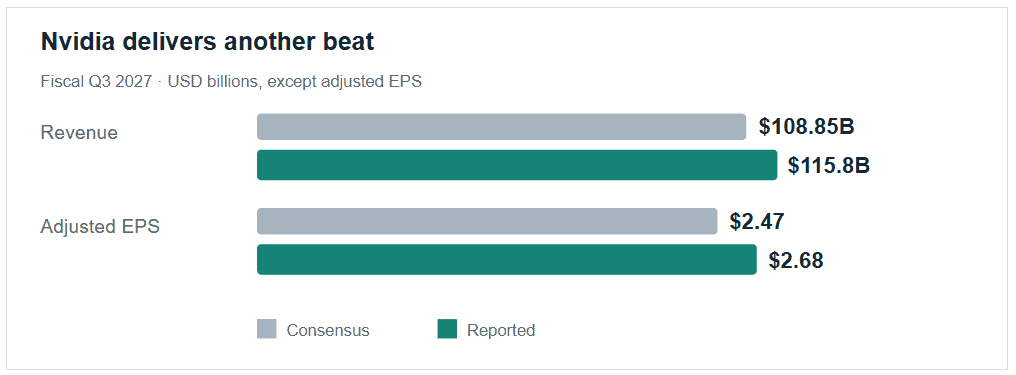
Nvidia’s first earnings report since Jensen Huang stepped down has, as expected, delivered another beat and raise. This has given the Nasdaq a much-needed boost.
Nvidia initially jumped more than 5% after reporting earnings on Tuesday, reaching $163.56 at 6:14 pm ET.
But just six hours later, its overnight price was back around $157.87, much closer to its previous close of $155.46.
That suggests at least some hesitation from investors. A beat was already widely anticipated, so what really mattered was what interim CEO Colette Kress had to say about the future of the business.
And that may be what is keeping investors on their toes.
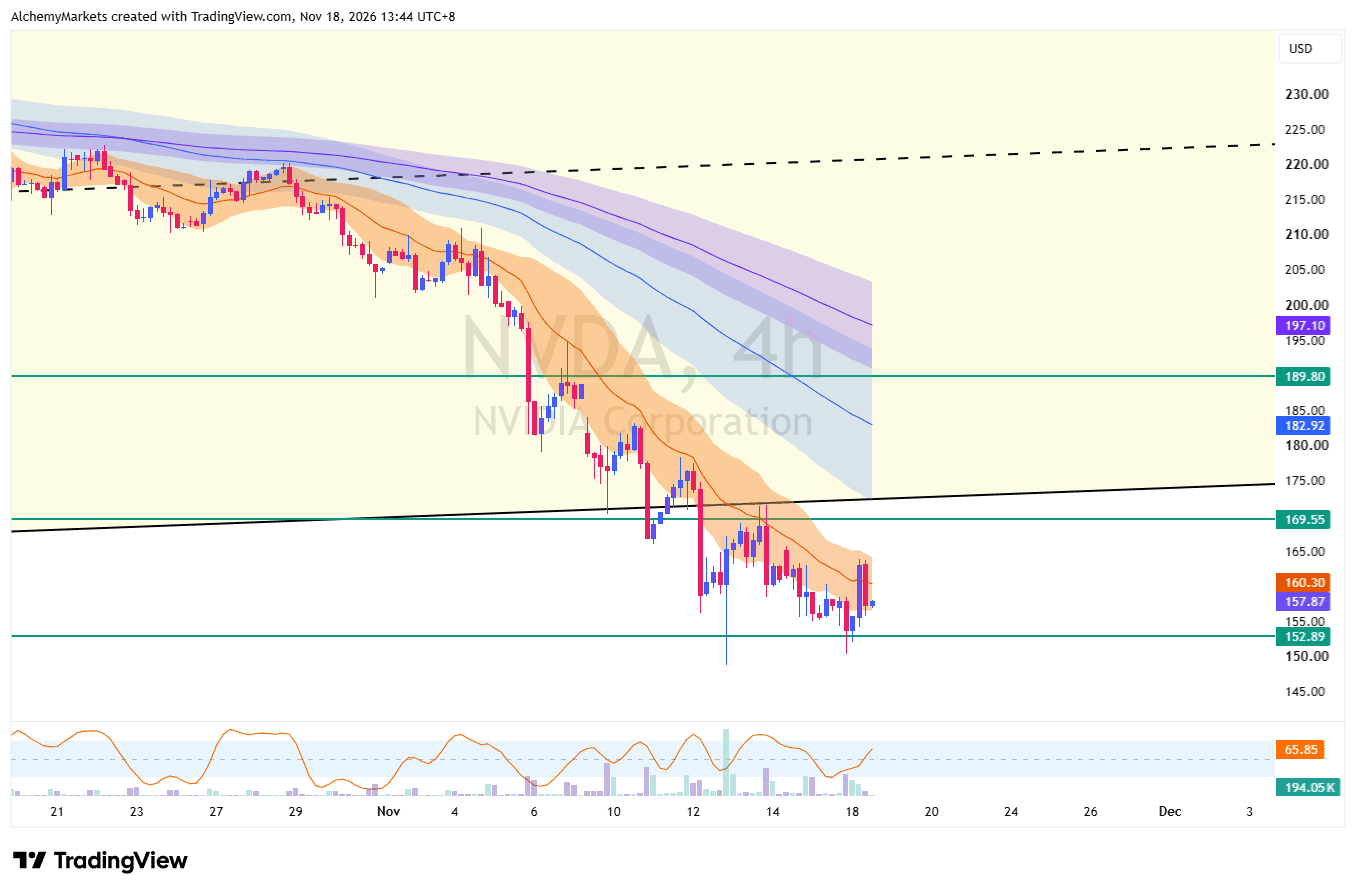
Now, we cannot tell from overnight trading alone why the rally lost momentum. But on the 4H chart, Nvidia is still in a downtrend and rejecting from the 20-EMA zone (in orange, one standard deviation) – that behaviour has not yet changed.
A first sign of change would be if NVDA can break above that orange band, at ~164 and hold its price without breaking back down. That would make a reversal here very interesting for me.
Earnings: What is Colette Kress actually promising?
On paper, Kress gave investors plenty of reasons to be optimistic.
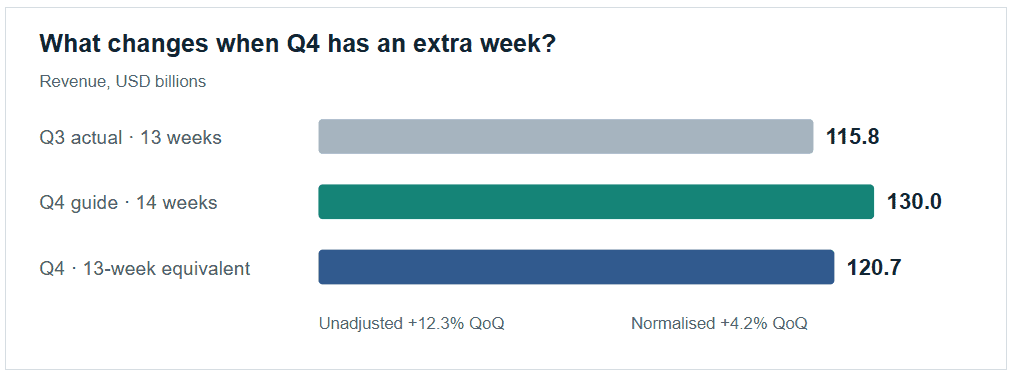
Nvidia expects to generate $130 billion in revenue next quarter, above the $125 billion analysts expected. Management also raised its fiscal 2028 revenue growth outlook from 70% to approximately 75%.
There is a little catch with that $130 billion figure. Nvidia’s upcoming quarter is 14 weeks long instead of 13.
Adjusting for that extra week, Nvidia’s projected sequential revenue growth works out closer to 4% rather than 12%, assuming sales are evenly distributed.
Meanwhile, adjusted gross margins are expected to fall from 74.9% to between 71% and 72%.
None of this necessarily points to trouble at Nvidia. But it does raise an interesting question: is Huang’s absence going to accelerate this slowdown?
It’s undeniable that investors very much want Jensen back at the helm, with the #StandWithJensen Open Letter growing over 190,000 in signatures and major shareholders threatening to walk away.
Investors very much see Nvidia’s success today as the fruit of Jensen Huang’s leadership. The products, supply agreements and customer relationships that are generating these revenues were largely established before his departure.
Some even say that the entire AI economy is thanks to Huang’s ability to cut deals through his connections with Taiwan and other AI players.
So Kress, stepping in as an interim, is under high scrutiny of whether she can maintain that Nvidia mote.
Should that growth disappoint over the coming quarters, investors may start questioning whether Nvidia’s leadership change has anything to do with it.
Which brings us to arguably the most important question from the earnings call:
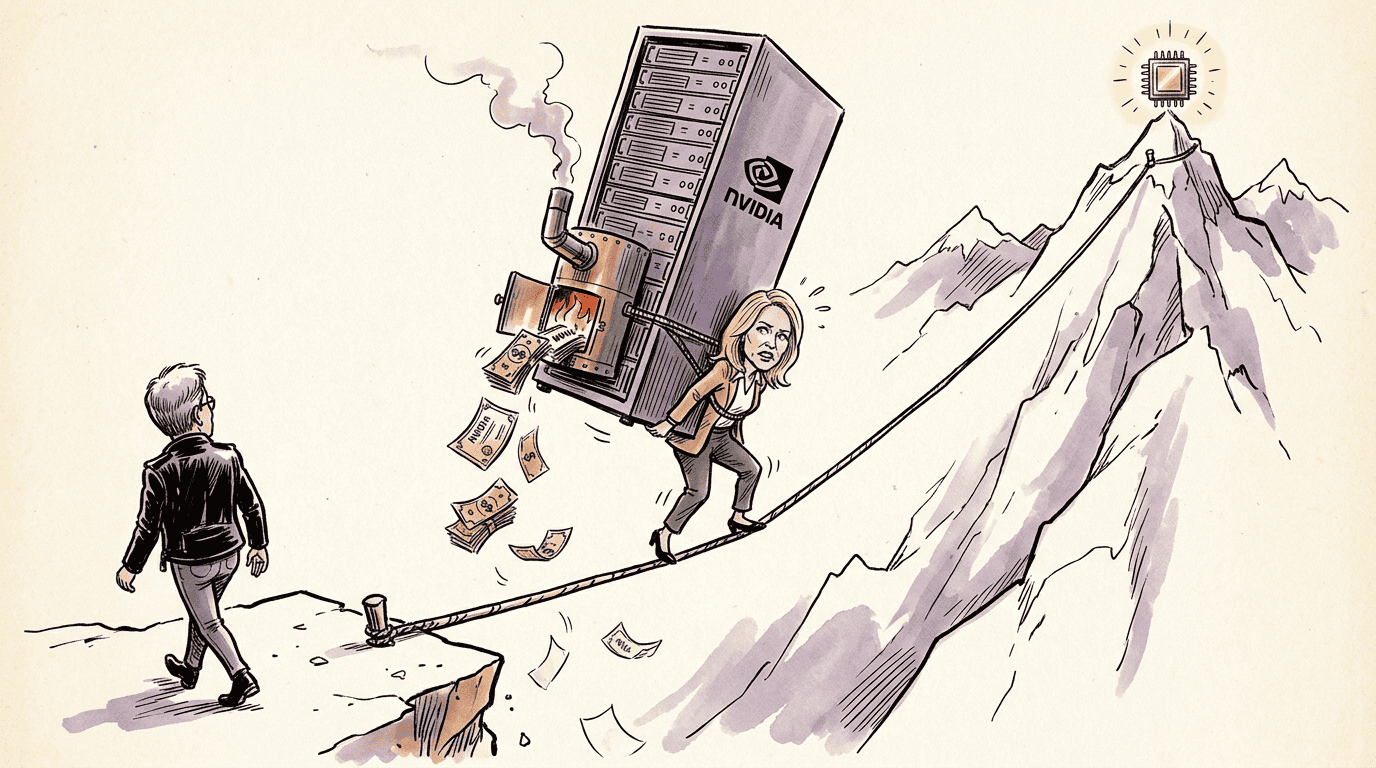
Will Nvidia continue financing the companies buying its chips?
Guidance: Who is going to pay for all those chips?
During the earnings call, Kress was asked about Nvidia’s willingness to help finance its customers. Here is where the changes are beginning.
Nvidia will continue supporting some of its established customers, but will become more selective of which companies to finance going forward.
Now, why would a chipmaker need to help finance the companies buying its chips?
Building an AI data centre is expensive. You need the land, a building, cooling systems and enough electricity to run thousands of GPUs. All of that needs to be paid for before the data centre can start selling computing power.
For smaller cloud providers that do not have the cash of Microsoft or Google, that often means borrowing money or raising it from investors.
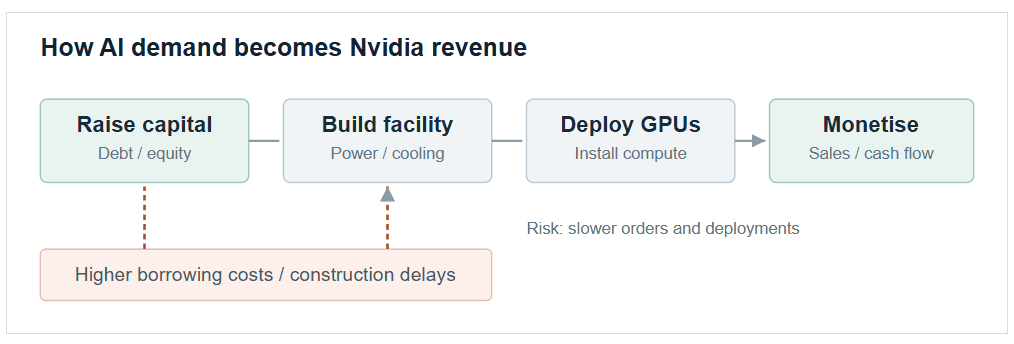
One way Nvidia has helped is by providing financial guarantees. These can make lenders more comfortable financing certain projects.
Kress clarified that certain guarantees only come into effect once the data centres are operational, meaning that their facilities are already built and running.
While she insists this is not a change in policy, her emphasis on being more selective about future financing is interesting.
Under Jensen Huang, Nvidia actively used its balance sheet to help fund the AI boom. If Kress takes a more conservative approach, could that inadvertently slow the very growth she is promising investors?
Being more selective is arguably good for Nvidia’s balance sheet. But if some of its customers were relying on that financial support to expand, being stricter could also slow their spending. And that is the risk that investors might be pricing in now; how quickly Nvidia can deliver the growth it just promised with this new conservative tone.
Jensen’s work is still paying off
There is one more thing to keep in mind. Nvidia’s latest quarter ended on 25 October. Jensen Huang stepped down on 12 November.
Much of the revenue being celebrated today is the result of the business, products and customer relationships built while Jensen was still CEO.
The board will consider both internal and external candidates for the permanent CEO role. It wants someone capable of navigating the technology business as well as increasingly complicated national security and trade issues.
Chairman Harvey Jones also said the board does not intend to reinstate Huang.
So for now, investors are effectively placing their faith in a business whose long-term plans were largely put in motion by Jensen, while waiting to see who will be responsible for carrying them out.
What does this mean for the Nasdaq?
The Nasdaq is structurally on the 50 weekly EMA. This has acted as, albeit not very clean, support in the past – as highlighted by the yellow circles in the chart.
If broken, the Nasdaq could fall lower. That’s where a more interesting level to watch kicks in: the Anchored vWAP support at 25,921, which is arguably a more important support level.
Personally, I think the Nasdaq is nearing a low. Tech stocks have already been heavily sold, and the index is trading at levels which has created pivotal price action before.
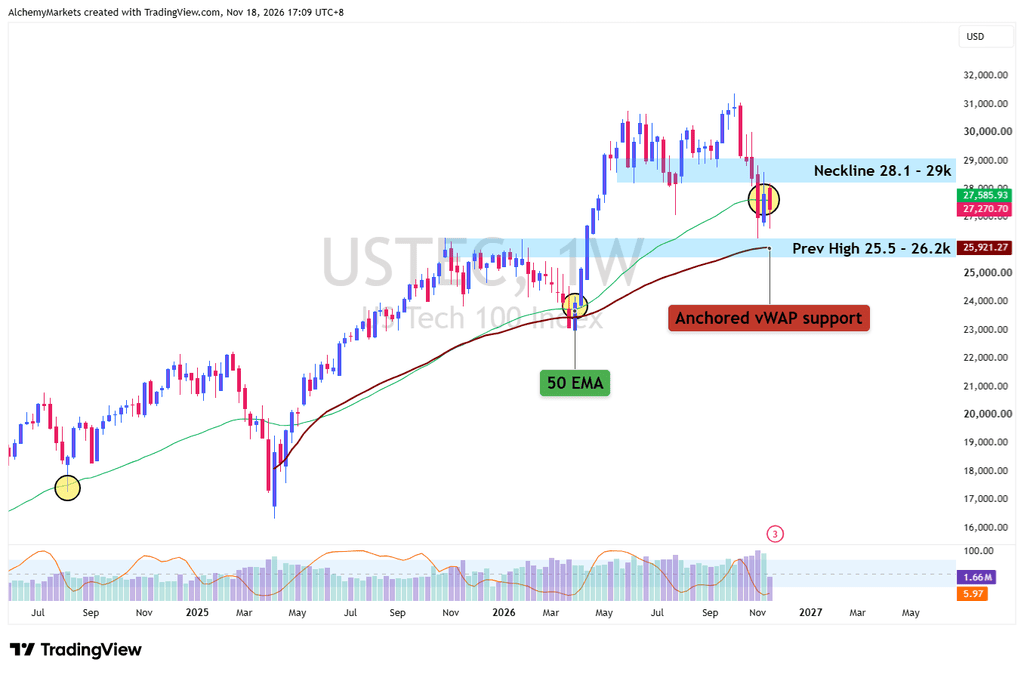
The catch is we don’t know if a dead cat bounce will follow this low, or if this is the beginning of a new multi-week rally.
Part of that risk comes from a potential Double Top pattern on the VanEck Semiconductor ETF (SMH) chart.
This index is a basket of 25 major AI hardware and semiconductor stocks, with Nvidia leading at the helm as its largest holding at roughly 17.4% of the fund.
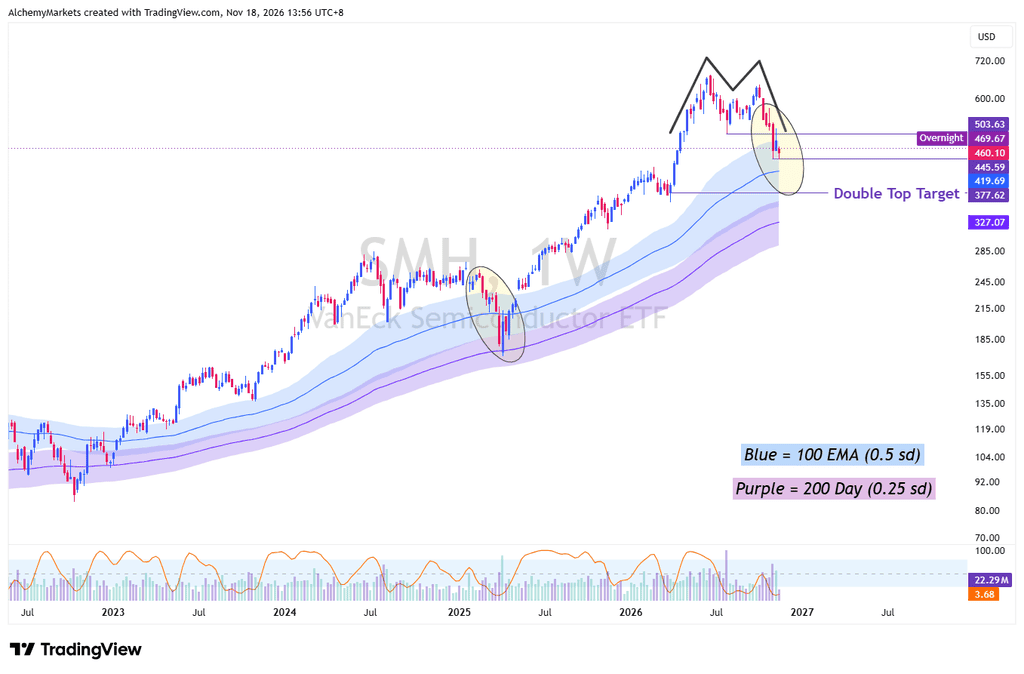
Technically, semiconductors are already in a downtrend. So, a rally from here could simply just be a retest of the neckline resistance at 503.63 and continue the decline towards 377.62.
Should $445.59 give way, that would induce a headwind on the Nasdaq, as the index’s rally is very much accredited to AI hardware stocks.
On the other hand, Nvidia’s earnings could still turn out to be the catalyst that the semiconductor sector needed. I would start taking that idea more seriously if Nvidia can break and hold above its 4H resistance around $164–170, and SMH can reclaim $503.63.