Written by:

Reviewed by:

- March 7, 2026
- 24 min read
CFD Trading: What are CFDs in Trading and How Do They Work?
Did you know that in financial markets you can trade price movements without owning the underlying asset?
With CFDs, traders can look to profit in both rising and falling markets using buy and sell orders.
One of the reasons CFDs attract attention is leverage. It allows traders to control a larger position with a smaller amount of capital, effectively increasing buying power. However, leverage amplifies losses as well as gains, which means risk management becomes essential from the outset.
In this guide, you will learn how CFD trading works, how traders use it in practice, and the key factors to understand before getting started, helping you decide whether this approach is right for you.
What Is a Contract for Differences (CFD)?
A contract for difference (CFD) is an over-the-counter derivative contract between a trader and a CFD provider. It settles the difference between the opening and closing price of a position.
In simple terms, a CFD allows traders to speculate on the difference in price of an asset between entry and exit without owning the underlying asset. This difference in price determines whether the trade results in a profit or loss.
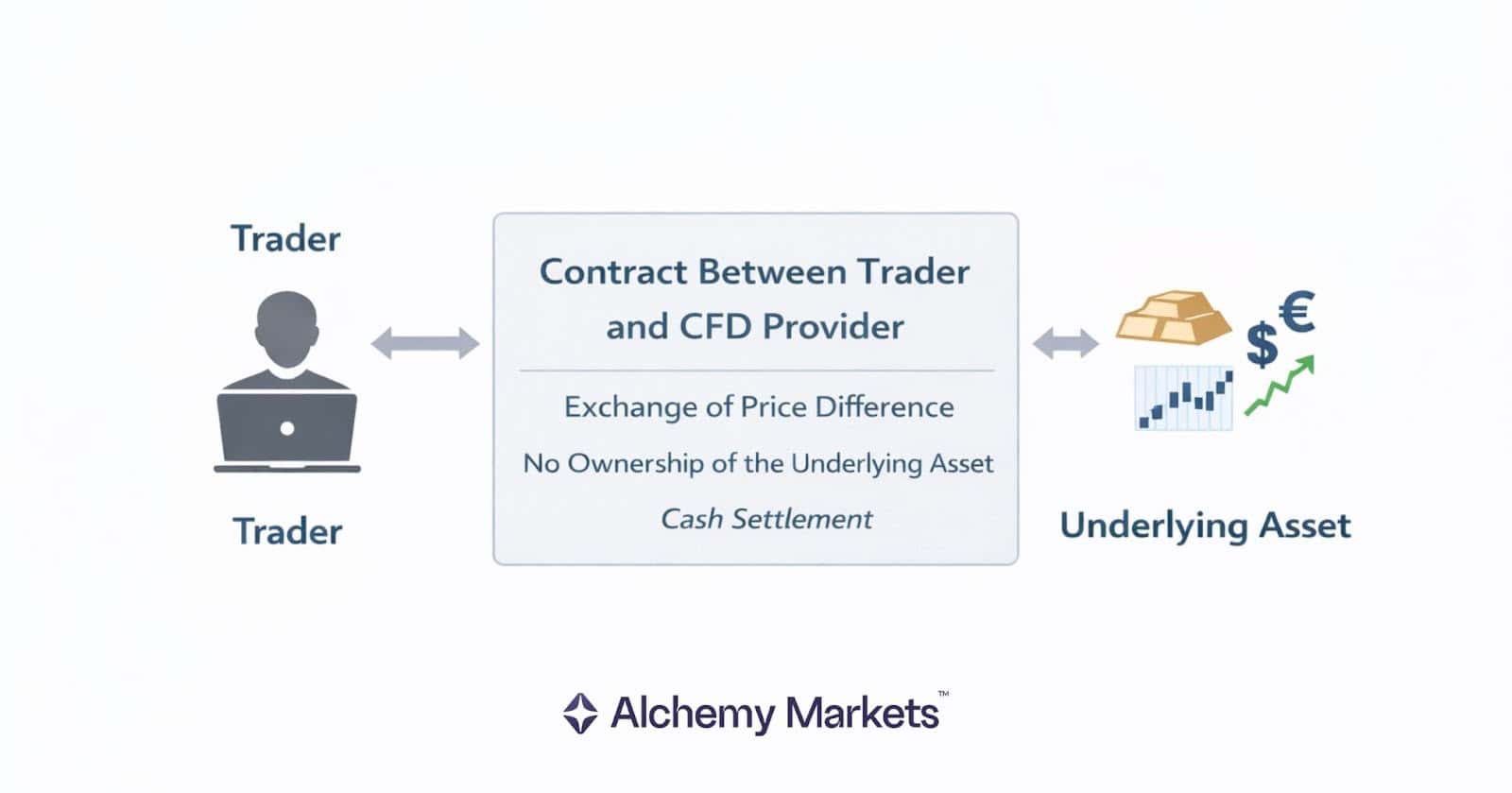
If the market moves in the trader’s favour, the price difference results in a profit. If it moves against the position, the same movement produces a loss.
CFDs track an asset’s price movement without transferring ownership of the underlying asset. Unlike traditional investing, there is no exchange of the underlying instrument, only cash settlement through the brokerage account.
CFDs provide access to markets such as currency pairs, indices, stock shares, commodities, and other financial markets. Common CFD markets include forex, gold, silver, and oil, alongside stock indices and cryptocurrencies.
Key characteristics of CFD trades:
- No ownership of the underlying asset
- Profit or loss determined by the difference between opening and closing trades
- Ability to buy or sell depending on market direction
- Trading conducted through OTC CFD providers
This structure allows exposure to underlying markets through price movements rather than asset ownership, while introducing counterparty risk between the trader and the provider.
Understanding Contract for Differences (CFD)
In practice, a CFD position is opened by selecting a market, choosing an order type, and defining the position size. The trade is executed at the broker’s displayed bid or ask price.
CFD providers quote two prices:
- Bid price – the price at which the trader can sell
- Ask price – the price at which the trader can buy
- Spread – the difference between the bid and ask, representing part of the trading cost
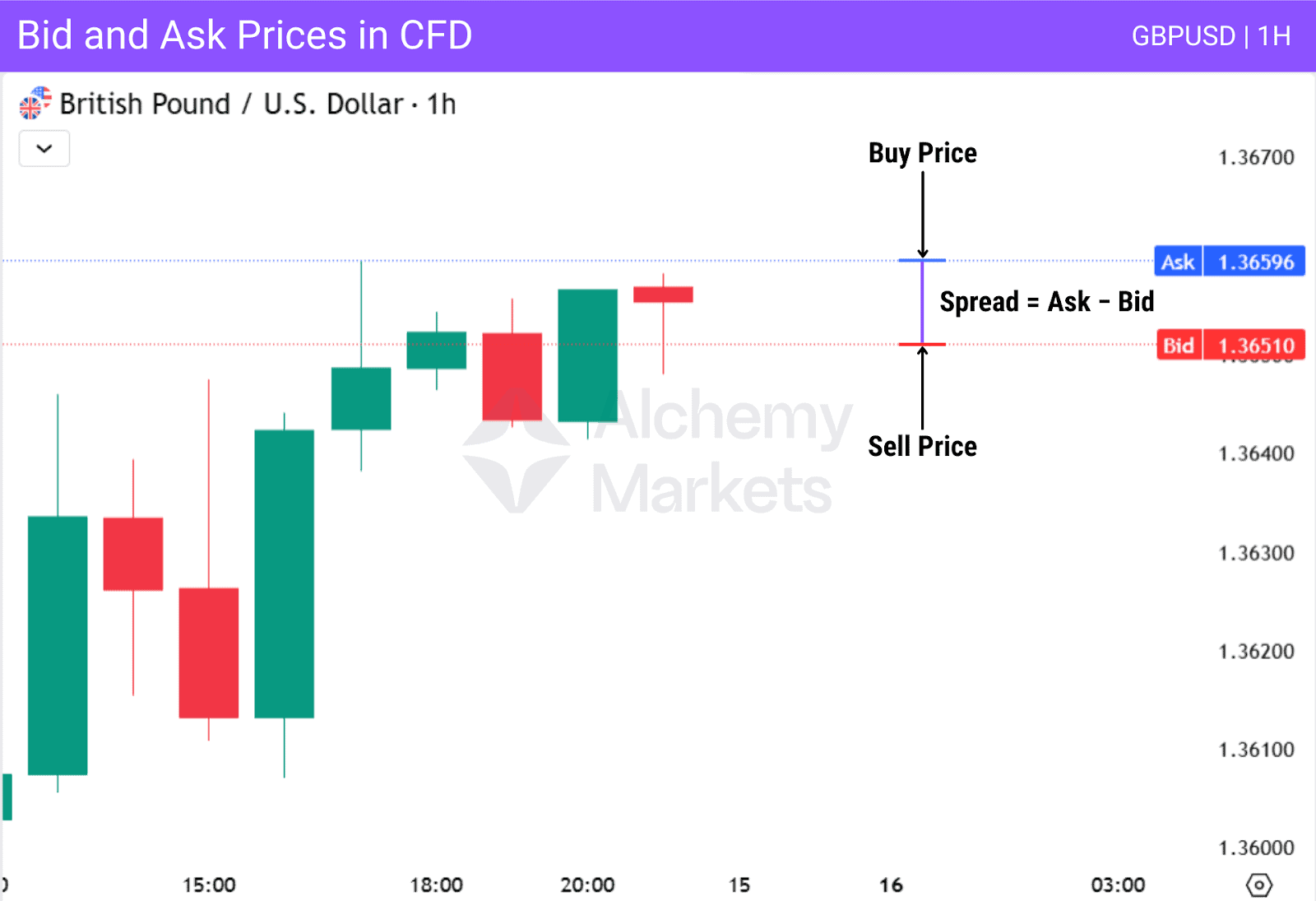
These prices are derived from the underlying market’s current price but are provided directly by the CFD provider. Because CFDs are traded over the counter rather than through a central exchange, spreads, execution conditions, and margin requirements may differ between providers.
When the position is closed, profit or loss is calculated as the difference between the opening and closing price, multiplied by the position size.
During volatile market conditions, spreads may widen and execution may occur at less favourable prices, which can increase overall trading costs.
Leverage in CFDs Trading Explained
One of the defining features of CFD trading is leverage. It gives traders greater buying power, allowing them to open larger position sizes than their account balance alone would normally permit.
Instead of paying the full value of a position, only a portion of the trader’s existing account balance is allocated as margin to open the trade. The position itself is based on the full contract size, which is why price movements have a significant impact on profits and losses.
Leverage works in both directions:
- If the market moves in the trader’s favour, potential profits increase
- If the market moves against the position, losses increase at the same rate
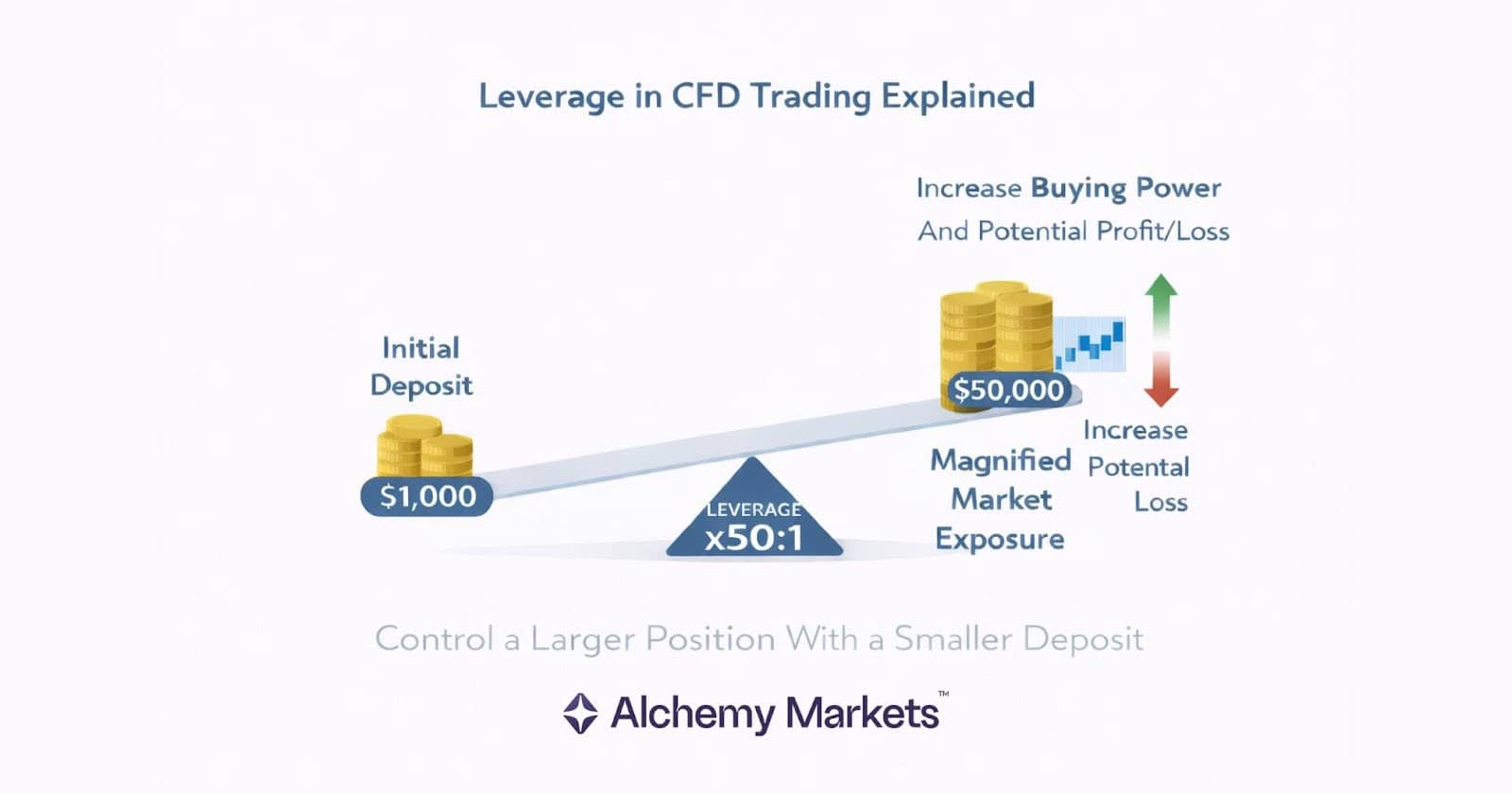
Because profits and losses are calculated on the full position size rather than the margin allocated, even small price movements can significantly affect account equity. For this reason, leveraged trading is considered high risk.
In trading terms, leverage can be expressed as:
| Leverage = Total Position Value ÷ Margin Used |
For example, controlling a $10,000 position with $500 of margin represents 20:1 leverage.
Key Points About Leverage:
- It increases market exposure, not the probability of profit
- It applies equally to gains and losses
- Profits and losses are calculated on the full position size
- It may result in losses exceeding the initial margin, depending on market conditions and whether negative balance protection applies
Leverage limits vary by asset class and regulatory jurisdiction. Retail traders are typically subject to capped ratios, while professional clients may access higher leverage depending on the provider.
Leverage should be viewed as a capital-efficiency mechanism, not as a method for maximising returns.
Margin in CFDs Explained
Leverage operates through margin trading. Margin is the portion of the trader’s account balance that is set aside to open and maintain a leveraged position. It acts as collateral for the exposure taken.
There are two main margin concepts:
Initial Margin
Initial margin is the amount required to open a CFD position. It is usually expressed as a percentage of the total position value.
For example, a 10% margin requirement means the trader must have 10% of the full contract value available in their account to open the trade.
This relationship can also be expressed as:
| Margin Requirement (%) = 1 ÷ Leverage |
The higher the leverage, the lower the margin required.
Maintenance Margin
Once a trade is open, the account must maintain sufficient equity to support the position.
If losses reduce account equity below the required level, a margin call may occur. If additional funds are not added, the provider may automatically close positions to limit further losses.
The Link Between Margin and Leverage
- Higher leverage means lower initial margin
- Lower margin increases the impact of price movements on account equity
Effective margin management is critical. Excessive leverage and poor margin control are among the primary reasons retail traders experience substantial losses.
How Do Contracts for Differences (CFDs) Work?
CFDs track the price movement of an underlying market and settle the difference between the entry and exit price of a position.
When a trader opens a position, profit or loss is calculated from the difference between the entry price and the exit price, multiplied by the position size. The exit may occur manually or through predefined stop-loss or take-profit levels.
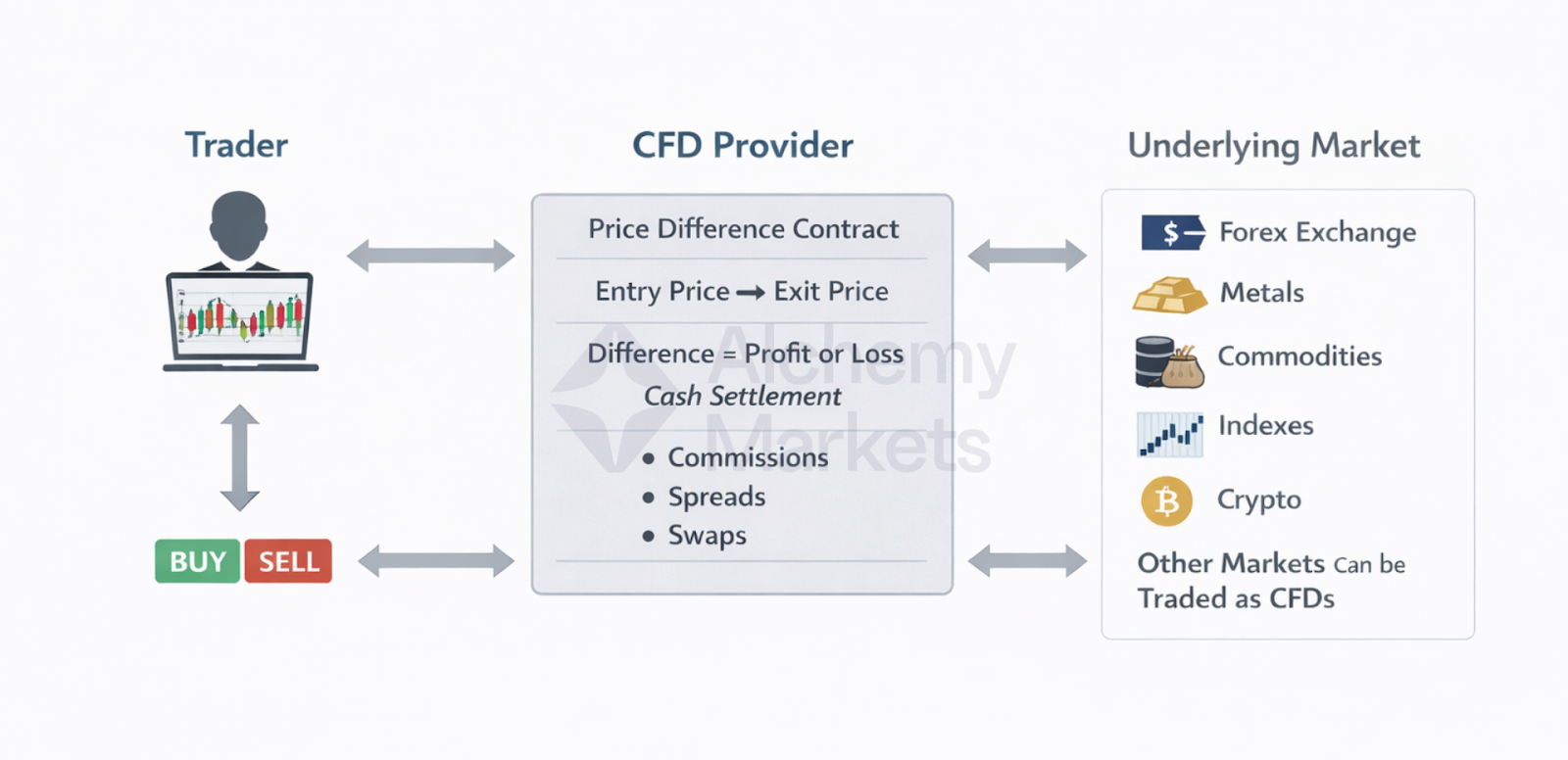
How CFD Trading Works
When opening a CFD trade, the trader decides:
- Which market to trade
- Whether to go long (buy) or short (sell)
- The position size (number of contracts or units)
Most CFDs do not have a fixed expiry date. Positions remain open until the trader closes them manually, until price reaches a stop-loss or take-profit level, or until they are closed automatically due to insufficient margin.
This flexibility allows the CFD trader to react to short-term price movements or hedge existing exposure. However, holding positions for an extended period may result in additional costs.
CFD Example
Let’s look at a practical example using the EUR/USD pair on the 4-hour timeframe, traded as a CFD with defined entry, stop-loss, and take-profit levels:
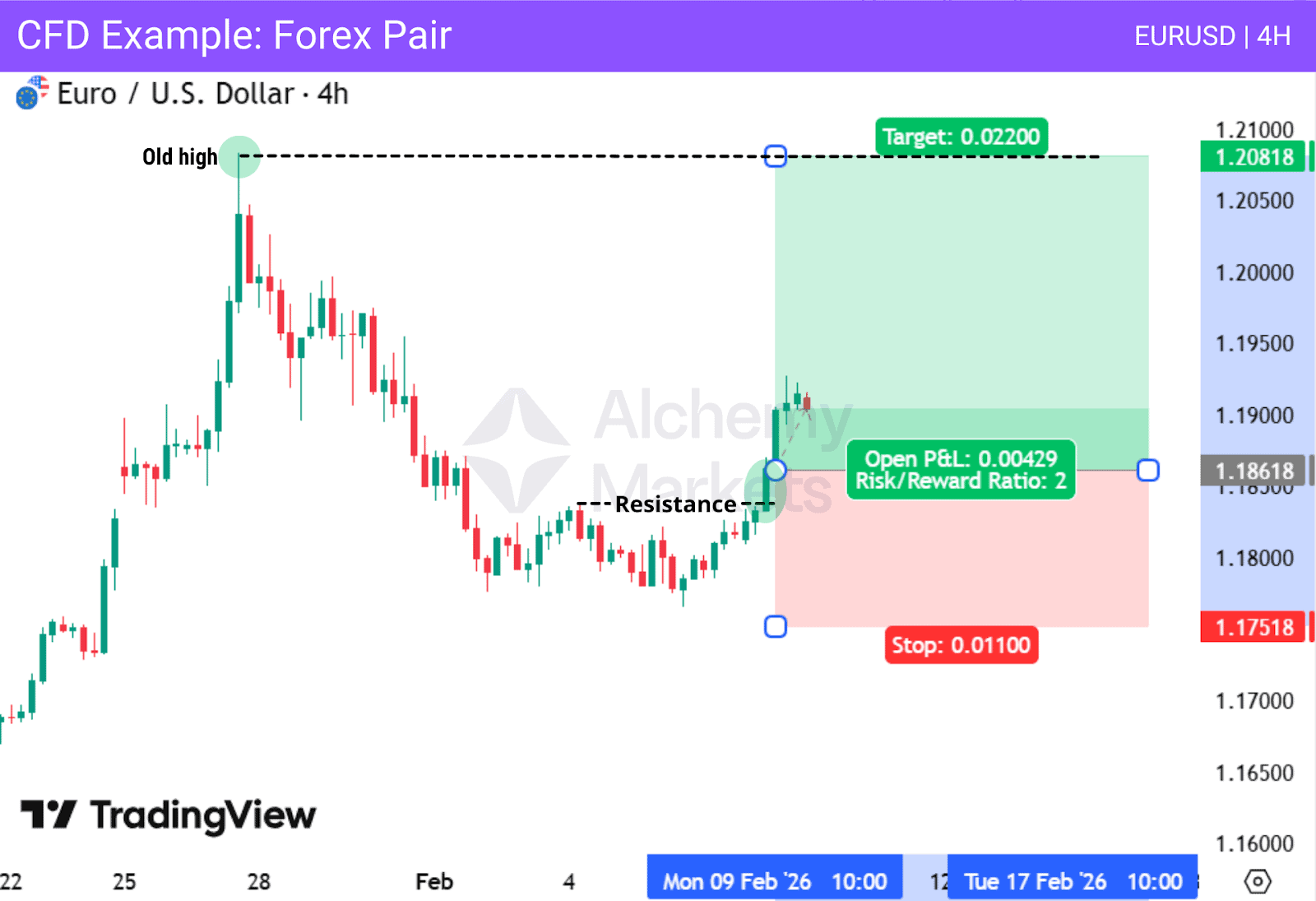
There are at least two possible scenarios for this trade:
- If price moves to the stop-loss level:
The position is closed after a 110-pip adverse move. With a position size of 0.10 lot, where each pip in EUR/USD is worth approximately $1, this results in a $110 loss. - If price moves to the take-profit level:
The position is closed after a 220-pip favourable move. Using the same 0.10 lot size, the gain equals $220, reflecting a 1:2 risk-to-reward ratio, where the potential reward is twice the predefined risk.
This example shows how pip distance and position size together determine the final outcome of a CFD trade. Leverage affects the margin required to open the position, but it does not change the size of the profit or loss.
CFD Regulations by Country
CFD trading is regulated differently across jurisdictions. In many countries, CFDs are classified as leveraged derivative products and are subject to specific investor protection rules.
Regulatory frameworks typically focus on limiting retail risk rather than promoting participation.
Common measures include:
- Leverage limits for retail traders
- Mandatory standardised risk warnings
- Negative balance protection
- Margin close-out rules
- Restrictions on marketing and promotional incentives
Because regulatory treatment evolves, traders should always verify the current position with their local financial authority before opening a CFD account.
Countries Where You Can Trade CFDs
CFDs are available in many parts of the world, but there is no single global standard. Access depends on local financial regulation, not on where a broker is based or how a platform is marketed internationally.
In regions where CFDs are allowed, regulators usually prioritise retail protection through leverage limits, margin controls, and transparency requirements.
CFDs are available in:
| United Kingdom Permitted through firms authorised by the Financial Conduct Authority, with capped leverage and mandatory retail protections. |
| European Union / EEA Available under ESMA aligned rules implemented by national regulators, including leverage limits and negative balance protection. |
| Australia Permitted under ASIC supervision with structured retail leverage caps and compliance requirements. |
| Canada CFDs are available through investment dealers regulated by provincial securities authorities and overseen nationally by the Canadian Investment Regulatory Organization (CIRO). |
| Middle East In certain jurisdictions, CFDs are accessible through locally licensed or internationally regulated brokers, depending on national oversight frameworks. |
| Africa and Latin America Access exists in parts of these regions, often via internationally regulated providers. Regulatory protections differ between countries. |
| Other Regions In parts of Asia, including Singapore, Hong Kong and Japan, as well as in Russia, CFD trading may be permitted through firms authorised by the country’s financial regulatory authority. |
In other jurisdictions, regulators do not formally authorise retail CFDs and instead issue warnings regarding offshore providers operating without local approval.
Countries Where CFDs Are Restricted or Accessed Through Offshore Providers
In some jurisdictions, CFDs are not widely authorised as a domestic retail product. Retail traders may access CFDs primarily through offshore or internationally regulated brokers rather than locally licensed providers.
This includes:
- Brazil
- China
- Malaysia
Regulatory treatment in these countries may limit domestic distribution, marketing, or licensing of CFD providers. Access through offshore brokers may not provide the same level of local investor protection.
Countries Where CFDs Are Banned for Retail Traders
In some jurisdictions, retail CFD trading is prohibited under domestic financial regulation. These bans are generally based on concerns related to leverage, investor protection, and speculative risk.
Examples of countries where CFD trading is banned:
- United States
- Belgium
How to Check If CFDs Are Allowed in Your Country
CFD regulation varies by jurisdiction and can change over time. The most reliable approach is direct verification with your national financial regulator.
A practical method includes:
- Identifying your country’s official financial authority
- Reviewing published guidance on CFDs or contracts for difference
- Confirming whether retail trading is permitted and under what conditions
- Checking whether brokers must hold local authorisation and what investor protections apply
Relying solely on general country lists can be misleading. Regulatory detail matters, particularly when trading leveraged products.
The Costs of CFDs
While CFDs offer flexibility and leverage, they also involve trading costs that directly affect performance. These costs vary depending on the broker, account type, asset traded, position size, and market conditions.
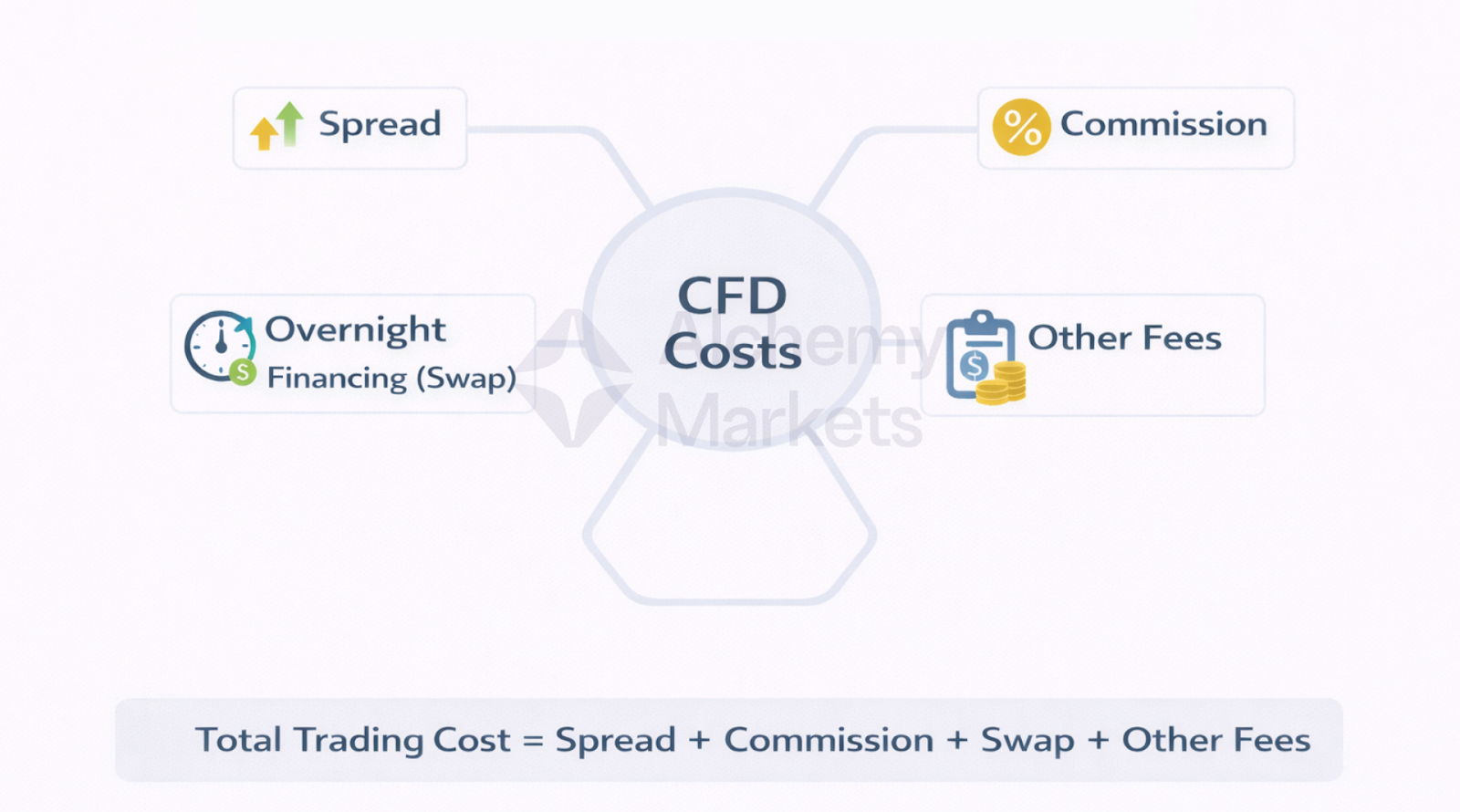
Trading style
Trading style influences overall cost exposure. Scalping can generate higher cumulative spread and commission costs due to frequent entries and exits, while swing or position trading may incur higher overnight financing charges when positions are held for multiple days.
Spread
The spread is the difference between the buy and sell price of a CFD. It represents an immediate trading cost and is paid when entering a position. Spreads may widen during low-liquidity periods or major news events, increasing the total cost of execution.
Commission
Some CFD instruments, particularly share CFDs, include an additional commission charged per trade. This fee is separate from the spread and is typically calculated based on trade size or notional value.
Overnight Financing (Swap)
Positions held overnight usually incur financing charges, known as swaps. These are applied daily and may increase over weekends or public holidays.
Swap-free accounts remove overnight financing but may apply alternative pricing adjustments.
Other Potential Costs
Depending on the broker and account structure, additional fees may apply, including:
- Currency conversion fees
- Guaranteed stop-loss premiums
- Account maintenance or inactivity fees
Understanding how these costs interact with trading frequency and position size is essential. Even small charges can meaningfully impact long-term results, particularly in leveraged trading.
How Can I Get Started Trading CFDs?
To begin trading CFDs, the first step is opening an account with a regulated broker. Most providers offer both demo and live accounts, allowing traders to become familiar with the platform before committing real capital.
How to Choose a CFD Broker
- Examine the broker’s regulation and any protection’s they might offer. For example, some jurisdictions require negative balance protection
- Examine the broker’s margin requirements and margin close out policies
- Examining trading conditions, including spreads, commissions, swaps, and leverage limits
- Review the broker’s regulatory status, execution quality, platform reliability, and customer support
- Selecting a regulated CFD broker and completing registration and identity verification
Once you’ve identified a CFD broker to use, open a practice demo account and develop a clear trading strategy. Backtest and forward test the strategy in the demo account.
Depositing funds into a live account once risks and costs are clearly understood and choose markets and position sizes based on experience and risk tolerance
Before placing live trades, it is essential to understand how margin, leverage, and trading costs affect potential outcomes. Having a structured trading strategy and a defined risk management plan is equally important.
CFD Trading Strategies
CFD trading strategies focus on how to enter and exit trades to profit from price fluctuations in a market. There are many approaches available, typically based on technical analysis, fundamental analysis, or a combination of both.
However, long-term profitability is not only about the strategy; it is about the combination of a winning strategy, discipline, and strict risk management.
Below are the most common approaches used when trading CFDs:
Short Selling CFDs
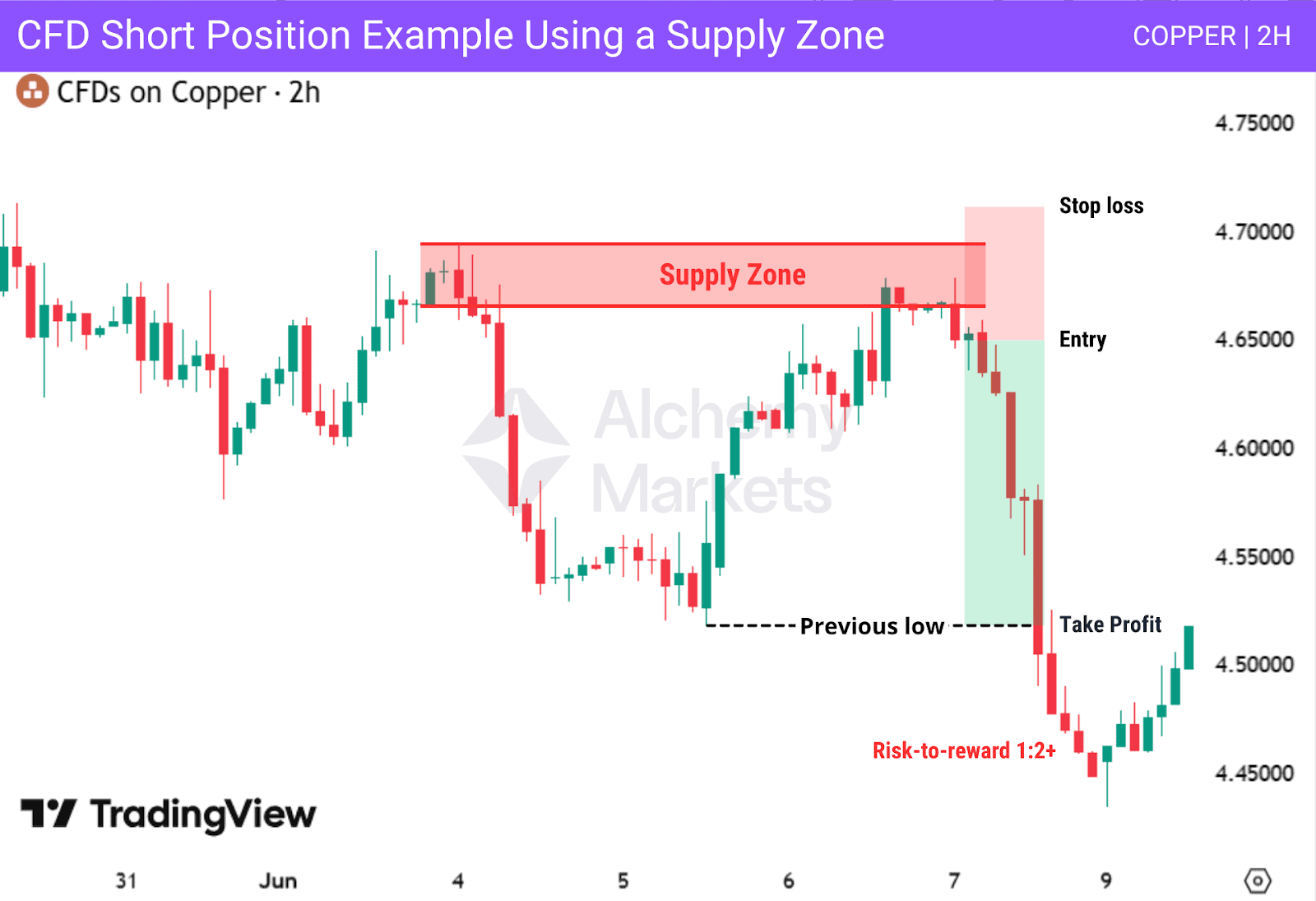
Short selling in CFD trading means opening a short position when a trader expects the price of an asset to decline. Instead of buying first, the trader sells the CFD and aims to close the position later at a lower price.
In CFD trading, short positions can be opened using different order types, depending on how the trader wants to enter the market:
- Sell market order – selling immediately at the current market price
- Sell limit order – selling at a predefined level (or better) above the current market price
- Sell stop order – selling at a predefined level below the current market price
The decision to short an asset can be based on technical analysis, fundamental analysis, or a combination of both:
From a technical perspective, traders may look for signs of weakness such as price rejecting from a resistance or supply zone, a clear break below support, bearish candlestick patterns or respecting a down trendline.
These signals can suggest that buying pressure is fading and that price may continue lower.
From a fundamental perspective, short positions may be considered when economic data is weaker than expected or negative news reduces confidence in the asset. Falling interest rates can also affect markets, especially currency pairs.
Going long on CFDs
Going long means opening a position when the price of an asset is expected to rise, with the intention of closing it later at a higher level.
Long positions can be opened using different order types:
- Buy market order – execute immediately at the current price
- Buy limit order – enter at a predefined level below the current market price
- Buy stop order – enter once price breaks above a specified level
From a technical perspective, traders may look for signs of strength such as price rejecting a support level, breaking above resistance, bullish candlestick patterns or continuing to respect a rising trend line.
From a fundamental perspective, long positions may be considered when economic data is stronger than expected, interest rates are rising, or positive news improves confidence in the asset.
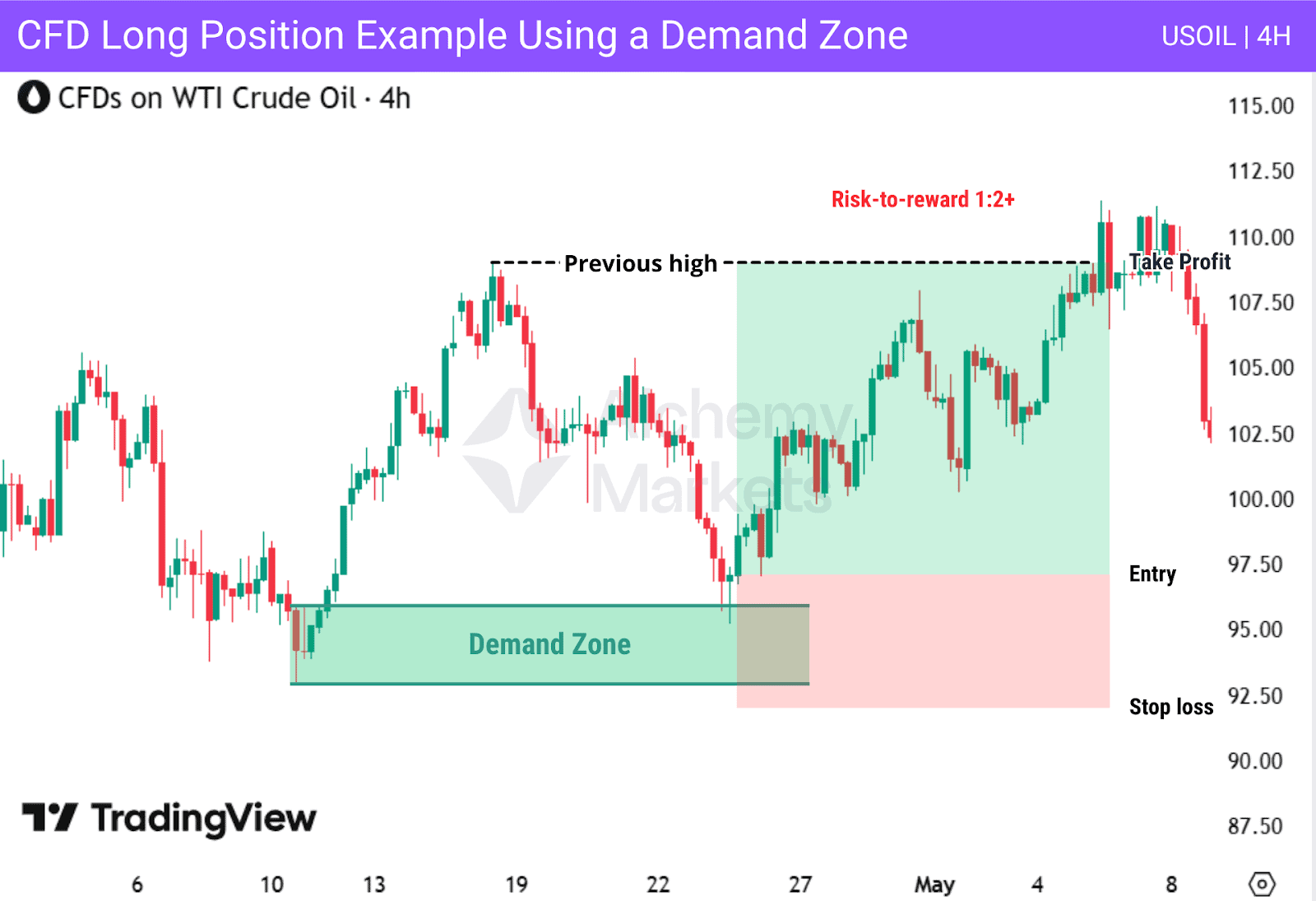
Leveraged trading with CFDs
Leverage is a core feature of CFD trading because it allows larger positions to be controlled using a small amount of capital. Instead of paying the full value of the underlying asset, only a portion of the position value, known as margin, is required.
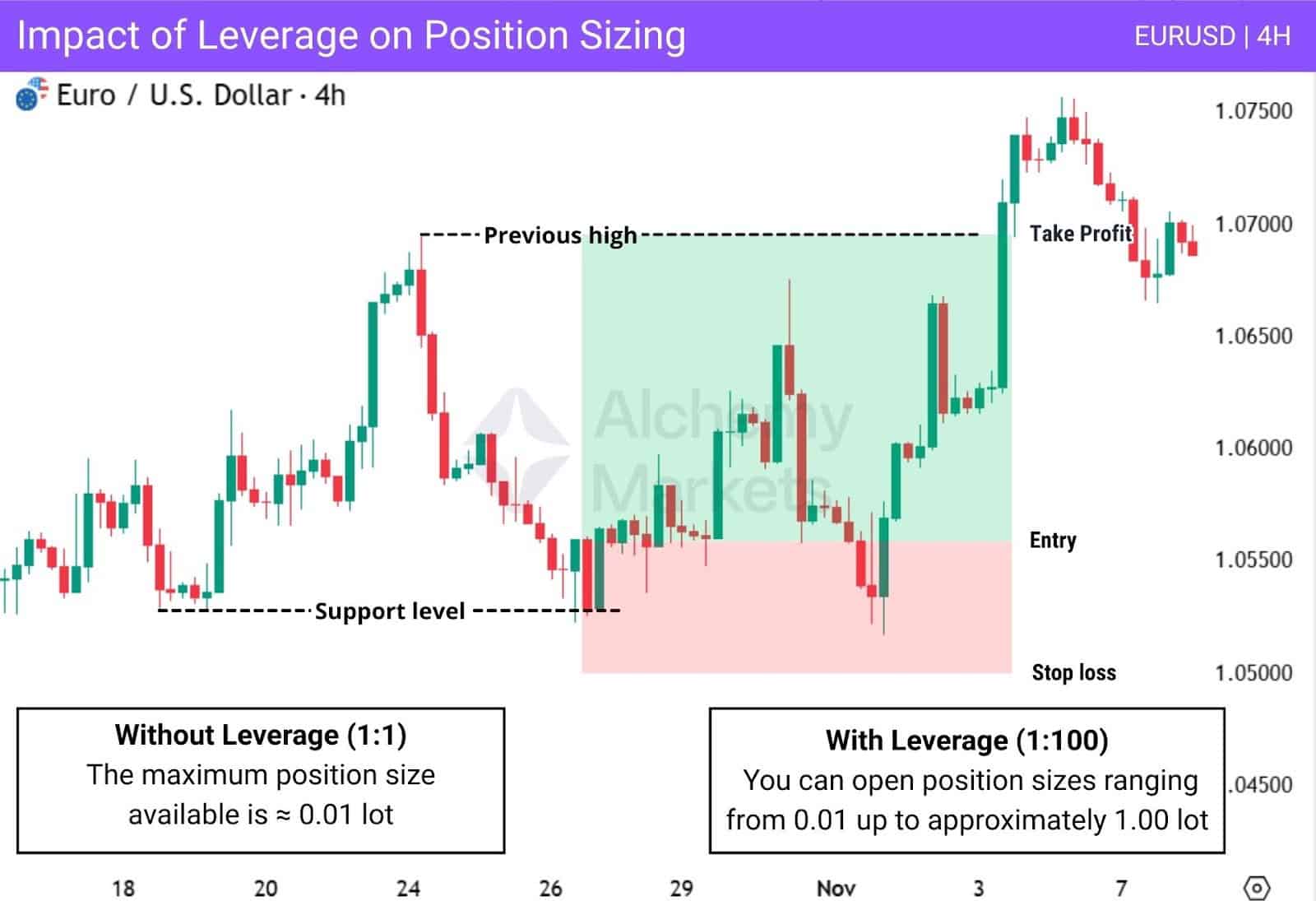
To illustrate, consider a $1,000 account trading EUR/USD:
| Without leverage (1:1): The full position value must be covered. With $1,000, the maximum position size is approximately 0.01 lot, since one standard lot represents 100,000 currency units. In this case, position size is limited to the available capital. |
| With 100× leverage: The same $1,000 account can control significantly larger positions. Depending on margin requirements and the current EUR/USD price, position sizes may range from 0.01 lot up to approximately 1 standard lot (0.01 x 100 = 1.00 lot size). |
This highlights an important principle: leverage increases the maximum position size available, but it does not determine risk per trade. Losses are applied directly to trading capital, meaning leverage amplifies both gains and losses.
For this reason, leverage should be used cautiously and combined with strict risk management. Many traders limit risk to 0.5%–1% per trade and rarely exceed 2%, regardless of available leverage.
Hedging with CFDs
CFDs are commonly used as hedging tools. Hedging involves opening a CFD position to offset potential losses in another investment.
This can be applied to the same asset (direct hedge) or to a negatively correlated asset (cross-asset hedge), depending on the objective and market conditions.
CFD hedging may be used for:
- Reducing short-term drawdown exposure without selling long-term holdings
- Managing risk during periods of high volatility
- Protecting portfolios around earnings releases or major macroeconomic events
- Temporarily adjusting overall portfolio exposure
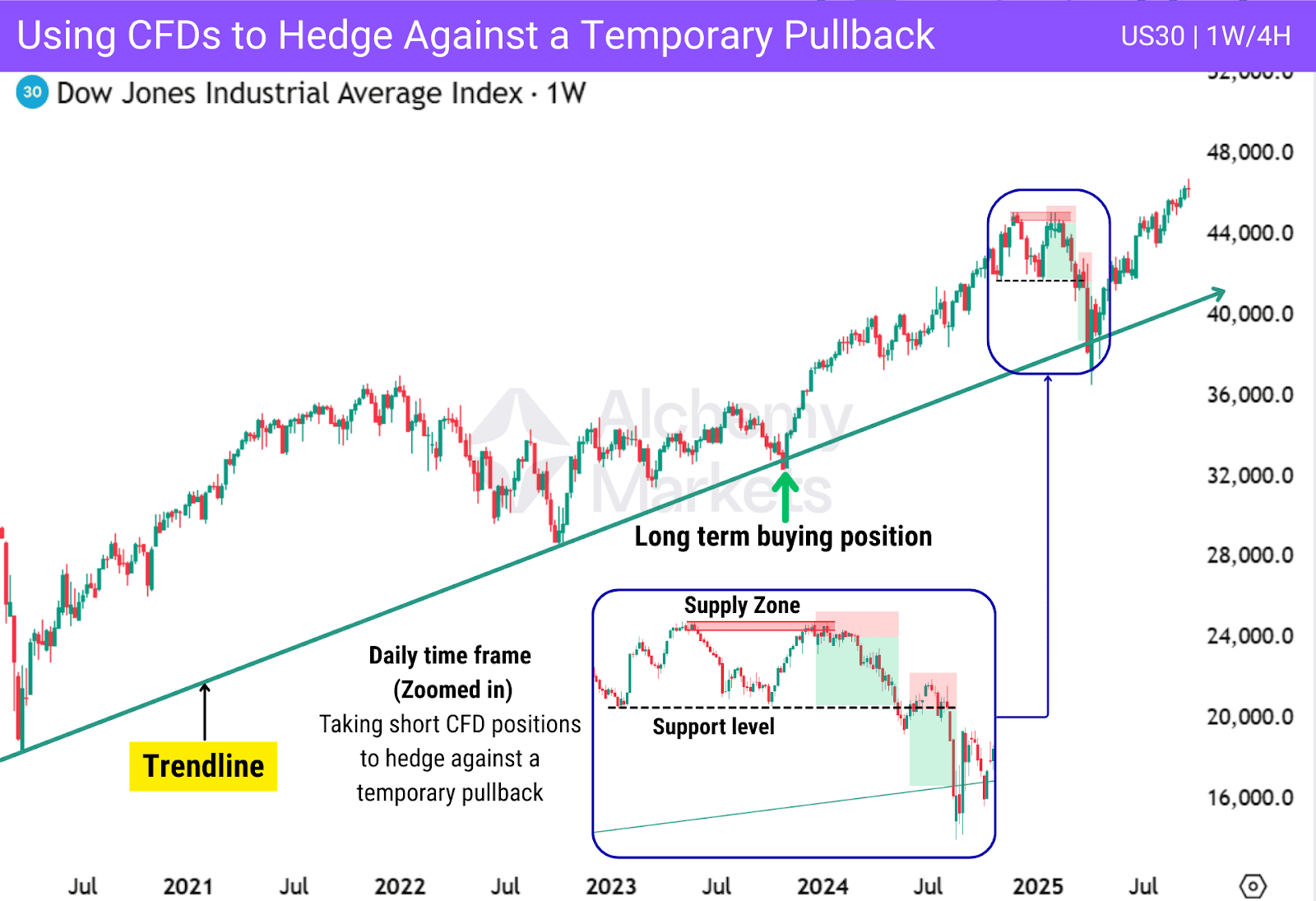
You can see in this example a hedge applied to the Dow Jones Industrial Average (US 30). A long-term position remains open, while short CFD positions are used during a temporary pullback to reduce overall market exposure.
This approach helps manage short-term downside risk without closing the core investment.
Day Trading with CFDs
Day trading is one of the most common ways CFDs are used in active markets. This approach involves opening and closing positions within the same trading day, often holding trades for minutes to several hours.
The objective is to capture short-term price movements without carrying exposure overnight.
Day traders typically focus on:
- Lower time frames such as 1-minute, 5-minute, 15-minute, or 1-hour charts
- Opening and closing trades within the same day
- High-volatility periods during London and New York sessions
Because positions are closed before the trading day ends, overnight financing charges are avoided. However, day trading requires fast decision-making, disciplined risk management, and consistent execution.
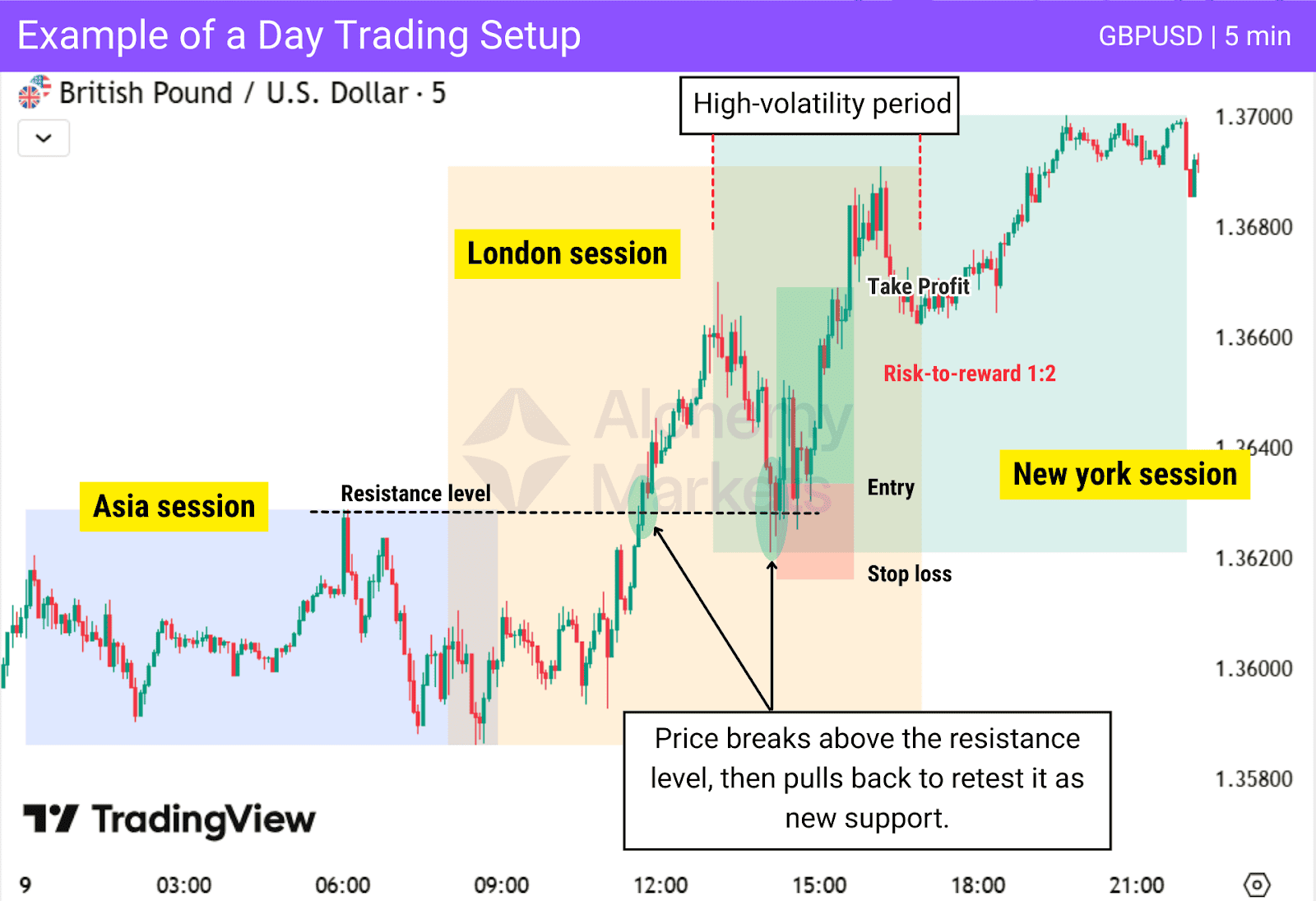
On the GBP/USD 5-minute chart, price establishes a clear resistance level during the Asian session, then breaks above it during the London session.
Within the high-volatility London–New York window, price pulls back to retest the former resistance as support and shows bullish rejection, confirming a strong long setup.
Advantages of CFDs
CFDs are often used by active traders because of the flexibility they offer across different markets.
Higher Leverage
With CFDs, traders can control a larger market position using a relatively small amount of capital. This improves capital efficiency, although it also increases exposure to risk and requires careful position sizing.
Access to Multiple Markets
CFD accounts can give access to forex pairs, global indices, commodities, shares, crypto. This makes it easier to shift focus between markets as conditions change, without needing separate brokerage accounts.
Ability to Trade Both Directions
CFDs allow traders to open long or short positions without borrowing the underlying asset. This means falling markets can be traded just as easily as rising ones.
Transparent Cost Structure
For many forex and index CFDs, trading costs are mainly built into the spread, making them visible at the time of execution. This allows traders to estimate transaction costs before entering a trade. Some instruments may also include commissions or overnight financing charges.
Fewer Structural Restrictions
Unlike traditional stock trading, CFDs do not involve ownership of the underlying asset. This removes requirements related to borrowing shares for short selling or complying with exchange-based settlement procedures.
As long as margin requirements are met and broker conditions allow, positions can be opened and closed freely.
Strategy Versatility
Because CFDs cover multiple asset classes and can be traded in both directions, they can be adapted to different approaches, whether short-term intraday trading or longer swing setups.
Disadvantages of CFDs
While CFDs offer flexibility, they also involve risks that should not be overlooked.
Spread and Financing Costs
Every trade includes a spread. During high impact news or outside peak trading hours, spreads may widen. Positions held overnight usually incur financing charges, which can affect overall profitability if trades are kept open for extended periods.
Over the Counter Nature
CFDs are traded over the counter rather than on centralised exchanges. Regulation exists in many jurisdictions, but protections vary depending on the regulatory framework and the provider.
Leverage Amplifies Risk
Leverage increases both potential gains and potential losses. Adverse market movements can reduce account equity quickly, particularly when large position sizes are used.
For this reason, CFDs are generally considered more suitable for traders who understand margin mechanics and risk management.
Contract for Differences (CFD) vs Futures Contract
CFDs and futures contracts are both derivative instruments, but they differ in structure, access, and practical use.
A futures contract is an agreement traded on an exchange, with a fixed expiry date and contract size. At expiry, it is settled either financially or through delivery, depending on the asset.
Futures are widely used by institutions and operate under exchange rules and margin requirements.
A contract for difference, by contrast, usually has no fixed expiry date. CFD positions remain open until the trader closes them or the provider closes them due to insufficient margin.
CFDs are traded over the counter and are designed to mirror the underlying market rather than represent a standard contract.
Key differences include:
- CFDs usually have no expiry date, while futures contracts do
- CFDs are accessed through providers, not exchanges
- Futures contracts are standardised; CFDs are provider-based
- CFDs are typically more accessible to retail investors
Both instruments involve leverage and market risk, but CFDs are often preferred for short-term trading due to their flexibility and lower capital requirements.
Going Long vs Going Short in CFD Trading
CFD trading allows traders to profit from both rising and falling markets.
When going long, the trader buys a CFD because they expect the market price to rise. If the price increases, the position generates a profit. If the price falls, the position results in a loss.
When going short, the trader sells a CFD because they expect the market price to fall. If the price declines, the trader profits. If the price rises, the position incurs a loss.
Both approaches follow the same mechanics:
- Positions are opened at the buy price or sell price
- Profits and losses are determined by the price movement
- Trades are closed by taking the opposite action
This flexibility is one of the defining features of CFD trading and allows traders to adapt to different market conditions without borrowing the underlying instrument.
Spread Betting vs CFD Trading
Spread betting and CFD trading share many similarities, but they operate differently.
With CFD trading, traders buy or sell contracts that track the price of an underlying market. Profits and losses are calculated from the difference between the opening and closing price, multiplied by the position size.
With spread betting, traders speculate on whether a market will rise or fall by staking a fixed amount per point of movement. Profit or loss depends on how far the market moves in the chosen direction.
Key distinctions include:
- CFDs are contracts; spread betting is structured as a wager
- CFD profits may be subject to capital gains tax depending on jurisdiction
- Spread betting may have different tax treatment in certain regions
Both products involve leverage and carry significant risk. The choice between them depends on regulatory availability, tax rules, and personal trading preferences.
What Assets Can You Trade with CFDs?
CFDs provide access to a wide range of financial instruments across global markets. At Alchemy Markets, traders can access multiple asset classes through CFD markets, including:
- Forex pairs: Over 80 currency pairs, covering major, minor, and exotic markets
- Index CFDs: Major global indices such as the S&P 500, Dow Jones (DJIA), Nasdaq 100, DAX, and others
- Share CFDs: Global companies including Tesla (TSLA), Microsoft (MSFT), and other leading stocks
- Commodity CFDs: Gold, silver, crude oil, natural gas, and copper
- Crypto CFDs: Over 60 cryptocurrency CFDs, including Bitcoin (BTC), Ethereum (ETH), and Solana
This range allows traders to diversify strategies, adapt to different market conditions, and focus on assets that align with their trading knowledge and risk tolerance.
Why Trade with Alchemy Markets?
Alchemy Markets is a regulated broker providing access to CFD trading across global markets, supported by advanced tools, platform infrastructure, and execution technology designed to assist trader decision-making.
Key features include:
Advanced AI Technology at Its Core
Alchemy Markets integrates AI-powered analytical tools through Trading Central, offering technical insights, trade ideas, and real-time market analysis. These tools are designed to support structured decision-making while leaving strategy and risk management in the hands of the trader.
Trading on Margin
CFD trading at Alchemy Markets allows traders to access leveraged exposure across multiple asset classes. Margin trading enables positions to be opened with a smaller initial deposit relative to the full contract value, increasing both potential gains and potential risks.
Trading the Difference
At Alchemy Markets, CFDs allow traders to speculate on price movements without owning the underlying asset. Positions can be opened long or short, with profit or loss determined by the difference in price between entry and exit levels.
All-Round Trading Analysis
Alchemy Markets provides access to additional analytical resources, including FXBlue tools, VPS hosting for automated strategies, integrated research support, and copy trading solutions. These features aim to enhance analysis, execution efficiency, and overall trading workflow.
Alchemy Markets focuses on delivering infrastructure, liquidity access, and analytical support rather than promoting speculative outcomes, allowing traders to apply their own strategies within a structured trading environment.
FAQ
Why Are CFDs Illegal in the U.S.?
CFD trading in USA is not permitted for retail investors residing in the United States due to regulatory restrictions. U.S. regulators favour exchange-traded derivatives such as futures contracts.
Is Trading CFDs Safe?
CFD trading involves significant risks. Leverage can magnify losses, volatile markets can move quickly, and poor risk management can result in rapid drawdowns. CFDs are generally more suitable for traders who understand the risks involved.
Can You Make Money With CFDs?
It is possible to generate profits through CFD trading, but it requires disciplined risk management, market understanding, and realistic expectations. Many retail investors lose money when trading leveraged products.
How Do I Use CFDs for Hedging?
CFDs can be used to hedge existing positions by opening opposing trades. For example, a short CFD position may offset losses in a physical investment during short-term market declines.
Does a CFD Expire?
Most CFDs do not have an expiry date and remain open until closed. Some forward-style CFDs may have defined durations, depending on the provider and market.
What Is the Best CFD Timeframe?
CFDs are commonly used on short to medium timeframes because overnight financing costs can accumulate over longer holding periods. Day trading and short-term swing trading are typical approaches.
Are CFDs Better Than Forex?
In many jurisdictions, retail forex trading is offered through CFD contracts. Whether CFDs are better depends on the trader’s objectives, risk tolerance, and strategy.
Is CFD Trading Good for Beginners?
CFD trading can be accessible to new traders because it allows exposure to multiple markets with relatively small capital through margin trading. However, it’s only when the trader understands the basics of leverage, margin, and risk management, that CFD trading can become a sustainable venture. Beginners are recommended to start with a demo account before trading with real funds.
Why Is CFD Trading So Hard?
CFD trading is challenging because it combines leverage, market volatility, and emotional pressure. Success requires strong risk control, consistent execution, and realistic expectations.