Written by:


- Quarterly Forecast
- October 1, 2026
- 11 min read
Q4 2026 Equity Market Forecast: Can the Bull Market Broaden Into Year-End?
Global equity markets enter the final quarter of 2026 in an unusual position. Growth remains resilient, corporate earnings have generally held up well and artificial intelligence continues to support investment and earnings growth. At the same time, higher energy prices, persistent inflation and renewed central-bank tightening have increased the hurdle for equities.
Our base case for Q4 is therefore constructive, but increasingly selective.
We remain broadly bullish on the S&P 500, Nasdaq 100, Dow Jones and DAX. The FTSE 100 retains a more moderate positive bias, while the Russell 2000 offers potentially greater upside if financial conditions stabilise, but also carries considerably greater sensitivity to rates and credit conditions.
The central theme for the quarter is no longer simply whether equities can rise.
It is whether market leadership can continue broadening beyond the handful of mega-cap technology companies that dominated earlier phases of the rally.
Q3 2026: Resilience Despite Rising Macro Risks
Q3 was characterised by remarkably resilient equity markets despite a difficult macro backdrop.
US equities finished Q3 with solid year-to-date gains despite a weaker September. At the 30 September close, the S&P 500 was up around 11.8% year-to-date, the Nasdaq Composite 15.6%, the Dow Jones 5.9% and the Russell 2000 12.7%.
AI remained an important driver. The Nasdaq returned to record territory during September as enthusiasm surrounding AI monetisation and corporate earnings recovered following an earlier correction.
But Q3 also introduced a new complication.
US economic activity accelerated sharply into the quarter-end. September’s flash US Composite PMI rose from 56.0 to 58.4, its strongest reading since July 2021. Employment and demand strengthened, but cost pressures also accelerated, reinforcing the case for tighter monetary policy.
So markets enter Q4 facing a slightly different equation:
Stronger growth is supporting earnings, but stronger growth is also keeping inflation and interest rates higher.
Corporate earnings remain an important counterweight. Rather than experiencing the normal downward drift in estimates, analysts increased the S&P 500’s Q3 bottom-up EPS estimate by 1.2% during July and August, while the full-year 2026 estimate increased 6.1%.
This creates our central Q4 tension:
earnings momentum versus higher discount rates.
S&P 500: Bullish – 8,000 Comes Into View
Of the major indices, the S&P 500 continues to offer the strongest all-round fundamental setup.
US economic growth remains strong, earnings expectations are rising and AI investment continues to support technology and infrastructure spending. Importantly, however, leadership appears capable of broadening into industrials, financials, energy and other cyclical areas.
BlackRock’s Q4 outlook similarly argues that strong earnings and AI investment remain supportive while the opportunity set expands beyond the original technology beneficiaries. equity-market-outlook-emea
This matters because a healthier bull market does not require technology to stop rising.
Instead, the ideal Q4 scenario would be:
AI leadership remains intact
- earnings growth broadens
- industrials and financials participate
= stronger market breadth.
What could push the S&P higher?
Continued upward earnings revisions would be the most important fundamental support. Cooling energy prices or inflation would also help by reducing pressure on Treasury yields, allowing the market to benefit from strong economic growth without facing progressively tighter financial conditions.
The risk is that growth remains too strong.
If inflation stays elevated and Treasury yields continue rising, valuation compression could begin offsetting otherwise healthy earnings.
Technical outlook
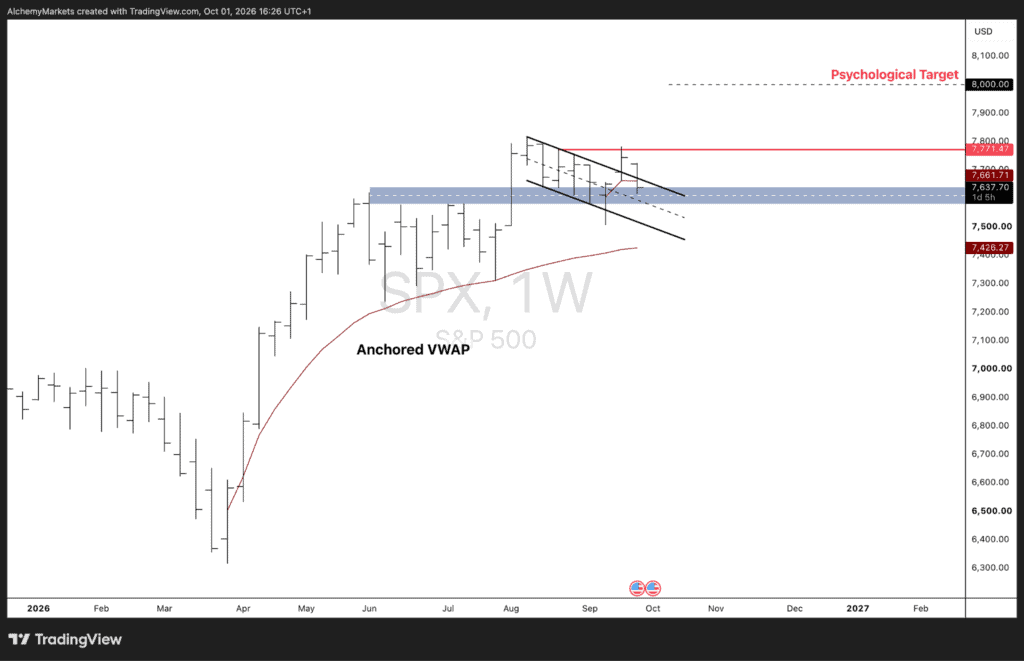
The weekly chart remains constructive.
Price is consolidating beneath the recent highs inside a short-term descending structure, while the 7,600 region provides an important area of support.
A break above the recent 7,770–7,800 resistance area would put the psychological 8,000 level firmly into focus during Q4.
Interestingly, independent technical analysis from Reuters has also identified a sustained break above the August highs as potentially opening the way towards 8,000.
Q4 bias: Bullish
Technical objective: 8,000
Nasdaq 100: Bullish, but the Earnings Hurdle Is Rising
The fundamental bull case for the Nasdaq remains intact.
AI infrastructure investment continues to increase and evidence of monetisation is emerging. BlackRock estimates that infrastructure investments are now achieving payback periods of less than three years for some hyperscalers, while cloud revenue growth has accelerated.
That gives the Nasdaq something much stronger than a purely speculative AI narrative:
capex → compute capacity → AI adoption → cloud revenue → earnings.
However, expectations are now considerably higher.
That makes Q4 less forgiving.
An AI company simply reporting good growth may no longer be enough; investors increasingly need evidence that enormous capital expenditure is translating into incremental revenue and earnings.
Higher bond yields create another constraint. Nasdaq companies generally carry longer-duration earnings profiles, meaning higher discount rates can exert disproportionately large pressure on valuations.
What could push the Nasdaq higher?
Continued hyperscaler capex growth, upward earnings revisions and evidence of improving AI monetisation would reinforce the existing trend.
The major downside scenario would be a combination of rising yields and weakening confidence in AI returns.
Technical outlook
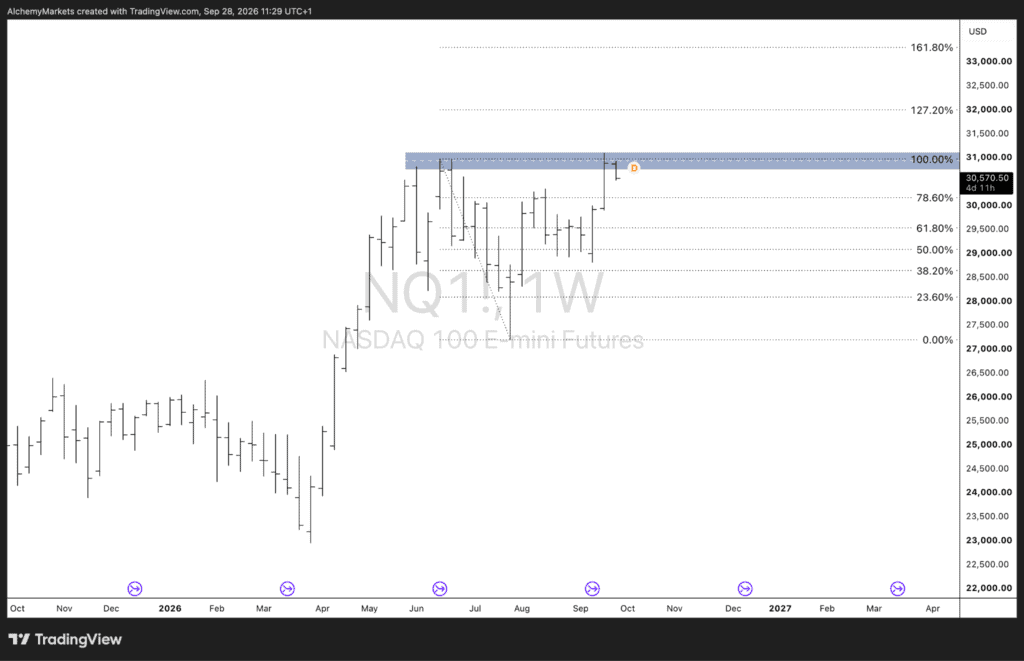
The Nasdaq 100 is testing a major resistance region around 30,800–31,000.
This is an important technical decision area.
A decisive breakout would place the Fibonacci extension levels back into play, with approximately 32,000 representing the next major upside objective before the larger 161.8% extension above 33,000.
The chart therefore fits the fundamental story well: the index remains bullish, but it must clear an important expectations barrier first.
Q4 bias: Bullish, but higher volatility
Technical objective: 32,000
Dow Jones: Broadening Could Drive Another Leg Higher
The Dow may be one of the more interesting beneficiaries if Q4 becomes a breadth story rather than simply an AI story.
Its greater exposure to industrial companies, financials, healthcare and mature corporate earnings makes it well positioned if US growth remains strong.
That appears plausible.
September’s US PMI data showed acceleration across both manufacturing and services, with US activity materially outperforming other major developed economies.
The fundamental chain is therefore straightforward:
stronger demand
→ industrial activity improves
→ corporate volumes rise
→ operating leverage improves
→ earnings broaden outside technology.
This does not require Nasdaq weakness.
Both can rise simultaneously, but for different reasons.
Technical outlook
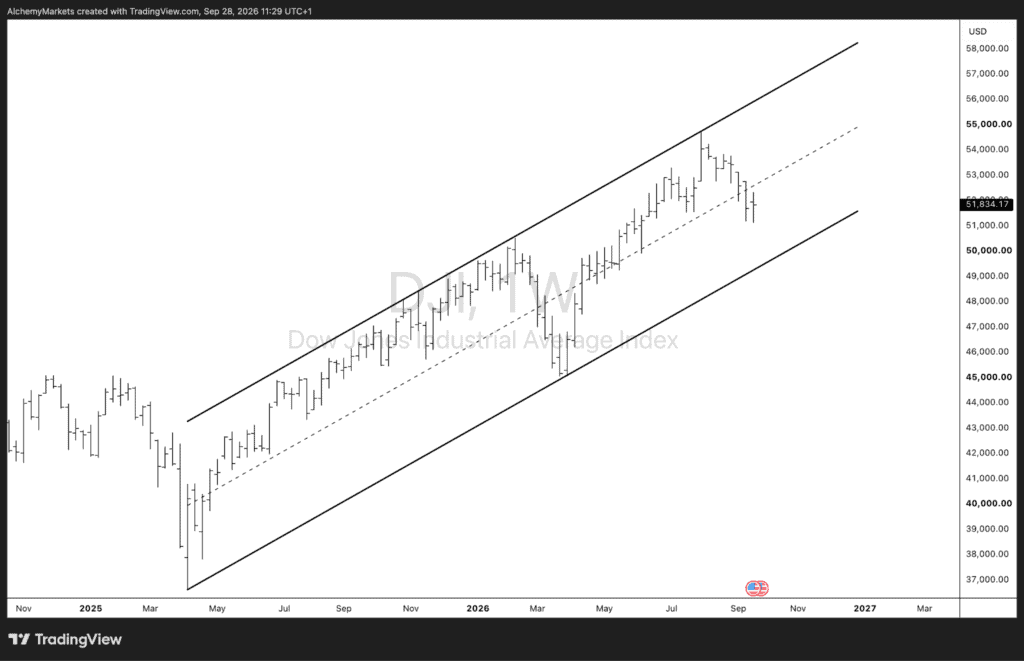
The Dow remains inside its longer-term rising channel.
The recent correction has taken the index below the channel midpoint, but the broader structure remains intact.
The initial technical objective is a recovery towards the previous highs around 54,500–55,000.
A sustained recovery could then allow price to rotate towards the upper boundary of the rising channel later in the quarter.
Q4 bias: Bullish
Initial technical objective: 55,000
Russell 2000: The Highest-Convexity Q4 Setup
The Russell 2000 is perhaps the most interesting index in the forecast because its bull case is also the most conditional.
Small-cap companies should benefit disproportionately if US economic growth remains robust and earnings participation continues broadening.
The problem is financing.
Smaller businesses generally have greater sensitivity to borrowing costs, refinancing conditions and domestic credit availability than the mega-cap companies dominating the S&P 500.
That leaves Russell caught between two powerful forces:
stronger growth = positive for earnings
but
higher rates = negative for financing and valuations.
That makes Treasury yields and credit spreads especially important for the Q4 Russell thesis.
If economic growth remains healthy while yields begin stabilising, the Russell could become one of the strongest catch-up trades in the market.
If yields continue aggressively higher, Russell is considerably more vulnerable.
Technical outlook
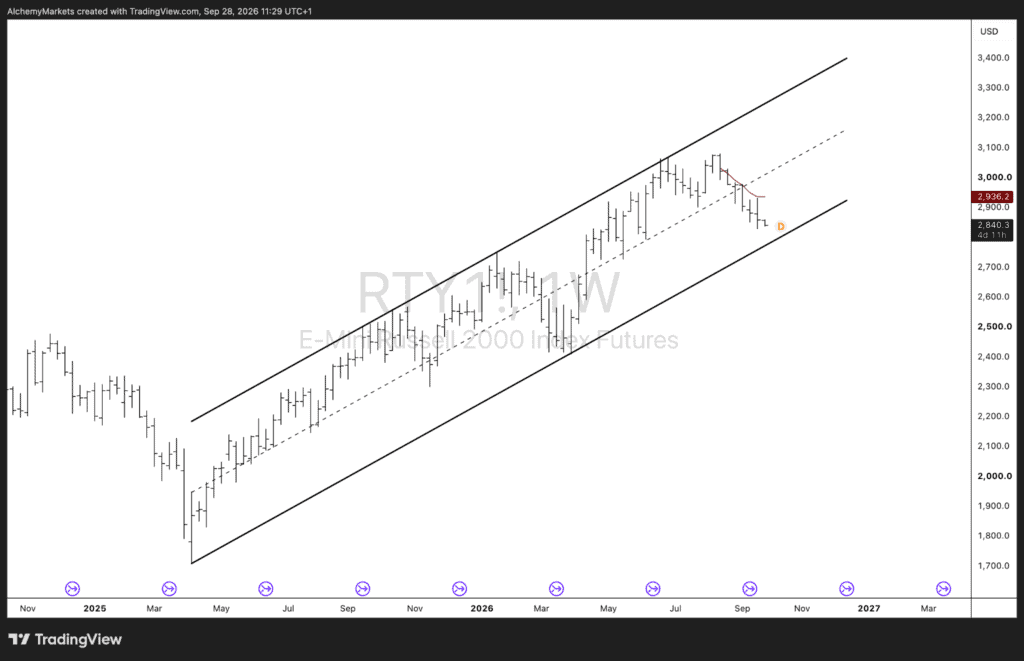
The weekly chart shows Russell retreating from the upper portion of its long-term rising channel.
A further correction towards the lower channel boundary would not necessarily invalidate the broader bullish structure.
Instead, that area could provide the technical base for another rotation higher.
A successful hold and reversal from the lower channel would reopen a move towards the upper channel boundary, potentially taking the index back through the 3,000 region during Q4.
Q4 bias: Conditional bullish
Technical roadmap: lower-channel test → recovery towards upper-channel resistance
DAX: German Growth Finally Provides Fundamental Support
The DAX enters Q4 with one of the more interesting improving macro backdrops.
The Eurozone Composite PMI accelerated to 53.1 in September from 52.0, its strongest pace of growth since April 2023. Growth was broad-based and accompanied by improving order books.
Germany has been an important part of that improvement.
This matters because the DAX has substantial exposure to industrial machinery, manufacturing, electrification, chemicals and other globally cyclical businesses.
Government infrastructure and defence spending provide another source of demand.
The potential earnings chain is therefore:
fiscal investment + improving orders
→ stronger industrial production
→ utilisation improves
→ operating leverage
→ earnings revisions higher.
The risks remain meaningful.
European inflationary pressures are rising again alongside energy prices, potentially requiring further ECB tightening. German manufacturers also remain highly exposed to global demand and Chinese competition.
Nevertheless, compared with the stagnant German backdrop seen previously, the rate of change has improved materially.
Technical outlook
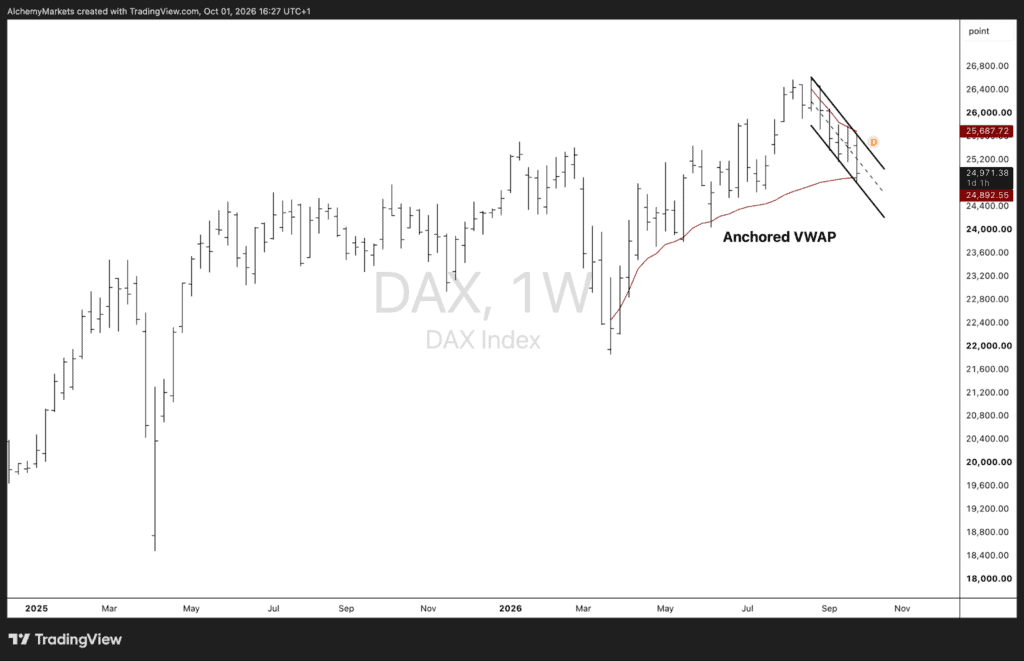
The DAX is currently trapped between two important anchored VWAPs.
The lower anchored VWAP continues to provide structural support, while the AVWAP drawn from the August high remains resistance.
That creates a straightforward Q4 trigger:
reclaim the upper anchored VWAP → bullish continuation confirmed.
A successful breakout from the current descending structure would reopen the broader uptrend, with approximately 28,000 representing our major upside objective.
Q4 bias: Bullish, conditional on the AVWAP reclaim
Technical objective: 28,000
FTSE 100: A Global Index in a Weak Domestic Economy
The FTSE 100 requires a different interpretation because the UK economy itself remains relatively subdued.
The average UK PMI nevertheless improved from 50.5 in Q2 to 52.1 in Q3, indicating some acceleration, although S&P Global estimates underlying quarterly growth remains modest. Inflation pressures have simultaneously increased, particularly in services.
That leaves the Bank of England facing an uncomfortable combination of:
weak-to-moderate growth
- persistent inflation.
But the FTSE 100 is not simply a UK domestic-economic trade.
Large parts of the index generate revenues internationally and it carries substantial exposure to banks, energy, mining, pharmaceuticals and multinational consumer companies.
That gives it several Q4 supports.
Commodity strength benefits parts of the mining and energy complex. Higher rates can support bank revenues provided credit deterioration remains contained, while weaker sterling can increase the sterling value of overseas earnings.
The FTSE has consequently remained resilient despite the relatively uninspiring domestic backdrop, recently trading around the 10,700–10,800 region.
Technical outlook
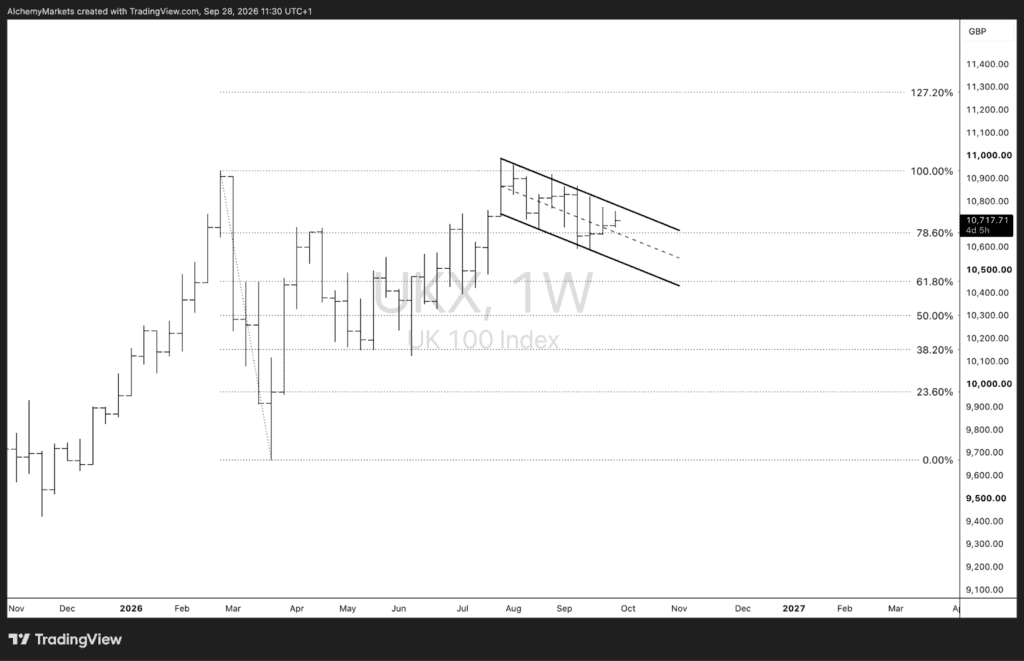
The weekly structure resembles a bull flag following the strong advance earlier in the year.
Price is currently consolidating inside a descending channel around the 78.6% retracement area.
A breakout above the upper flag boundary would indicate that the consolidation has likely run its course.
That would expose the previous high around 10,900 before opening the 127.2% Fibonacci extension near 11,300.
Q4 bias: Mildly bullish
Technical objective following breakout: 11,300
Q4 2026 Fundamental Map
The overall picture remains constructive, but the drivers differ considerably between markets.
| Index | Q4 Bias | Fundamental Engine | Technical Outlook |
| S&P 500 | Bullish | Earnings revisions + AI + broader US growth | 8,000 |
| Nasdaq 100 | Bullish / volatile | AI monetisation + earnings growth | 32,000 |
| Dow Jones | Bullish | Industrials + financials + broader economic growth | 55,000 initially |
| Russell 2000 | Conditional bullish | Domestic earnings breadth, conditional on rates | Lower channel → upper channel |
| DAX | Bullish | German industrial recovery + fiscal capex | 28,000 if upper AVWAP reclaimed |
| FTSE 100 | Mildly bullish | Banks + miners + energy + overseas earnings | 11,300 on bull-flag breakout |
The Bigger Q4 Story
Q4 does not begin with an obvious recession or earnings contraction.
Instead, the problem facing markets is almost the opposite.
The global economy has remained surprisingly resilient. US growth has accelerated, Eurozone activity has improved and corporate earnings continue to support equity prices. Yet energy and inflation pressures mean central banks cannot comfortably declare victory.
S&P Global’s latest global outlook describes exactly this combination: resilient economic conditions alongside renewed energy-price pressure, rising sovereign yields and the prospect of additional monetary tightening.
That makes the final quarter of 2026 a test of whether earnings growth can continue outrunning the rise in discount rates.
Our base case says it can.
But the character of the rally may change.
Instead of relying almost entirely on mega-cap technology, stronger economic activity could allow industrials, financials, materials, smaller companies and European cyclicals to participate.
That is ultimately the central Q4 thesis:
AI remains an important engine, but market breadth becomes the next leg of the story.
If earnings revisions remain positive, oil and inflation pressures moderate and bond yields stabilise, the technical upside targets across the major indices become increasingly achievable.
If the opposite occurs — inflation reaccelerates, yields continue climbing and earnings revisions begin rolling over — the bullish Q4 roadmap would need to be reassessed.
For now, however, the fundamental and technical pictures remain broadly aligned: the primary trend is still higher, even if the route through Q4 is unlikely to be a straight line.