Written by:


- Opening Bell
- March 17, 2026
- 4 min read
AUDUSD Eyes Breakout as Oil Surge Backs RBA Stance
Markets are no longer reacting to the initial shock—they are beginning to price what comes next.
What started as a geopolitical-driven surge in oil has quickly evolved into something far more important: a shift in the global monetary policy narrative. Inflation expectations are rising again, central banks are turning cautious, and the confidence around rate cuts is beginning to crack.
We are no longer in the reaction phase.
We are now in Phase 2.
Understanding the Shift: From Shock to Repricing to Consequence
To properly frame the current market environment, it’s critical to understand that this is not a single event—but a three-phase macro process.
Phase 1: The Shock (Already Played Out)
This phase was driven by the initial oil spike and geopolitical escalation.
- Energy prices surged rapidly
- Markets moved into risk-off positioning
- Volatility picked up across asset classes
Despite this, the broader narrative remained intact:
Inflation would continue to ease, and central banks would eventually cut rates.
Markets treated the shock as temporary.
Phase 2: The Repricing (Where We Are Now)
This is where things begin to matter more.
Markets are now adjusting to the realization that the oil shock may not be transitory—and that it carries second-order effects.
- Inflation expectations are rising again
- Central banks are becoming more cautious
- Rate cut expectations are being delayed or repriced
The narrative has shifted from:
“When do we get cuts?”
To:
“Can central banks afford to cut at all?”
This is the phase where positioning changes—not just sentiment.
Phase 3: The Consequences (Not Yet Fully Priced)
This phase is still ahead—but it’s where the real risks sit.
If inflation persists and policy remains tight, markets will begin to reflect:
- Margin compression from higher input costs
- Consumer demand weakening
- Tighter financial conditions
- Stress in credit markets and leveraged sectors
This is when macro pressure turns into earnings and liquidity stress.
And importantly—this is not yet fully priced.
RBA Signals the Shift, Fed Holds the Key
The Reserve Bank of Australia (RBA) has effectively confirmed that inflation risks remain present.
While Australia itself is not the center of global monetary policy, it plays an important role as an early responder to commodity-driven inflation dynamics. Its latest stance suggests that central banks are not yet in a position to declare victory over inflation.
This matters because it reinforces what Phase 2 is about: the breakdown of the rate-cut narrative
However, the real catalyst now lies with the Federal Reserve (Fed).
Markets are increasingly sensitive to whether the Fed will:
- Validate the repricing → by leaning hawkish and acknowledging inflation risks
- Push back on it → by maintaining a softer stance and keeping cuts on the table
This decision will determine not just rates—but global positioning across all asset classes.
AUDUSD: Compression Ahead of a Policy-Driven Breakout
The AUDUSD is now sitting at a critical intersection of technical structure and macro narrative.
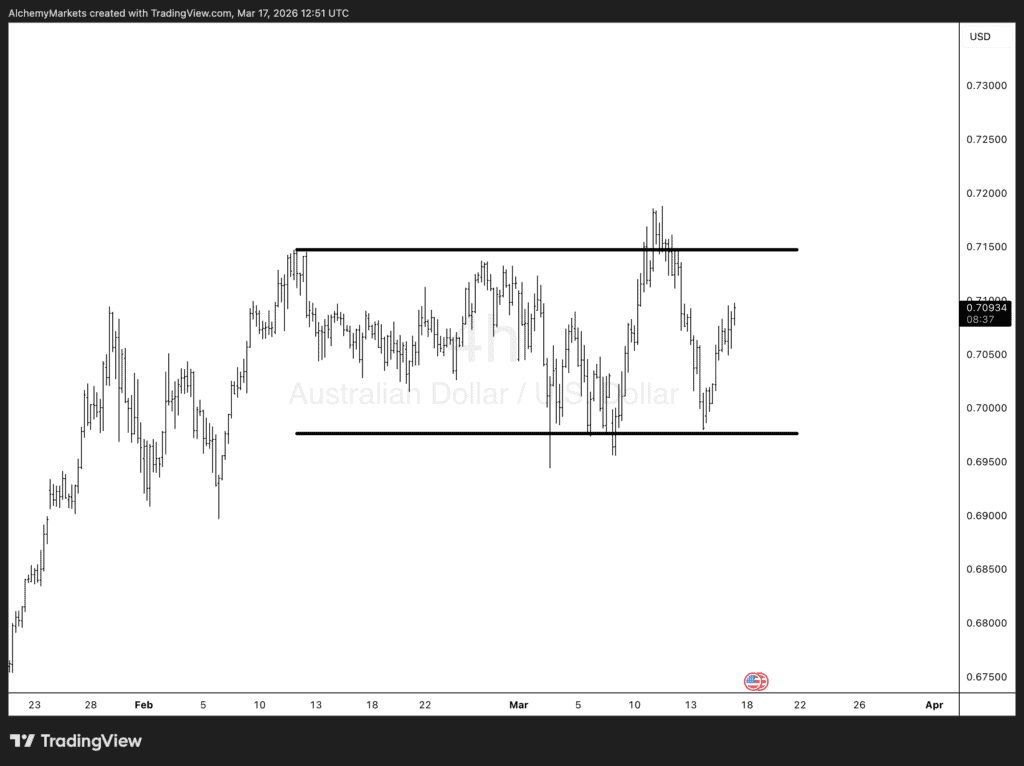
Price action shows a well-defined range, with resistance repeatedly tested and support holding below. More importantly, the pair is beginning to form higher lows into resistance, signaling pressure building beneath the surface.
This type of structure typically resolves with a breakout—but the direction is not purely technical.
It is policy-dependent.
The Macro Driver Behind the Setup
What makes AUDUSD particularly interesting here is the divergence in clarity:
- RBA → already leaning cautious / relatively hawkish
- Fed → still uncertain, but expectations are shifting
This creates a setup where:
- The Australian side of the equation is relatively stable
- The US side is the variable driving the next move
Scenario Framework: What Breaks the Range?
Bullish Breakout (Upside Resolution)
This scenario plays out if:
- The Fed fails to fully validate the hawkish repricing
- Markets regain some confidence in eventual easing
- USD weakens as expectations soften
In this case, AUDUSD likely:
- Breaks above resistance
- Transitions from range to trend
Bearish Rejection (Range Holds or Breaks Lower)
This occurs if:
- The Fed leans into inflation risks
- Reinforces a “higher for longer” stance
- Yields move higher and USD strengthens
In this environment:
- AUDUSD likely rejects resistance
- Range persists or breaks to the downside