Written by:

- Chart of the Day
- July 30, 2026
- 4 min read
KOSPI Fell 44%, SOXX 30%: Is US Tech on the Brink?
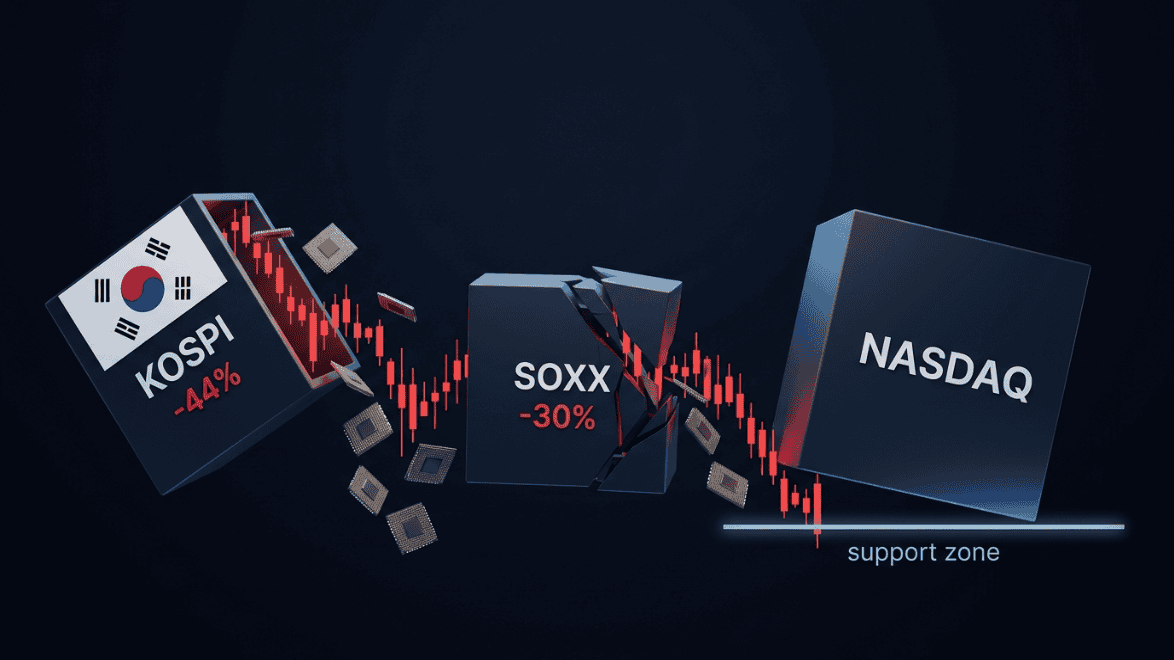
South Korea’s stock market has continued to fall today, turning the KOSPI into one of the biggest talking points among global investors.
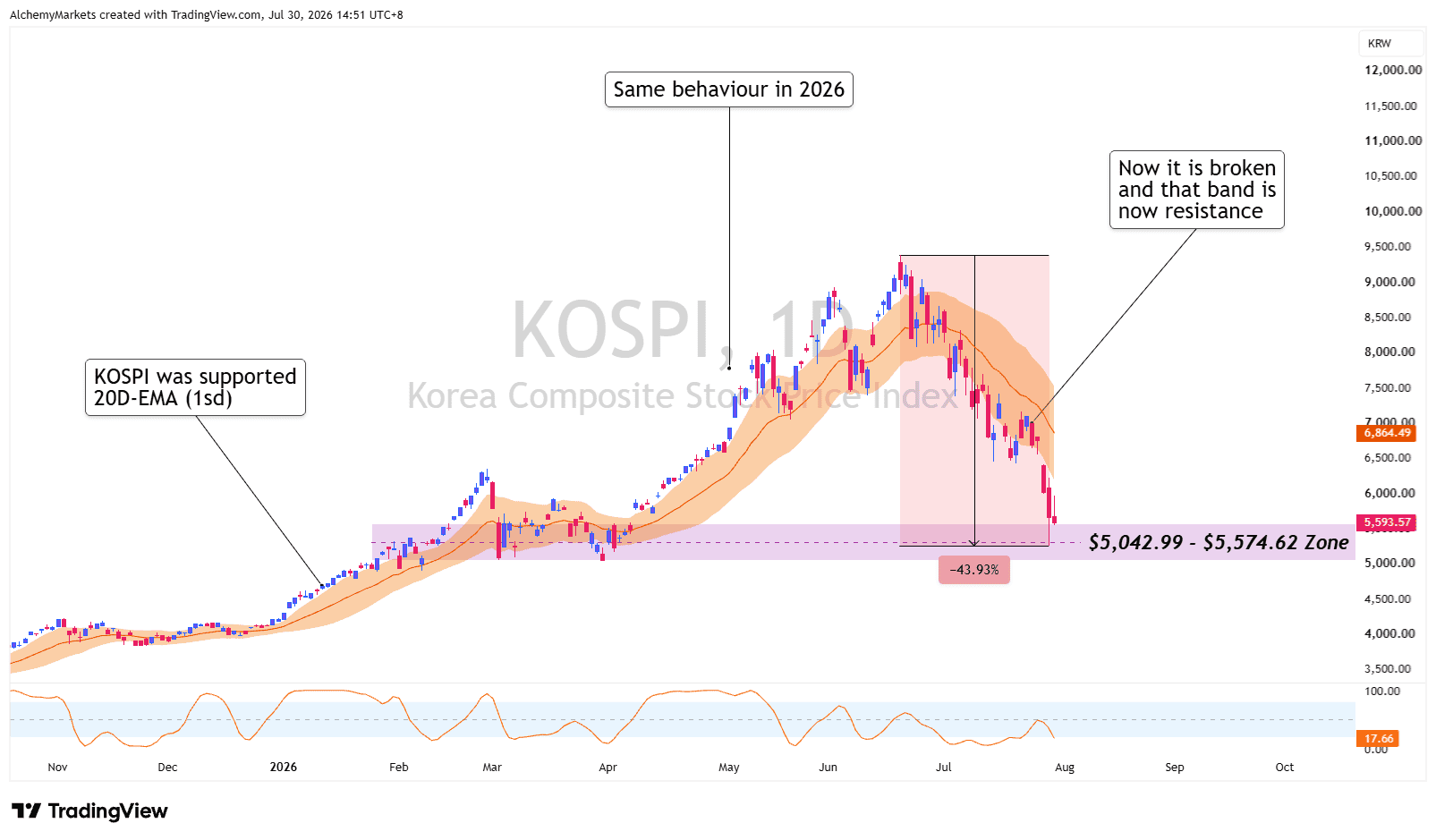
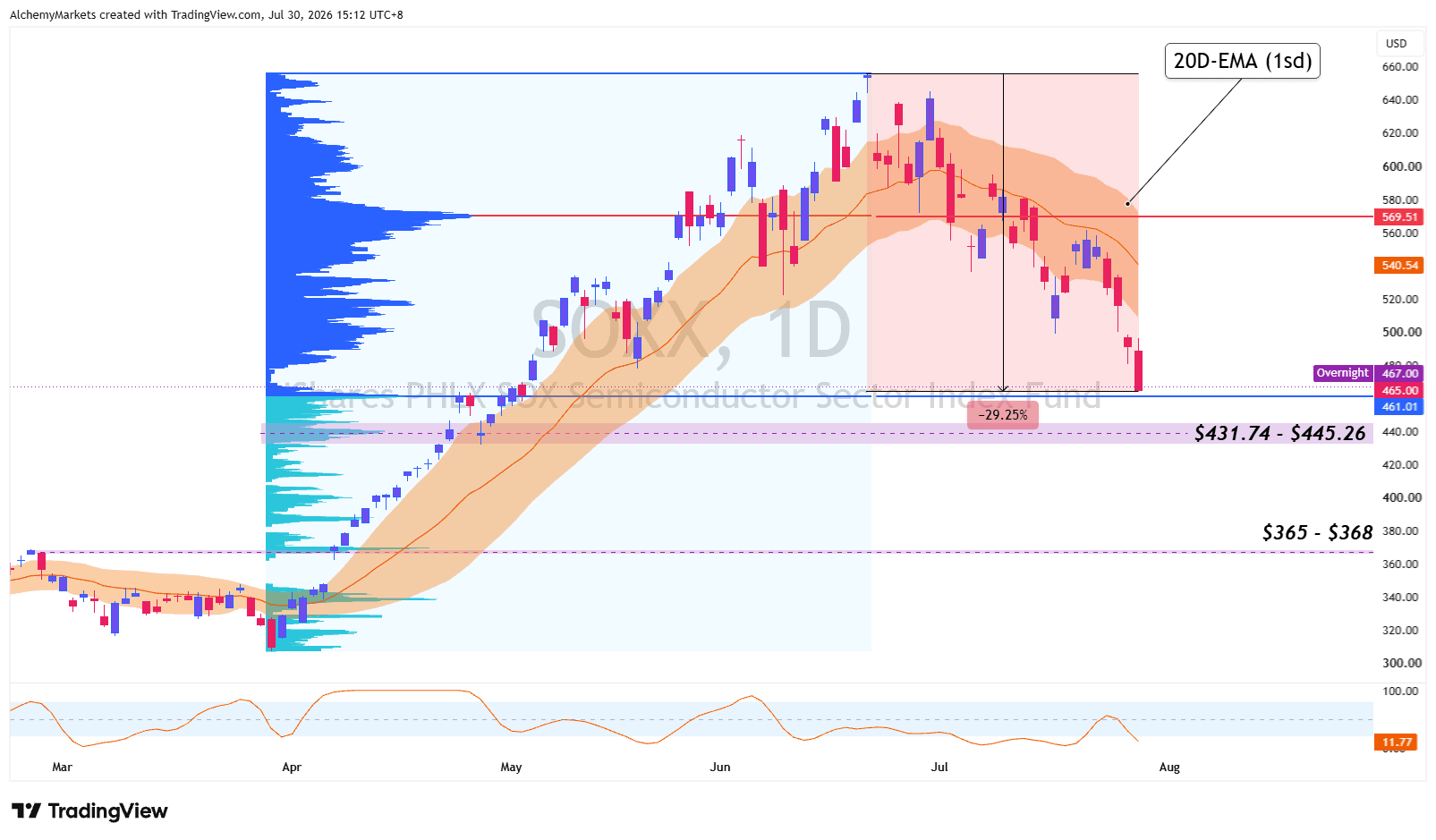
The index has now fallen almost 44% from its June high, making it the most extreme example of the sell-off spreading through the technology sector. The SOXX semiconductor ETF is also down close to 30%.
KOSPI 1D CHART:
SOXX 1D CHART:
Nasdaq has held up better, falling around 13%, but most of its decline has arrived over the past seven trading sessions. That has raised concerns that the pressure could spread more broadly across US technology stocks.
What makes the move unusual is that the selling has continued despite strong earnings, rising revenue and, in some cases, better-than-expected guidance.
Nasdaq is testing a hidden support zone
Nasdaq has now fallen below its daily 50-EMA band. This marks a change in behaviour, with the band likely to act as resistance during any recovery attempt.
However, the index is also testing the lower trendline of a descending channel. The channel appears relevant because its midpoint has already influenced price several times during the decline.
The 26,800 to 27,400 area also overlaps with a previous consolidation zone. Meanwhile, the Stochastic RSI has entered oversold territory, creating the conditions for a possible short-term rebound.
NASDAQ 1D CHART:
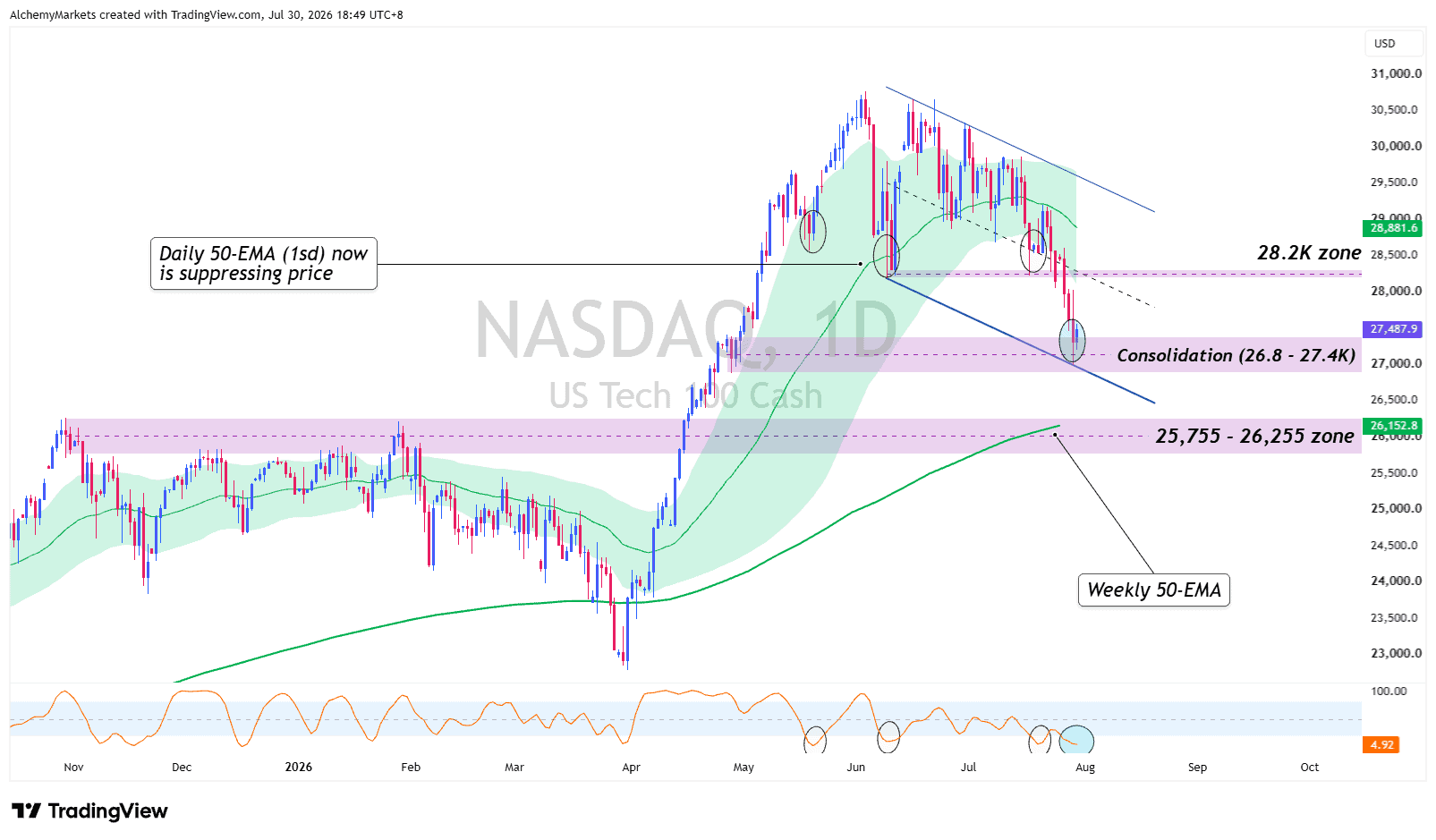
Below that, the weekly 50-EMA is approaching the 2025 highs around 25,755 to 26,255, forming another important support zone.
The wider technology market is approaching support at roughly the same time:
- KOSPI is nearing its previous consolidation range between 5,000 and 5,500.
- SOXX is testing its value-area low near 461. If that level fails, the next area to watch sits between 431.74 and 445.26.
This alignment could support a temporary relief rally across all three markets. However, oversold conditions alone do not confirm that a bottom has formed.
Yesterday’s earnings were supposed to calm investors
Microsoft and Meta were among the most important companies reporting yesterday because both have committed huge amounts of money to artificial intelligence.
Their results gave investors another chance to judge whether that spending is producing enough growth and cash flow.
| Company | What looked strong | What remained a concern |
| Microsoft | Revenue reached around $90 billion, ahead of forecasts near $87.6 billion. Azure grew 43%, while Microsoft Cloud revenue rose 27%. | Capital expenditure remained high at around $41 billion. |
| Microsoft guidance | Azure growth is expected to reach approximately 45% in constant currency next quarter. Revenue guidance stood at $89.85 billion to $90.95 billion. | Investors still need cloud growth to remain strong enough to justify further spending. |
| Meta | Revenue increased 28% to $60.8 billion, supported by stronger advertising activity. | Costs rose 55%, operating margin fell from 43% to 31%, and operating income declined 8%. |
Microsoft provided the clearer evidence that AI investment is producing returns.
Despite spending around $41 billion on capital expenditure, the company still generated approximately $19.6 billion in free cash flow. Its cloud growth and guidance showed that new infrastructure is already contributing to revenue.
Meta’s result was more difficult to interpret. Its advertising business remained strong, but rising costs and weaker margins reinforced concerns over how quickly AI investment can translate into profits and cash flow.
The market appears willing to tolerate heavy spending when companies can show visible returns. Microsoft came closer to providing that evidence, while Meta left more questions unanswered.
Why Korea has suffered the most
Korea’s market has been especially vulnerable because the KOSPI is heavily influenced by Samsung Electronics, SK Hynix and the wider memory-chip industry.
| Pressure on KOSPI | Why it matters |
| High semiconductor concentration | Weakness in Samsung and SK Hynix has an unusually large effect on the wider index. |
| Expectations were already extreme | SK Hynix reported a 557% increase in operating profit, but still missed elevated forecasts. Its shares fell almost 10%. |
| Crowded positioning | Investors had built large positions around the AI and memory-chip cycle. |
| Leveraged ETF unwinding | Falling chip prices triggered forced selling and intensified the decline. |
This shows how difficult the market has become to satisfy.
Strong semiconductor demand and rapid earnings growth are already expected. Companies now need to keep exceeding forecasts while convincing investors that the AI investment cycle can continue at its current pace.
That makes Nasdaq’s support test even more important. KOSPI and SOXX are already close to major technical levels, while US technology is only now approaching the point where buyers need to return.
Bottom Line: Relief Rally is Possible From Here
If Nasdaq holds, the descending-channel floor could allow oversold conditions and nearby support across KOSPI and SOXX to produce a relief rally. Nasdaq would then need to recover its daily 50-EMA band to show that buyers are regaining control.
If Nasdaq, SOXX and KOSPI all lose support together, the semiconductor correction could develop into a much broader technology sell-off.