Written by:

- Weekly Outlook
- January 23, 2026
- 6 min read
AI Becomes the New Operating System – and Why the Fed’s Pause Could Define the Next Phase for Markets
AI: The New Operating System for the Global Economy
Artificial intelligence is no longer just a collection of tools or clever apps — it’s becoming the new operating system for modern life. Rather than functioning as single-purpose applications, AI systems are learning to access tools, reason independently, and adapt dynamically to deliver outcomes. Computing itself is evolving — from static, rule-based logic to fluid, outcome-oriented intelligence that can reprogram itself in real time.
This shift is transforming how economies work. Context is becoming the new frontier: today’s AI can weave together vast pools of data to deliver deeply personalised and situational responses. That means the systems of tomorrow won’t just retrieve information — they’ll understand it, interpret it, and act on it autonomously.
At the individual level, the rise of personal AI agents will change how people interact with technology. Imagine a world where your AI agent rebooks your flight after a cancellation, reschedules your meetings, and orders food before you even ask. This is no longer science fiction — it’s a near-term reality.
For companies, the “agent-as-a-service” economy will replace much of the traditional, human-centric workflow. Businesses will orchestrate hybrid teams of human experts and AI agents, charging clients not by hours worked, but by the tokens consumed — the very units of AI computation. In this new paradigm, learning becomes the most vital skill. The most successful professionals won’t simply be the most qualified — they’ll be the most adaptable, able to continually reimagine their roles alongside AI.
In many ways, this evolution mirrors what’s unfolding in global markets today: systems adapting, recalibrating, and learning — just like the Fed.
Setting the Scene: The Fed’s Balancing Act
As the technological landscape shifts beneath our feet, the economic one is undergoing its own recalibration. The Federal Reserve’s first meeting of 2026 takes place this Wednesday, and for once, markets expect no major surprises.
After three consecutive 25-basis-point cuts since September — a total of 75 basis points — the Fed is widely expected to hold interest rates steady in the 3.50%–3.75% range.
The rationale is straightforward: growth remains robust, unemployment is low, equity markets hover near record highs, and inflation is still above target. In short, there’s little justification for further easing.
Chair Jerome Powell’s firm defence of the Fed’s independence earlier this month — in response to political pressure from the White House to lower rates further — reinforces that message: the Fed will not be coerced into oversteering the economy.
What’s Happened So Far
The Fed last trimmed rates in December 2025, a move that included dissent from the ultra-dove Stephen Miran, who favoured a larger 50bp cut, while two others preferred to pause. Since then, economic data has remained steady: inflation has cooled only modestly, and consumer spending has stayed resilient.
In short, the Fed’s prior easing has done its job in cushioning growth without overheating markets. That’s why a pause this week feels both justified and prudent.
Market Expectations Going In
Markets are firmly priced for a “hold and wait” stance. The real focus will be on the tone of the statement and Powell’s press conference, particularly whether he acknowledges the stronger inflation readings or hints that the next move could still be downward later this year.
Wall Street is split between those expecting a slightly hawkish hold (emphasising inflation vigilance) and those betting on a balanced, data-driven message.
Three Scenarios: How the Dollar and S&P 500 Could React
Base Case: The Fed Holds Steady with a Balanced Tone (Most Likely)
What Happens:
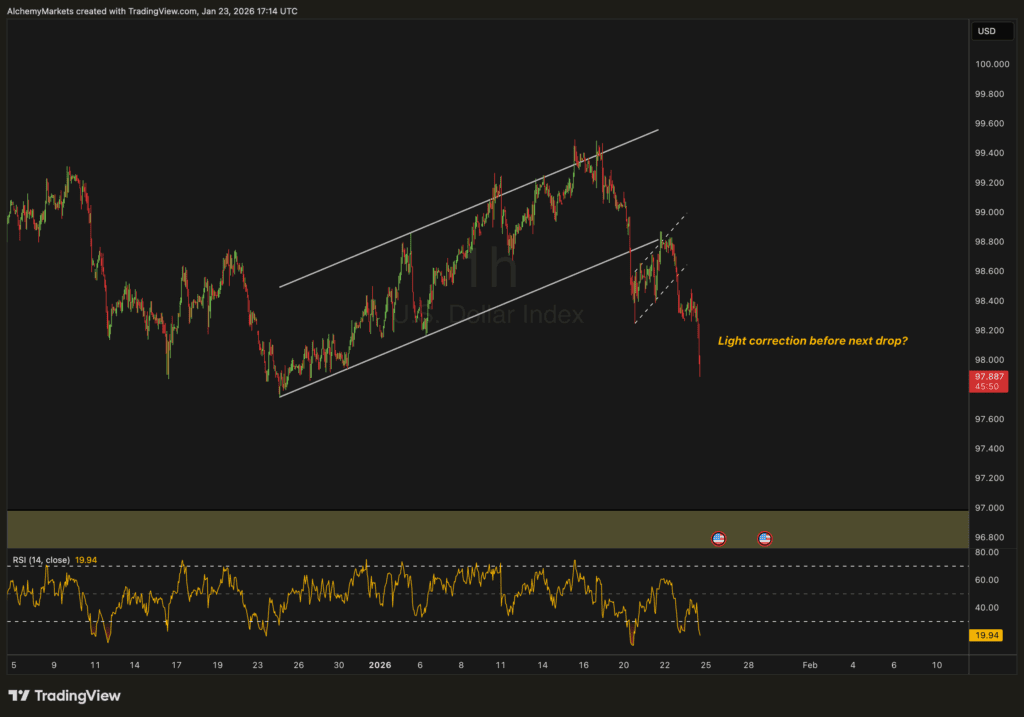
The Fed keeps the target range unchanged at 3.50%–3.75%, while Powell emphasises that the current stance is “appropriate for now.” He reiterates independence from political pressure and leaves future moves fully dependent on inflation and labour data.
Market Reaction:
- Dollar (DXY): Slightly firmer, up 0.2%–0.5%, supported by stable yields and a cautious Fed.
- S&P 500: Likely to trade sideways or modestly higher, as stability and no new surprises give earnings season room to shine.
- Investor takeaway: Risk assets breathe a sigh of relief — but no reason yet to chase rallies.
Hawkish Surprise: Powell Pushes Back on Market Easing
What Happens:
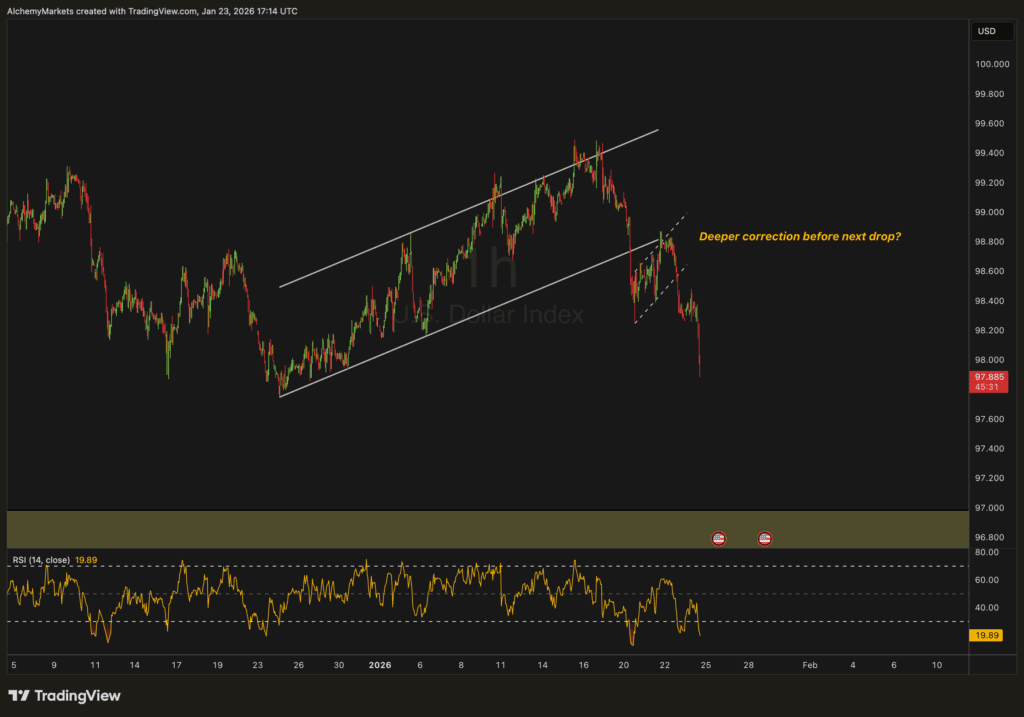
The statement highlights sticky inflation, and Powell signals fewer cuts ahead for 2026. There might even be subtle hints of concern about excessive risk-taking in equities or housing.
Market Reaction:
- Dollar: Jumps 0.5%–1.0%, as rate differentials widen and Treasury yields climb.
- S&P 500: Pulls back 0.5%–1.5%, led by tech and high-valuation names most sensitive to interest rates.
- Investor takeaway: The Fed is reminding markets that inflation isn’t fully defeated — a short-term shock, but a longer-term credibility boost.
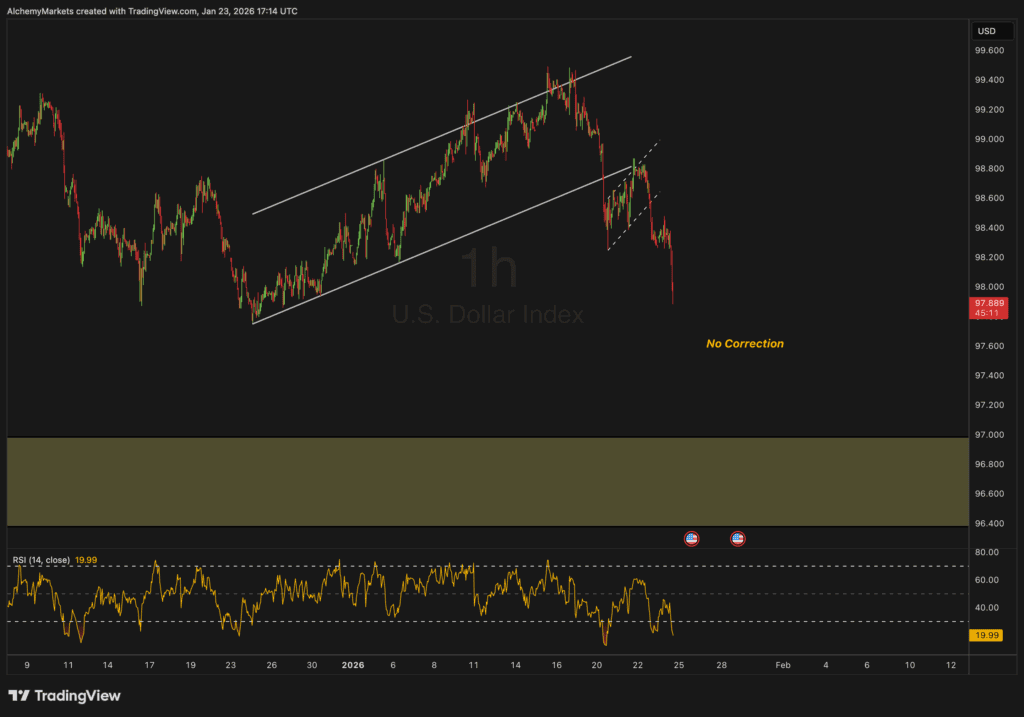
Dovish Surprise: The Fed Opens the Door to More Cuts
What Happens:
Powell acknowledges easing inflation and slower wage growth, hinting that another cut could come by mid-year if the labour market weakens further. The tone shifts gently towards supporting continued expansion.
Market Reaction:
- Dollar: Slides 0.5%–1.0%, as traders price in an earlier easing path.
- S&P 500: Rallies 0.5%–1.5%, with small caps and cyclicals leading the charge.
- Investor takeaway: Risk-on mood returns — but raises questions about whether the Fed sees something weakening beneath the surface.
The Politics vs. Policy Dynamic
It’s impossible to ignore the political noise surrounding the Fed this year. With an election on the horizon and pressure from the administration to maintain lower rates, Powell’s recent 11 January remarks served as a clear line in the sand.
“The Fed will not be swayed by short-term political interests,” he stated firmly — a reassurance that monetary decisions remain guided by data, not politics. That independence theme will likely echo again on Wednesday.
Big Picture: What to Watch Next
- Fed Statement: Does it mention inflation’s persistence or global headwinds?
- Press Conference Tone: Is Powell calm and balanced, or does he push back on market pricing for future cuts?
- Market Reaction: The first 30 minutes after the release will likely set the tone — especially for the dollar and U.S. equities.
Bottom Line
The most probable outcome this week is a steady, no-drama Fed meeting — a “pause with purpose.” Powell will reaffirm the Fed’s independence, maintain flexibility, and keep markets guessing about the exact path ahead.
For traders, that means the dollar remains supported, and the S&P 500 stays driven by earnings, not central bank surprises.
In the end, doing nothing may be the smartest move the Fed can make right now.