Skriven av:


- Opening Bell
- maj 5, 2026
- 6 min läsning
RBA Hikes Cash Rate but AUD Turns Bearish
Understanding the Latest RBA Rate Decision
The Reserve Bank of Australia (RBA) has once again tightened monetary policy, raising the cash rate by 25 basis points to 4.35%. While the move was widely expected by markets, the tone and underlying economic signals have shifted significantly. The decision was notably more decisive than previous meetings, with eight out of nine board members voting in favor of the hike.
What Is the Cash Rate and Why It Matters
The cash rate is the interest rate that banks charge each other for overnight loans. It acts as the backbone of the financial system, influencing borrowing costs, mortgage rates, and overall economic activity. When the RBA raises rates, it aims to slow inflation by reducing spending and investment.
Market Expectations vs Reality
Markets had already priced in this rate hike, meaning the Australian dollar (AUD) saw little support from the announcement itself. Instead, investors shifted their focus toward future policy direction and economic forecasts—where the real story lies.
Economic Growth Downgrade: A Key Turning Point
The most critical development in the RBA’s latest update is the sharp downgrade in economic growth projections. This shift is central to understanding why the AUD is weakening despite higher interest rates.
Revised Growth Forecasts Explained
The RBA cut its GDP growth forecast for 2026 by 0.5 percentage points to just 1.3%. This is a substantial downgrade and signals that economic momentum is slowing more rapidly than previously expected.
A growth rate of 1.3% is considered below trend, indicating a sluggish economy that may struggle to generate strong employment and income growth.
Impact on Businesses and Consumers
Slower growth has ripple effects across the economy:
- Businesses may delay investment due to uncertain demand
- Consumers may cut spending as incomes stagnate
- Credit demand weakens despite higher rates
This combination creates a challenging environment where monetary tightening has a more pronounced negative effect.
Inflation Outlook: Only a Modest Increase
While growth forecasts were significantly downgraded, inflation projections saw only minor adjustments.
Why Inflation Isn’t Rising Sharply
The trimmed mean CPI forecast was raised by just 0.1 percentage points to 3.8% for mid-2026. This modest increase suggests that inflation pressures are not accelerating dramatically.
Key reasons include:
- Weak consumer demand
- Slowing wage growth
- Global disinflation trends
Timeline for Inflation Returning to Target
The RBA expects inflation to peak around mid-2026 and gradually return to target levels by mid-2028. This extended timeline reinforces the idea that inflation is sticky—but not spiraling out of control.
Labor Market Signals Weakening Momentum
Another important factor influencing the bearish AUD outlook is the labor market.
Rising Jobless Rate Concerns
The unemployment rate is now projected to rise to 4.6% by the end of 2027. While this increase may seem small, it signals a gradual cooling in labor demand.
A rising unemployment rate typically indicates:
- Reduced hiring activity
- Lower wage growth
- Declining consumer confidence
Neutral Rate and Policy Positioning
The RBA has indicated that the current cash rate is within—but near the upper bound of—the neutral range.
What “Restrictive Policy” Means
A restrictive policy stance means interest rates are high enough to slow economic activity. This is a critical turning point because it suggests:
- The central bank may be nearing the end of its tightening cycle
- Further hikes could risk over-tightening
- Policy may shift toward a pause or eventual easing
Why AUD Is Bearish Despite Rate Hike
At first glance, higher interest rates should support a currency. However, the AUD is weakening—and for good reason.
Interest Rate Differentials vs USD
Currency values are heavily influenced by interest rate differentials. If other central banks—particularly the Federal Reserve—maintain higher or more persistent rates, the AUD loses its relative appeal.
Capital Flows and Yield Dynamics
Investors seek the highest returns. If U.S. yields remain elevated:
- Capital flows into USD assets
- Demand for AUD declines
- AUD/USD trends lower
This dynamic explains why the AUD remains under pressure despite domestic rate hikes.
Market Interpretation: End of Tightening Cycle?
Markets are increasingly interpreting the RBA’s tone as signaling a potential pause in rate hikes.
Expectations for Future Rate Moves
While forecasts still suggest a peak cash rate of 4.7% by the end of 2026, the central bank’s cautious language indicates flexibility.
Unless inflation surprises to the upside, the RBA is likely to:
- Pause in upcoming meetings
- Assess economic data carefully
- Avoid aggressive tightening
Technical Outlook for AUD/USD
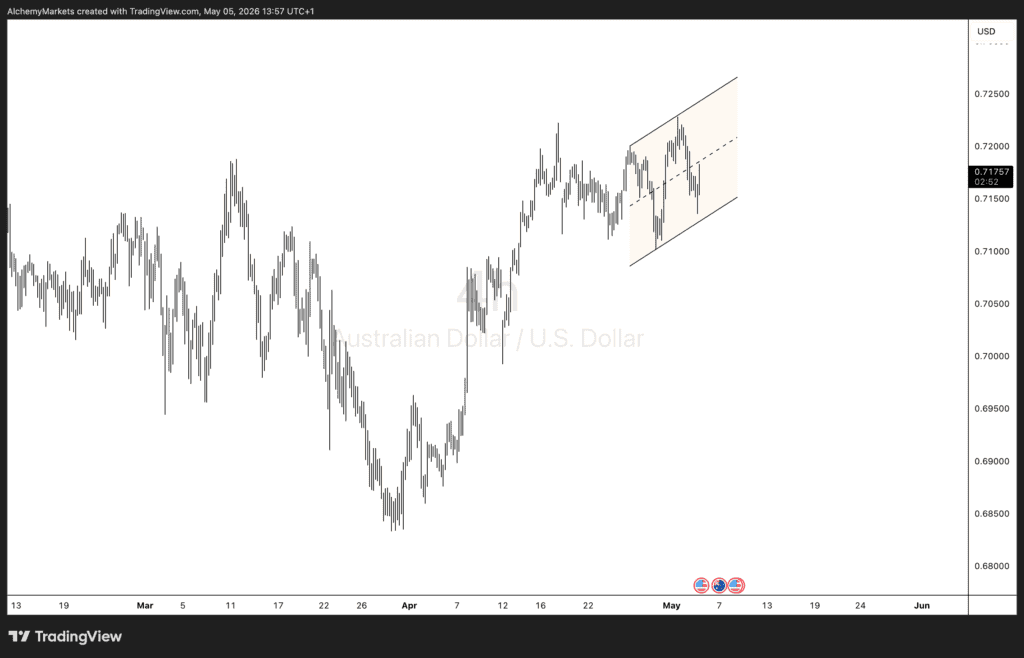
The chart shows AUD/USD trading within an upward-sloping channel but struggling to maintain momentum near resistance levels.
Trend Analysis and Key Levels
- Resistance: Around 0.7250
- Support: Near 0.7100
- Current bias: Bearish within the channel
A break below support could accelerate downside momentum, especially if macro fundamentals continue to weaken.
Risks to the Outlook
Inflation Surprise Risk
If inflation rises faster than expected:
- The RBA may resume aggressive hikes
- AUD could strengthen temporarily
Growth Shock Risk
If growth deteriorates further:
- Recession risks increase
- AUD could fall more sharply
Strategic Implications for Traders
Traders should consider:
- Monitoring U.S. Federal Reserve policy closely
- Watching inflation data for surprises
- Tracking labor market indicators
Short-term rallies in AUD may present selling opportunities if fundamentals remain weak.
Broader Economic Impact
The combination of high rates and weak growth affects multiple sectors:
- Housing: Mortgage stress increases
- Consumption: Spending declines
- Investment: Business expansion slows
Global Context and Comparisons
Compared to other central banks, the RBA appears more cautious. While some economies remain resilient, Australia’s growth slowdown stands out, contributing to currency weakness.
FAQs
1. Why did the RBA hike rates if growth is slowing?
The RBA is still focused on controlling inflation, even as growth weakens. Balancing these two objectives is challenging.
2. Why is the AUD falling after a rate hike?
Because markets focus on future expectations. Slowing growth and limited further hikes reduce currency appeal.
3. What is the neutral interest rate?
It’s the rate that neither stimulates nor restricts the economy. The RBA believes current rates are near the upper end of this range.
4. Will the RBA hike rates again?
Possibly, but only if inflation rises more than expected. Otherwise, a pause is likely.
5. How does U.S. policy affect AUD?
Higher U.S. rates attract capital, strengthening USD and weakening AUD.
6. Is a recession likely in Australia?
Not guaranteed, but risks are increasing due to slowing growth and rising unemployment.
Conclusion
The RBA’s latest rate hike confirms its commitment to fighting inflation, but the broader economic picture tells a more complex story. Growth is slowing significantly, while inflation is only rising modestly. This imbalance is shifting market expectations and weighing heavily on the Australian dollar.
In essence, the rate hike itself is no longer the main driver of currency movement. Instead, it’s the outlook—marked by weaker growth, cautious policy signals, and global rate differentials—that is shaping the bearish trajectory of the AUD.