Skriven av:


- Opening Bell
- april 15, 2026
- 4 min läsning
Gold Holds Firm — But Cracks Are Forming Beneath the Surface
Gold is stepping into the session with resilience, but the real story isn’t just strength — it’s why that strength exists, and more importantly, what could unravel it. Price action on the 4H chart shows a rising channel (or wedge) forming within a broader downtrend, signaling a market that is still bid… but increasingly fragile.
Here’s how to frame it heading into the open.
1. What’s Driving Gold Higher Right Now
Gold’s bid isn’t coming from a single catalyst — it’s the result of a confluence of macro forces reinforcing each other.
At the core, geopolitical tension in the Middle East continues to anchor safe-haven demand. Markets are pricing in uncertainty, not necessarily escalation, but enough risk to justify holding protection. That creates a persistent bid under gold as a hedge against tail scenarios.
Layered on top of that is the macro liquidity narrative:
- The U.S. dollar has been soft, mechanically supporting gold prices
- Real yields have been drifting lower, reducing the opportunity cost of holding a non-yielding asset
- The market continues to lean into a “Fed will eventually ease” framework
Put simply, the dominant narrative is:
Uncertainty + falling real yields + weaker dollar = stay long gold
There’s also a positioning element that shouldn’t be ignored. Gold has become a crowded macro hedge, meaning flows are not just reactive — they’re anticipatory. Funds are already positioned for risk, not waiting for confirmation.
Technically, this is reflected in your chart:
- A rising channel/wedge structure
- Price grinding higher, but with waning momentum
- Movement driven more by positioning and narrative than fresh catalysts
This combination suggests we’re no longer in the early stages of a move — we’re likely in a late-cycle extension phase, where upside requires new information, not just continuation of the current story.
2. What Would Trigger a Correction in Gold
Gold doesn’t sell off simply because conditions improve — it sells off when expectations stop getting worse.
That distinction is critical.
The key trigger: a shift in expectations
Right now, markets are priced for:
- Persistent geopolitical risk
- Continued USD softness
- Falling or stable real yields
A correction begins when any of these stop reinforcing the narrative.
Primary catalysts to watch:
1. Geopolitical stabilization (not resolution)
This is the most powerful driver.
Gold doesn’t need peace to fall — it just needs:
- No escalation
- Headlines cooling
- Risk perception stabilizing
Second-order effect:
- Safe-haven demand fades
- Hedging flows reverse
- Positioning unwinds
– This creates the potential for a fast downside move (“air pocket”)
2. USD stabilisation or bounce
Even a modest shift matters here.
If the dollar:
- Stops weakening
- Or begins to squeeze higher
Then:
- One of gold’s key tailwinds disappears
- Macro funds begin rotating out
– This can trigger a correction independently of geopolitics
3. Real yields rising
Gold is extremely sensitive to this.
If:
- Bond yields rise
- Inflation expectations fall
Then:
- Real yields move higher
- Gold becomes less attractive
– This is a classic macro unwind signal
4. “Nothing happens” (the silent catalyst)
Often overlooked — and often the most dangerous.
If:
- No escalation occurs
- No new catalyst emerges
Then:
- The risk premium slowly decays
- Markets begin to question positioning
– Gold drifts lower simply due to time decay of fear
5. Technical breakdown + positioning unwind
Your chart highlights this clearly:
- Rising wedge structure
- Weakening momentum
- Compression into resistance
Once support breaks:
- CTAs and trend followers flip
- Stops get triggered
- Liquidity thins
– This is where technical structure meets macro shift
3. Where the Move Targets — The Base of the Channel
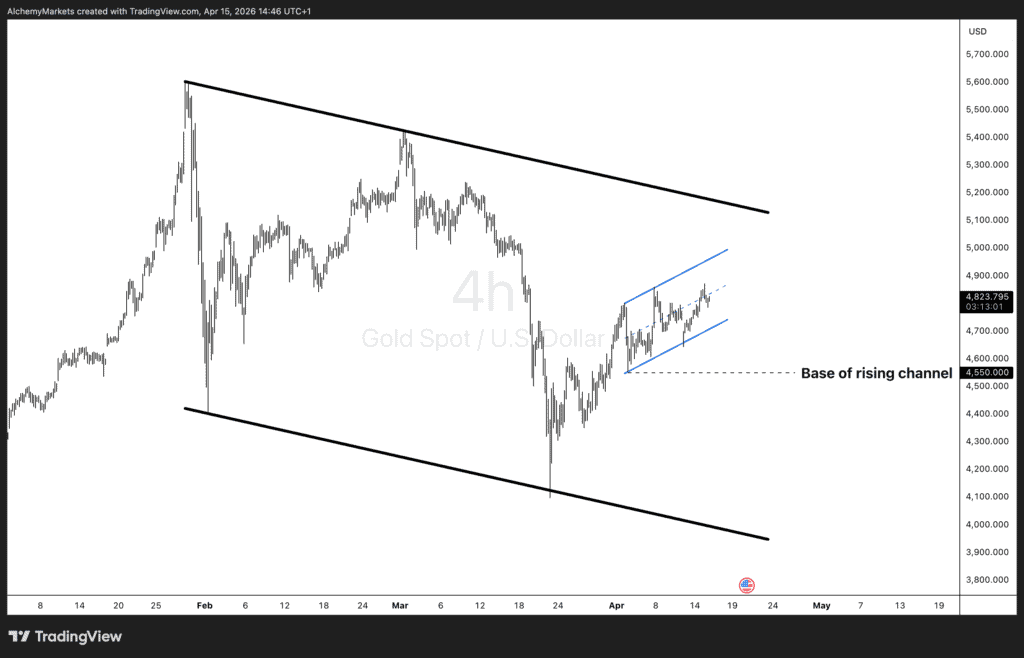
From a structural perspective, the key level isn’t arbitrary — it’s already defined on your chart.
The base of the rising channel (~4,550 area) acts as the first logical downside magnet.
Why this level matters:
- It represents the trend support of the current move
- It’s where buyers have consistently stepped in
- A move back to this level would reflect a normalisation, not a trend reversal
In practical terms:
- Initial breakdown → momentum selling
- Follow-through → test of channel base
- Reaction there determines next phase
Scenario mapping:
Base holds:
- Gold consolidates
- Range forms
- Market waits for next macro catalyst
Base breaks:
- Structure shifts from corrective to directional
- Opens path toward broader downtrend continuation
Opening Bell Takeaway
Gold remains supported — but increasingly vulnerable.
This isn’t a market being driven by new bullish information. It’s being sustained by:
- Existing narratives
- Embedded expectations
- Crowded positioning
That’s an important distinction.
Upside now requires escalation or fresh catalysts.
Downside only requires “less bad” or “nothing new.”
The setup is clear:
- Watch the wedge
- Watch macro confirmation (USD, yields, headlines)
- Respect the 4,550 base as the first downside objective
This is no longer about whether gold is strong —
it’s about whether the market still needs it to be.