Scritto da:


- Weekly Outlook
- Ottobre 30, 2026
- 6 min di lettura
Weekly Market Outlook: Strong Earnings, Hawkish Central Banks and Oil’s Inflation Test
Week commencing 2 November 2026
Global financial markets enter November facing a delicate balance between resilient economic growth and persistent inflationary pressures. A busy week of corporate earnings has highlighted continued strength in technology investment and consumer activity, while the Federal Reserve’s latest policy decision suggests interest rates may need to remain elevated for longer.
With US midterm elections, major economic releases and the Bank of England’s policy decision approaching, investors will be watching whether the economy can maintain its momentum without triggering further monetary tightening.
Earnings and the Federal Reserve: Growth Remains Resilient, but Inflation Complicates the Outlook
The Federal Reserve held interest rates at 3.75%–4.00% this week, describing economic activity as expanding at a strong pace, supported by resilient consumer spending, robust capital investment and productivity growth. However, two policymakers voted for an immediate rate increase, highlighting continued concern over inflation remaining above the central bank’s 2% target.
The decision suggests that the US economy remains strong enough to withstand restrictive monetary policy, reducing the urgency for the Fed to ease financial conditions. Markets must now consider whether persistent inflation will require further tightening, with the December meeting increasingly dependent on incoming economic data.
Corporate earnings have reinforced this picture of economic resilience, particularly across technology and energy.
Microsoft reported quarterly revenue growth of 19%, with Azure expanding 48%, while management forecast further Azure growth of 49%–50% in constant currency for the following quarter. Meanwhile, Alphabet’s revenue increased 25%, supported by Google Cloud growth of 103%, although weaker-than-expected advertising performance and rising investment costs raised questions about profitability and cash generation.
Amazon delivered 12% revenue growth and a record operating margin of 13.9%, with its AWS cloud division expanding approximately 39%. Looking ahead, the company expects fourth-quarter revenue of $240 billion–$247 billion and operating income of $28.5 billion–$33.5 billion, suggesting continued demand heading into the holiday shopping season. However, its substantial AI investment programme is placing pressure on free cash flow.
Energy companies also benefited from the inflationary environment. ExxonMobil and Chevron reported strong quarterly earnings as geopolitical disruptions drove refining margins higher, illustrating how elevated energy costs can support producer profitability while increasing pressures on households and businesses.
Taken together, the earnings picture suggests underlying economic demand remains resilient, particularly in AI infrastructure and cloud services. However, higher energy costs, substantial capital expenditure and restrictive interest rates are creating an increasingly complicated outlook for corporate profitability.
The central question for markets is whether economic growth can remain strong enough to support earnings while inflation begins to moderate, or whether central banks will ultimately need to tighten policy further.
Economic Calendar: A Busy Week for Global Markets
United States
Attention turns to Tuesday’s midterm elections, which could reshape control of Congress and influence the direction of US fiscal, trade and regulatory policy. A divided Congress could limit President Trump’s domestic legislative agenda, potentially shifting greater attention towards executive authority and foreign policy.
Friday’s October employment report will provide another important test for the Federal Reserve. Expectations for approximately 75,000 new jobs and unemployment near 4.2% suggest a relatively stable labour market. However, with inflation still elevated, a stronger-than-expected report could reinforce expectations of additional tightening, while significant labour-market weakness may challenge the Fed’s assessment of economic resilience.
United Kingdom
The Bank of England announces its latest policy decision on Thursday, with policymakers balancing persistent inflation pressures against the impact of higher borrowing costs on economic activity.
Elevated energy prices remain an important concern, particularly if businesses begin passing higher input costs through to consumers. Markets will focus on the Monetary Policy Committee’s vote and updated economic projections for indications of whether further tightening may be necessary.
Eurozone
Wednesday’s October inflation estimate will provide an important update following the European Central Bank’s latest policy meeting. With energy prices elevated, investors will be particularly attentive to underlying inflation pressures beyond energy, including services and food.
Evidence of broader price increases could strengthen expectations of further ECB tightening, while signs of stabilisation may offer some relief to European bond and equity markets.
Technical Outlook: US Oil Could Hold the Key to Inflation Expectations
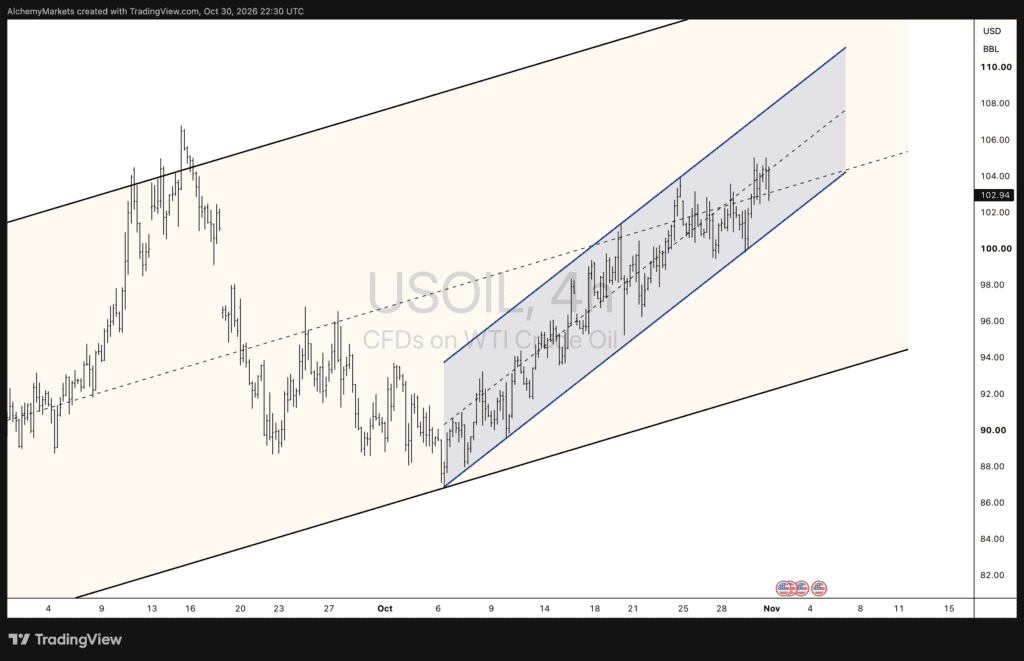
US crude oil remains one of the most important markets to monitor as investors assess the inflation outlook.
September’s US CPI report showed headline inflation reaching 3.7% annually, with gasoline prices rising 9.1% during the month and accounting for more than half of the monthly headline increase. This highlights the considerable influence energy prices have had on the recent inflationary picture.
From a technical perspective, US Oil continues to trade within a rising channel that has guided prices higher since early October. However, the broader structure also shows crude trading within a larger ascending formation, leaving the immediate trend vulnerable should buyers fail to defend the shorter-term channel.
A decisive breakdown below the blue ascending channel would weaken the near-term bullish structure and could open the door towards the lower boundary of the broader channel, currently around the mid-$90 region.
Such a move could carry wider implications beyond the energy market.
Sustained weakness in crude oil, particularly if accompanied by falling gasoline and refined-product prices, could ease headline inflation expectations and reduce pressure on central banks to tighten monetary policy further. Lower energy costs could also support household purchasing power and ease operating expenses for energy-intensive businesses.
This scenario could provide a more supportive backdrop for equities, especially interest-rate-sensitive sectors, although the underlying reason for falling oil prices would remain important. A supply-driven decline would generally be more constructive than one caused by weakening global demand.
Conversely, continued support within the ascending channel and renewed upward momentum would keep inflation concerns elevated, potentially reinforcing expectations that interest rates will remain restrictive.
The technical picture therefore presents an important test for the coming week: whether crude oil’s upward momentum continues to sustain inflation pressures, or a breakdown begins to offer markets some much-needed relief.
The Week Ahead
With earnings pointing towards continued economic resilience and central banks maintaining their focus on inflation, markets face an important week of political and economic catalysts.
The US employment report, European inflation data and Bank of England decision will help shape expectations for monetary policy heading into December. Meanwhile, US Oil’s technical structure could provide an early indication of whether energy-driven inflation pressures are beginning to ease.
For investors, the key question is whether stronger economic growth can coexist with moderating inflation, creating a more supportive environment for risk assets, or whether persistent price pressures will force central banks to maintain an increasingly restrictive stance.