Scritto da:

- Weekly Outlook
- Ottobre 16, 2026
- 13 min di lettura
Nasdaq 100 Eyes Key Support as Inflation and AI Concerns Shake Wall Street
Markets are caught between persistent inflation, the prospect of further Federal Reserve rate hikes and growing concerns over the sustainability of the artificial intelligence investment boom. With the Nasdaq 100 retreating towards a key technical support area, the coming week could prove important for the direction of US equities.
Wall Street caught between two competing risks
Wall Street enters the new trading week facing an increasingly complicated outlook. Just as investors were adjusting to the possibility of further Federal Reserve interest rate hikes, concerns surrounding the financial sustainability of the artificial intelligence boom have introduced another source of uncertainty.
The latest US inflation figures surprised to the upside, reinforcing concerns that price pressures remain too persistent for the Fed to comfortably ease monetary policy. Higher inflation typically strengthens the case for tighter policy, pushing borrowing costs higher and weighing on equity valuations, particularly among growth-oriented technology companies.
However, the bond market’s initial reaction proved short-lived.
US two-year swap rates initially surged by approximately 20 basis points following the inflation release, before reversing as concerns surrounding AI infrastructure financing triggered a reassessment of the economic outlook.
At the centre of the latest uncertainty is AI cloud provider CoreWeave, whose shares and bonds have come under considerable selling pressure. Rising borrowing costs and the substantial debt required to finance data centres have raised questions about whether the sector’s aggressive investment cycle can maintain its current pace.
The concern extends beyond a single company. AI-related investment has become an important contributor to US economic growth, supporting demand for semiconductors, computing infrastructure, electricity and construction. Any meaningful slowdown in this spending could therefore have wider implications for corporate earnings and economic activity.
This leaves investors navigating two competing risks: inflation that keeps interest rates higher for longer, and an increasingly fragile technology-led growth outlook that could eventually discourage further tightening.
Could the Fed be tightening into a slowing economy?
The dilemma facing the Federal Reserve is becoming increasingly apparent.
While inflation remains elevated, there are reasons to believe some of the underlying pressures could moderate over the coming quarters. A subdued US housing market should gradually ease rental inflation, while slower wage growth could reduce pressure on labour-intensive services.
Nevertheless, rising energy prices, partly driven by ongoing Middle East tensions, complicate the outlook. Higher oil prices risk keeping headline inflation elevated while simultaneously squeezing household spending power and corporate profitability.
Meanwhile, economic growth outside the AI investment cycle appears considerably less convincing. Higher borrowing costs continue to weigh on interest-rate-sensitive industries, while financial pressure among lower-income consumers raises questions about the resilience of domestic demand.
The risk is that monetary policy becomes increasingly restrictive for the broader economy, even as investment linked to artificial intelligence remains comparatively resilient.
For equity markets, the distinction matters. If inflation remains the dominant concern, further rate hikes could place additional pressure on valuations. Conversely, if growth concerns begin to outweigh inflation fears, expectations for future monetary tightening could soften.
That would not necessarily translate into an immediate equity recovery, particularly if deteriorating growth expectations begin to threaten corporate earnings.
The coming weeks may therefore be less about whether the Fed raises rates again and more about whether the US economy can absorb further tightening without undermining the investment boom that has supported much of the market’s recent strength.
Economic calendar: What to watch next week
Although next week’s calendar is relatively light on major US releases, several indicators could help investors assess whether growth is holding up against persistent inflation and tighter financial conditions.
US housing activity, weekly jobless claims and Friday’s preliminary PMI surveys will be particularly relevant. Meanwhile, UK inflation and employment figures could influence expectations for the Bank of England’s next policy decision.
| Date | Time (UK) | Currency | Economic event | Previous | Forecast |
|---|---|---|---|---|---|
| Mon 19 Oct | 15:00 | USD | NAHB Housing Market Index | 32 | 31 |
| Tue 20 Oct | 07:00 | GBP | Unemployment Rate | 4.9% | 4.9% |
| Tue 20 Oct | 13:30 | USD | Building Permits | 1.403M | 1.385M |
| Tue 20 Oct | 13:30 | USD | Housing Starts | 1.275M | 1.305M |
| Wed 21 Oct | 07:00 | GBP | CPI YoY | 3.1% | 3.4% |
| Thu 22 Oct | 13:30 | USD | Initial Jobless Claims | 199K | 200K |
| Fri 23 Oct | 14:45 | USD | Flash Manufacturing PMI | 55.9 | 55.5 |
| Fri 23 Oct | 14:45 | USD | Flash Services PMI | 58.8 | 57.9 |
Times are BST, with forecasts available as of 16 October 2026. Sources: TD Economics, New York Fed and ONS.
Thursday’s US initial jobless claims will offer another indication of labour market conditions. A sustained rise in claims could strengthen concerns about weakening employment, potentially reducing expectations for further Fed tightening.
Friday’s preliminary manufacturing and services PMI figures may prove particularly important. Investors will be watching whether business activity remains resilient or begins showing signs of slowing under the weight of higher borrowing costs.
A weaker-than-expected reading could add to concerns about the broader economic outlook. However, stronger activity, particularly alongside persistent price pressures, could reinforce expectations that the Fed has more work to do.
The key question will be whether incoming data points towards an economy that is cooling sufficiently to ease inflation without suffering a more significant slowdown.
Nasdaq 100 technical outlook: March-anchored VWAP in focus
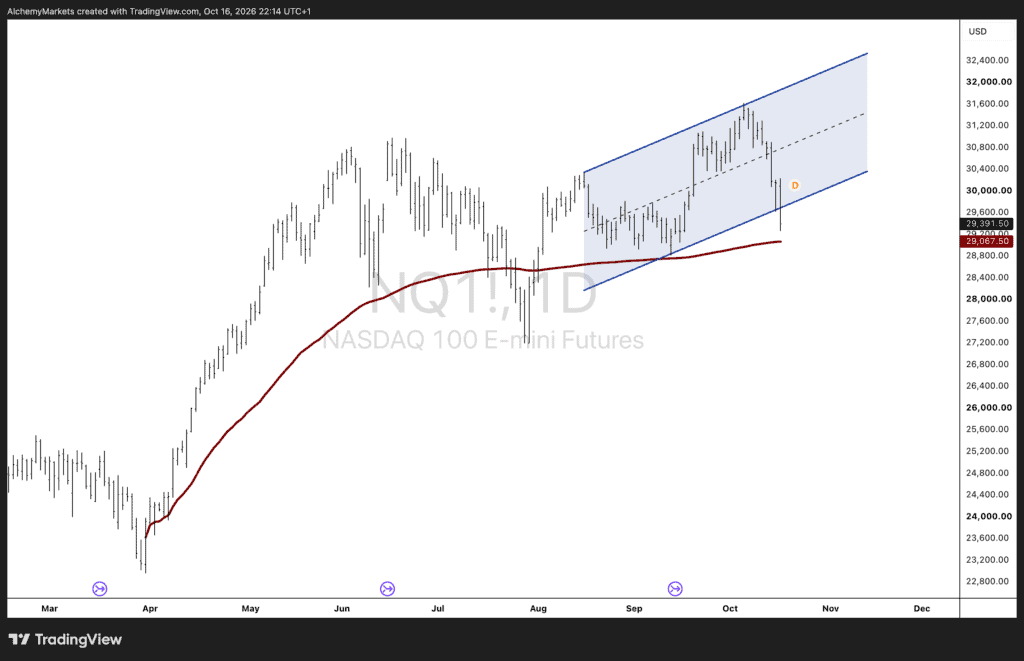
Following a period of sustained strength, Nasdaq 100 futures have come under renewed selling pressure as investors reassess technology valuations against the backdrop of higher interest rates and growing uncertainty surrounding AI investment.
The recent decline has brought attention to an important technical area: the anchored volume-weighted average price (AVWAP) measured from the March 2026 lows.
This indicator represents the average price paid, weighted by trading volume, since the selected March low. It provides a useful reference for assessing whether buyers who participated in the subsequent advance may defend their positions.
As prices approach this area, the March-anchored VWAP could offer a potential zone of dynamic support.
A successful test, followed by signs of buying interest and a recovery in upward momentum, would support the possibility that the current decline represents a corrective move within the broader advance.
Such a development could open the door to a recovery towards recent resistance levels, particularly if Treasury yields stabilise and concerns surrounding AI financing begin to ease.
However, the bullish scenario remains conditional.
A sustained break below the anchored VWAP, particularly if accompanied by stronger selling volume and weakening market breadth, would suggest that the correction may have further to run.
In that scenario, attention could shift towards lower structural support areas as investors continue adjusting their expectations for monetary policy and technology-sector earnings.
Our base case is that the March-anchored VWAP represents an important potential support area, where buyers may attempt to regain control. Nevertheless, confirmation through price action will be important before interpreting any recovery as a more durable reversal.Technical analysis is based on the proposed March-anchored VWAP setup; an exact NQ chart and live AVWAP level have not been supplied, so a support test is not yet confirmed.
Outlook for the week ahead
The Nasdaq 100 enters the new week at an interesting crossroads.
Persistent inflation continues to challenge expectations for monetary policy, while growing concerns over AI infrastructure financing threaten one of the principal drivers of US equity-market performance.
For now, the broader outlook remains uncertain rather than decisively bearish. The Fed’s next steps will depend on whether inflation remains stubbornly elevated or whether signs of slowing economic activity begin to justify a more cautious approach.
Against this backdrop, the March-anchored VWAP on Nasdaq 100 futures could become an important technical reference in the coming sessions.
A constructive reaction around this support area, particularly alongside stabilising bond yields, would strengthen the case for a near-term recovery. Conversely, a decisive break lower could suggest that the market’s reassessment of growth and interest-rate expectations has further to run.
For the week ahead, our attention remains on whether buyers can defend this technical support area as markets attempt to find a balance between inflation risks and increasingly uncertain growth expectations.