Scritto da:


- Weekly Outlook
- Ottobre 9, 2026
- 5 min di lettura
S&P 500: Is Wall Street Entering Bubble Territory?
Week Ahead: 12–16 October 2026
Wall Street continues to push into record territory, but beneath the surface, questions are growing over whether the US equity market is becoming increasingly vulnerable to a correction.
The S&P 500 recently reached fresh all-time highs, supported by enthusiasm surrounding artificial intelligence, resilient corporate earnings and expectations of continued economic growth. However, concerns over stretched valuations, concentrated market leadership and the sustainability of AI-related investment are beginning to challenge the bullish narrative.
One of the biggest concerns surrounds the enormous capital expenditure being committed to AI infrastructure. Technology giants continue to invest heavily in data centres, semiconductors and computing capacity, but investors are increasingly questioning whether these investments will generate sufficient returns to justify their costs.
Importantly, this does not necessarily mean the broader equity market is experiencing a speculative bubble. Unlike the dot-com era, today’s leading technology companies generate substantial revenues, profits and cash flows.
Nevertheless, even fundamentally strong companies can become vulnerable when market expectations run ahead of their ability to deliver.
Another concern is the increasingly narrow nature of the rally. While the S&P 500 has continued setting records, gains have become concentrated among a relatively small group of technology companies, leaving the broader market more exposed should sentiment towards these market leaders deteriorate.
For now, the underlying economic and earnings picture offers reasons for optimism. However, with valuations leaving less room for disappointment, incoming economic data could play an increasingly important role in determining whether the rally extends or gives way to a deeper correction.
Economic Calendar: Inflation and Consumer Spending Take Centre Stage
The upcoming week brings several important US economic releases, with inflation and consumer spending likely to dominate market attention.
Wednesday, 14 October – US Consumer Price Index (CPI)
Wednesday’s September inflation report could prove the week’s most influential release, particularly as investors assess the Federal Reserve’s next policy moves.
The previous headline CPI reading stood at 3.4% annually, while monthly inflation increased by 0.4%.
A softer-than-expected inflation reading could ease concerns over further monetary tightening, potentially supporting equities through lower Treasury yields and improved valuations.
Conversely, persistent inflation could reinforce expectations that interest rates will remain elevated, placing pressure on equity valuations, particularly among growth-oriented technology companies.
Thursday, 15 October – US Retail Sales
Attention will subsequently turn towards September’s retail sales figures, offering an important indication of the strength of American consumer spending.
The previous headline reading showed monthly growth of 1.2%.
Another resilient reading could support expectations of continued economic expansion and corporate earnings growth. However, stronger spending could also complicate the inflation outlook if it reinforces expectations of restrictive monetary policy.
A weaker reading, meanwhile, could strengthen the case for monetary easing, although a substantial deterioration would raise concerns over consumer demand and the broader economic outlook.
Thursday, 15 October – US Producer Price Index (PPI)
Thursday also brings September’s producer inflation figures, providing further insight into underlying price pressures faced by American businesses.
The previous headline PPI reading increased by 0.4% month-on-month.
A moderation in producer prices could offer some reassurance that inflationary pressures are easing, potentially supporting corporate profit margins.
Alternatively, another elevated reading could suggest businesses continue facing persistent input-cost pressures, reinforcing concerns over inflation and the outlook for interest rates.
Together, these releases will help investors determine whether economic conditions remain supportive of further equity gains or whether inflation and slowing demand could begin challenging the market’s optimistic earnings expectations.
S&P 500 Technical Analysis: Anchored VWAP Provides Support
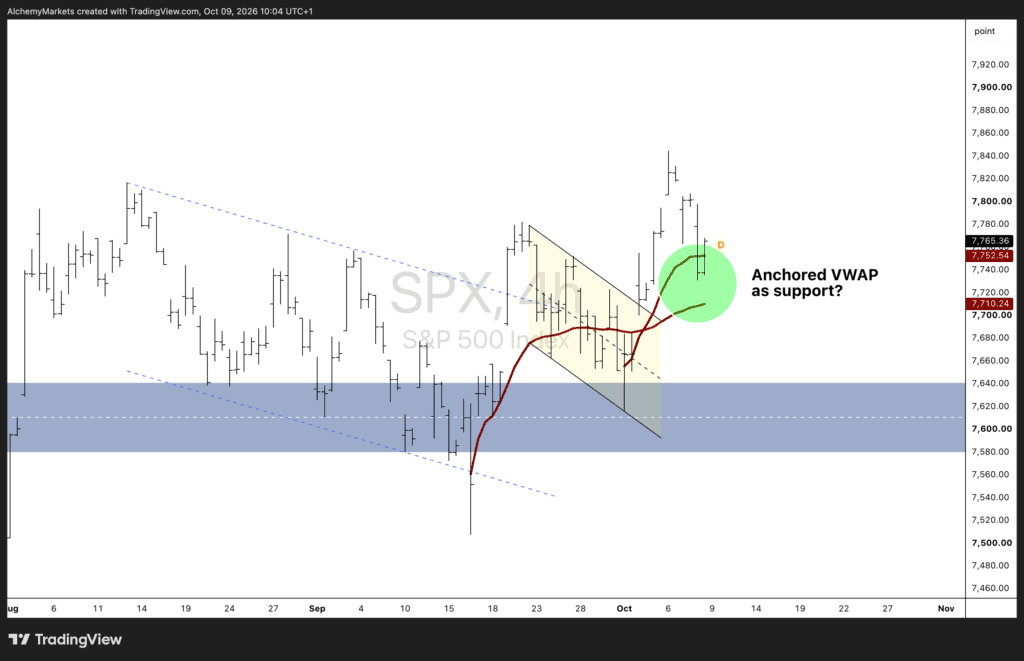
Turning to the technical picture, the S&P 500 recently broke above its previous highs, extending its bullish momentum towards the 7,840 region.
However, the breakout proved short-lived, with the index quickly surrendering its gains and retreating towards the 7,750 area.
Despite the pullback, buyers have so far defended an important technical area around the anchored Volume Weighted Average Price (VWAP), measured from the September lows.
This area also coincides with the higher-low structure established at the beginning of October, suggesting the recent decline could represent a corrective pullback rather than the beginning of a broader bearish reversal.
The index’s ability to maintain support around this region will be important heading into next week’s economic releases.
Should buyers successfully defend the 7,750–7,710 support region, the broader bullish structure could remain intact, opening the possibility of another advance towards 7,800 and a subsequent retest of the recent all-time highs around 7,840.
Conversely, a sustained break below this support area could weaken the near-term bullish outlook, potentially exposing the previous demand zone between 7,580 and 7,640.
Weekly Outlook
The S&P 500 enters the new trading week at an interesting crossroads.
Although concerns over stretched valuations and the sustainability of AI investment remain important risks, the technical picture continues to favour the broader bullish trend while the index maintains its recent higher-low structure.
Our base case remains cautiously bullish, provided the S&P 500 continues defending the anchored VWAP support region around 7,750–7,710.
However, with US inflation and retail sales figures approaching, increased volatility should not be ruled out.
A favourable combination of moderating inflation and resilient consumer spending could provide the catalyst for another attempt at record highs. Conversely, unexpectedly strong inflation or evidence of deteriorating demand could undermine sentiment and increase the risk of a deeper correction.
For now, the key question is whether the recent retreat from all-time highs represents healthy profit-taking within an established uptrend or the early stages of a broader change in market sentiment.