Written by:


- Weekly Outlook
- September 25, 2026
- 6 min read
Strong US PMIs Put Jobs Back in the Spotlight
US economic data has once again complicated the outlook for the Federal Reserve.
This week’s flash PMI surveys pointed to a sharp acceleration in US activity. The S&P Global US Composite PMI rose from 56.0 in August to 58.4 in September, its strongest reading since July 2021. Both manufacturing and services strengthened, while employment growth accelerated and business costs picked up. S&P Global described the combination as a distinctly hawkish signal for interest rates.
That matters because markets are currently trying to decide whether the Federal Reserve’s tightening cycle has further to run.
The PMI data suggests that economic activity is not rolling over under the weight of higher rates. If anything, the September surveys point towards an economy retaining considerable momentum. At the same time, stronger demand, tighter capacity and rising input costs increase the risk that inflation remains sticky.
The causal chain is therefore becoming increasingly important:
stronger activity → resilient employment and demand → persistent inflation pressure → less urgency for the Fed to stop tightening.
That does not guarantee another rate increase in October, but it keeps the possibility firmly in play.
The important point for markets is that one PMI report should not be treated as a complete change in regime. PMI surveys are leading indicators, particularly the forward-looking orders and activity components, while employment and inflation data help confirm whether that signal is feeding through into the wider economy.
The next two major US releases will therefore be particularly important.
United States: Jobs Report Takes Centre Stage
The September Employment Situation report is scheduled for Friday 2 October.
August payrolls surprised strongly to the upside, with the US economy adding 162,000 jobs, while the unemployment rate remained unchanged at 4.1%.
However, the broader labour-market story remains more nuanced than that headline suggests. The economy has generally been operating under a low-hiring, low-firing dynamic, making it important to see whether August represented the beginning of a genuine reacceleration or simply a stronger month within an otherwise softer trend.
Our base case is for September payroll growth to moderate towards roughly 100,000, with unemployment remaining around 4.1%.
Such an outcome would probably leave the October Fed decision finely balanced rather than resolving it.
A substantially stronger report would be more consequential. Strong payroll growth, resilient wages and stable unemployment would reinforce the message from the PMIs that demand remains robust. That could keep upward pressure on Treasury yields and strengthen expectations that the Fed still has work to do.
Conversely, a clearly weaker report could begin challenging the PMI signal. If hiring deteriorates materially while unemployment rises, markets may become more reluctant to price additional tightening.
The labour report therefore matters less because employment is itself a leading indicator and more because it will tell us whether the stronger activity signal coming from the PMIs is beginning to show up in the hard data.
The next major piece of the US puzzle will then be September CPI on 14 October.
That creates a clear sequence for markets:
PMIs → payrolls → inflation → Fed.
Each release will either strengthen or weaken the argument for another move from the Federal Reserve.
Eurozone: Is the Energy Shock Spreading?
Europe faces a different version of the inflation problem.
Euro-area inflation rose to 3.2% in August from 2.9% in July, but much of the acceleration has been driven by energy. Energy prices were running 14.3% higher year-on-year, while the narrower core measure excluding energy, food, alcohol and tobacco remained considerably more contained at 2.4%.
That distinction matters.
An energy-driven inflation shock is very different from a broad-based acceleration in underlying inflation.
The key question for Friday’s September flash inflation report is therefore whether higher energy costs are beginning to generate second-round effects elsewhere in the economy.
The areas worth watching closely will be services inflation and broader core prices.
If underlying inflation remains relatively stable while headline inflation stays elevated because of energy, policymakers may continue to view the shock as partly external.
If services and core inflation begin accelerating as well, however, the picture becomes more difficult.
That would suggest the original energy shock is increasingly being passed through into wages, pricing behaviour and the wider economy — a much more persistent form of inflation.
Eurostat is scheduled to release the September flash inflation estimate on Friday 2 October.
The PMI surveys have already provided an early warning. September activity across the eurozone improved, but cost pressures remained elevated across the major developed economies, reinforcing the risk that inflation remains sticky even as growth holds up.
S&P 500 Technical Outlook
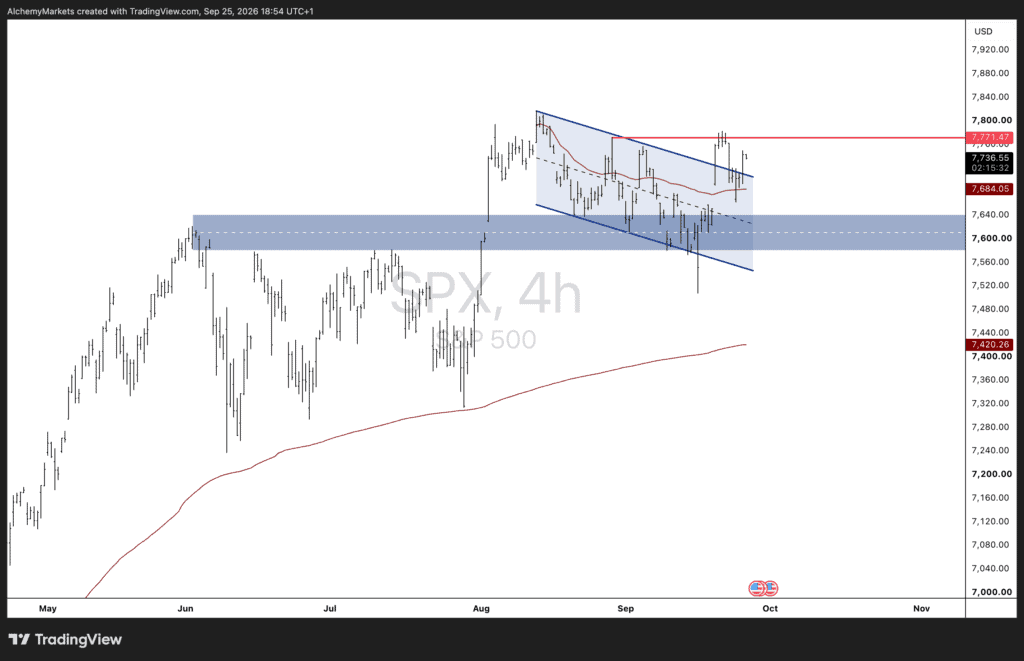
The macro backdrop leaves the S&P 500 approaching an important technical decision point.
The key upside level remains around 7,771.
A sustained break and hold above this area would suggest buyers are beginning to absorb the recent hawkish repricing in rates and could open the door to another leg higher.
The more interesting scenario, however, comes if price continues to reject the level.
If Treasury yields remain elevated and incoming economic data reinforces expectations of further Fed tightening, failure to clear 7,771 would leave the index vulnerable to another move lower.
In that scenario, the next major support area sits around 7,600.
The chart therefore gives us a relatively clean framework for the week ahead:
Break and hold above 7,771: bullish continuation becomes more credible.
Continued rejection below 7,771: risk remains tilted towards another test of the 7,600 support area.
As always, the technical picture should confirm the macro thesis rather than create it. The chart is the timing mechanism; the economic data determines whether the fundamental backdrop is becoming more or less supportive.
The Week Ahead
The central question facing markets next week is becoming increasingly clear:
Is the US economy simply resilient, or is it strong enough to force the Federal Reserve into further tightening?
September’s PMIs pushed the argument towards the latter. Growth accelerated, employment improved and cost pressures strengthened.
Now payrolls have to confirm it.
A strong employment report would reinforce the hawkish message from the surveys and could keep pressure on bonds and equity valuations.
A softer report would challenge that narrative and reopen the possibility that the September PMI acceleration proves harder to sustain.
Meanwhile, Europe will be watching a different transmission mechanism: whether the recent energy-driven inflation shock remains concentrated in headline prices or begins spreading into underlying inflation.
For equities, that leaves the S&P 500 caught between improving economic growth and the increasingly uncomfortable consequence of that strength — the possibility that interest rates remain higher for longer.
With 7,771 resistance above and 7,600 support below, the next round of economic data could determine which side of that range breaks first.