Written by:

- Weekly Outlook
- April 10, 2026
- 4 min read
CPI Signals, Key Data Ahead, and S&P 500 Technical Scenarios
Markets are heading into next week at a critical juncture. Inflation data has provided some relief beneath the surface, but geopolitical risks and energy prices continue to dominate sentiment. The Federal Reserve remains firmly data-dependent, while developments around the Strait of Hormuz continue to influence expectations for inflation and growth.
This outlook breaks down into three key areas: CPI, the upcoming economic calendar, and S&P 500 technical scenarios.
1. CPI Breakdown: Headline Strength, Core Weakness
The latest US CPI report delivered a split outcome. On the surface, inflation looks firm, but the underlying details tell a more constructive story.
Headline CPI: Energy-Driven Strength
- +0.9% month-on-month, in line with expectations
- Gasoline prices surged 21.2% month-on-month
- Airline fares rose 2.7%
- Apparel increased 1%
This confirms that the upside in inflation is being driven primarily by energy rather than broad-based price pressures.
Core CPI: Softer Than Expected
- +0.2% month-on-month (vs 0.3% expected)
- 2.6% year-on-year (vs 2.7% expected)
Key contributors to the downside:
- Used car prices fell 0.4%
- Medical care declined 0.2%
- Other goods and services dropped 0.4%
- Housing rose 0.3%, remaining stable
The takeaway is clear: underlying inflation pressures are easing.
Why This Cycle Is Different
This is not a repeat of the 2021–2022 inflation shock. Back then, inflation was driven by strong demand, rapid wage growth, and excess savings. Today, the backdrop is very different:
- Wage growth is closer to 3%
- Real household incomes are flat
- Consumer confidence is weaker
- There is no large-scale fiscal stimulus
Inflation is now largely a supply-side energy shock, not a demand-driven overheating.
Implications for Growth and Policy
Higher fuel costs are likely to act as a drag on demand rather than fuel sustained inflation.
- Consumers spend more on energy
- Discretionary spending declines
- Real income growth turns negative
This dynamic supports the argument that inflation pressures could fade over time, particularly if energy prices stabilize or decline.
From a policy perspective:
- The Federal Reserve is likely to look through energy-driven spikes
- Focus remains on core inflation and labor market conditions
- Rate cuts remain more likely than hikes, assuming inflation expectations stay anchored
2. Next Week’s Economic Calendar: Limited Data, Important Signals
While the calendar is relatively light, several releases will help shape expectations around inflation and growth.
Key Data Releases
Federal Reserve Beige Book (Wednesday)
The Beige Book from the Federal Reserve provides qualitative insight into economic conditions.
Expected themes:
- Increased corporate caution
- Slower hiring trends
- Ongoing cost pressures
This report is important because it feeds directly into policy discussions.
Primary Market Driver Remains Geopolitics
Despite the data releases, market direction will continue to be driven by:
- US–Iran negotiations
- Oil price movements
- Developments around the Strait of Hormuz
3. S&P 500 Technical Analysis (SPX)
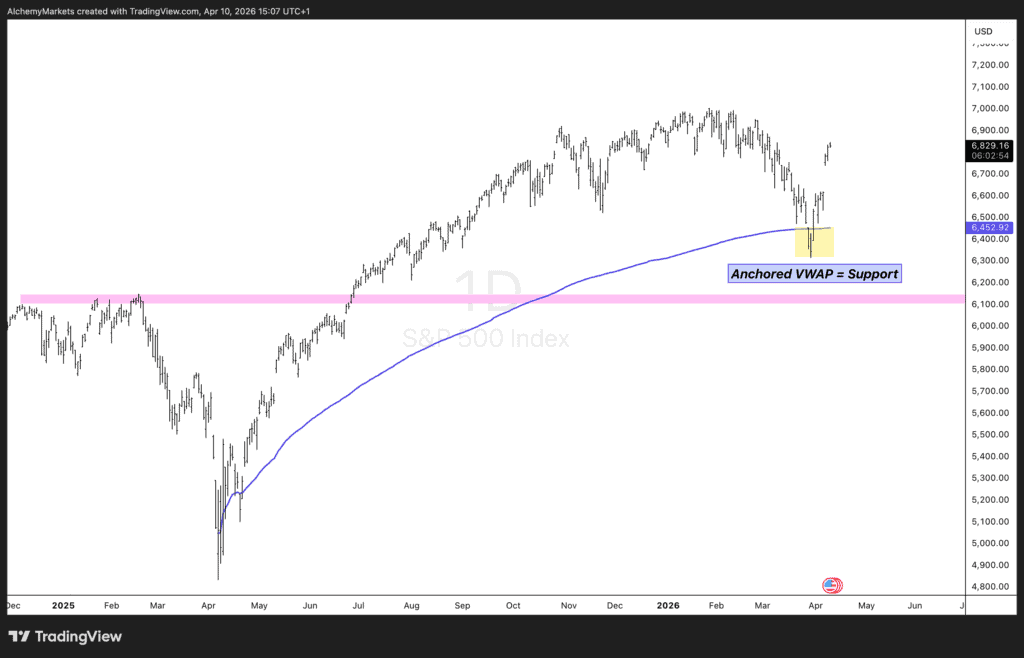
The S&P 500 is currently at a technically significant level, with price reacting around key support and forming a potentially decisive structure.
Current Structure
- Price has pulled back from recent highs
- Now testing anchored VWAP support near the 6,450 area
- Price action suggests a developing corrective phase
Bullish Scenario: De-escalation and Continuation
If geopolitical risks ease and energy prices stabilize, the market has room to recover.
Catalysts:
- De-escalation in Iran tensions
- Oil prices moving lower
- Continued softness in core inflation
Technical confirmation:
- Price holds above VWAP support
- Break above descending resistance
- Reclaim of the 6,900 level
In this scenario, the recent decline would be viewed as a temporary correction within a broader uptrend.
Bearish Scenario: Escalation and Deeper Correction
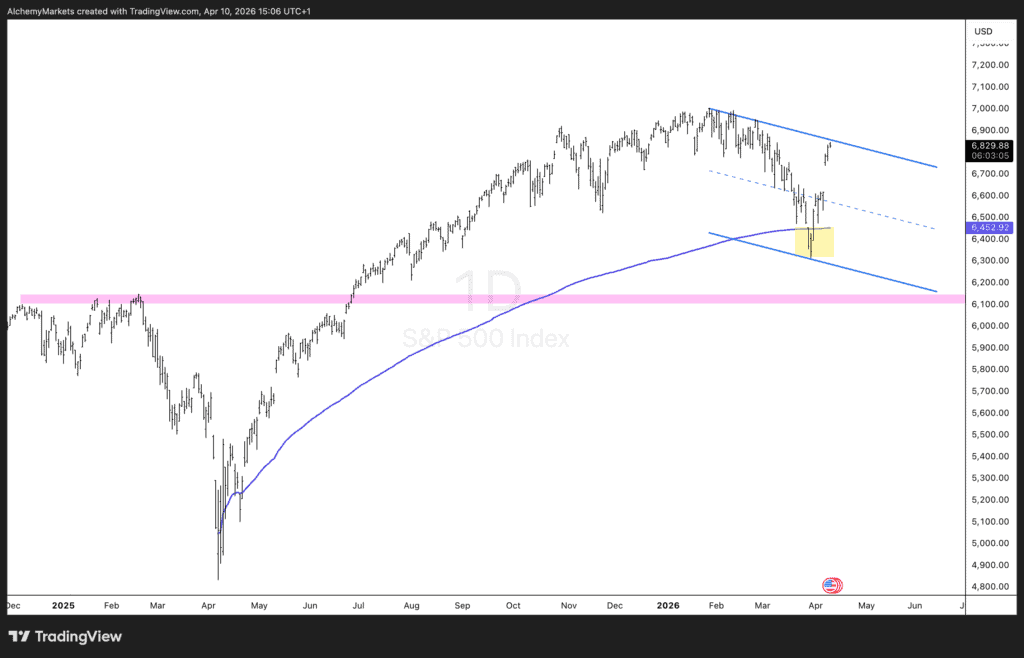
If risks intensify, the current structure could evolve into a larger corrective pattern.
Catalysts:
- Escalation in the Iran conflict
- Sustained rise in oil prices
- Shift higher in inflation expectations
Technical structure:
- Development of a broader corrective channel or flag
- Continued lower highs and lower lows
Key level:
- 6,100 horizontal support zone
This level is critical. A break below it would likely signal a deeper correction, while a hold could form a base for recovery.
Final Takeaway
Markets are balancing two competing forces.
On one side:
- Cooling core inflation
- Weakening demand
- Potential for rate cuts
On the other:
- Energy-driven inflation risks
- Geopolitical uncertainty
- Volatility in oil markets
At this stage, the most important variable remains energy.
Oil prices will determine:
- The path of inflation
- The timing of central bank policy
- The direction of equity markets
As a result, developments tied to the Middle East and global energy flows will continue to be the dominant driver in the near term.