Skriven av:

- Weekly Outlook
- september 14, 2026
- 7 min läsning
S&P 500: Fed Takes Centre Stage After Hot CPI
The S&P 500 heads into the new week with monetary policy firmly back at the centre of the market narrative. Last week’s US inflation report strengthened the case for the Federal Reserve to resume tightening, while the index itself has slipped back towards an important area of technical support.
August CPI rose 0.4% month-on-month and 3.4% year-on-year, while core CPI increased 0.3% on the month. The important takeaway was not simply that headline inflation accelerated — energy contributed heavily — but that underlying inflation was also firmer than expected. Coming after stronger producer-price data and against a backdrop of oil trading above $100 per barrel, the report weakened the argument that the Fed could comfortably remain patient.
That has produced a fairly dramatic repricing of the September meeting. Before the CPI report, markets were assigning roughly a two-thirds probability to a hike. That probability has since risen to around 85–87%, while Goldman Sachs and JPMorgan have now shifted their forecasts towards a September increase.
The change is particularly important following Fed Chair Kevin Warsh’s hawkish shift at Jackson Hole. The message has increasingly been that inflation has remained above target for too long, employment remains relatively firm and financial conditions are not sufficiently restrictive to rule out further tightening.
So Wednesday’s decision is no longer simply about whether the Fed hikes.
The bigger question for markets is:
Is September a one-off recalibration, or the beginning of another tightening cycle?
That distinction could determine the next major move in equities.
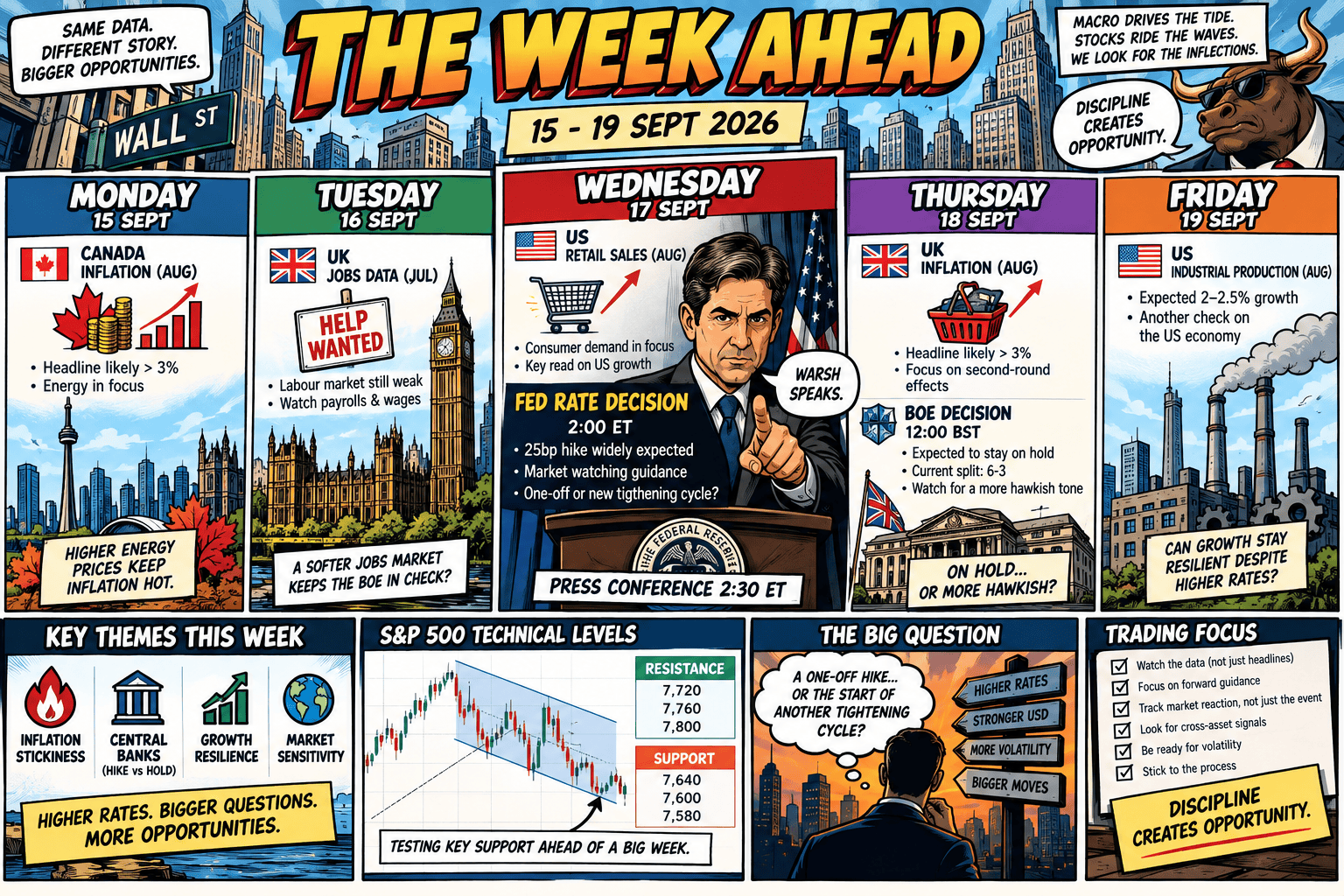
Wednesday: Fed decision becomes the week’s main event
The Federal Reserve concludes its two-day meeting on Wednesday 16 September, with the policy decision at 2pm Eastern Time followed by Chair Warsh’s press conference. Importantly, this is also a meeting accompanied by updated economic projections.
A 25bp increase is now largely expected, meaning the surprise threshold has shifted. A hike on its own may not necessarily be bearish if Warsh presents it as an insurance move designed to prevent the recent inflation shock becoming embedded.
The more difficult scenario for equities would be a hike accompanied by language suggesting that further tightening is likely.
That would push the discussion from:
one-off inflation adjustment
towards:
higher-for-longer rates + additional hikes + rising real yields.
That is a much tougher environment for equity valuations, particularly if longer-dated Treasury yields continue moving higher.
Conversely, the more constructive scenario would be a 25bp increase accompanied by acknowledgement that much of the recent inflation impulse reflects energy and other external shocks. In that case, the Fed could hike while still signalling that future decisions remain highly data dependent.
For the S&P 500, therefore, the forward policy path matters more than the headline 25bp decision itself.
US data: can growth absorb tighter policy?
The Fed isn’t the only US event to watch.
August retail sales are released on Wednesday, giving markets another look at whether household demand is holding up despite higher prices and borrowing costs. August housing starts and building permits follow on Thursday.
Industrial production later in the week will provide another check on the underlying growth picture.
This creates an interesting tension.
If activity remains consistent with roughly 2–2.5% growth, the Fed has greater freedom to tighten because the economy appears capable of absorbing it.
For equities, however, there is a point where good economic news becomes uncomfortable:
resilient growth + sticky inflation → Fed has room to hike → yields remain elevated → valuation pressure increases.
A softer activity picture would lower the case for repeated hikes, but markets would then need to distinguish between a welcome cooling in demand and a genuine deterioration in growth.
That growth-versus-inflation balance is likely to remain one of the dominant equity drivers over the coming weeks.
S&P 500: support is being tested
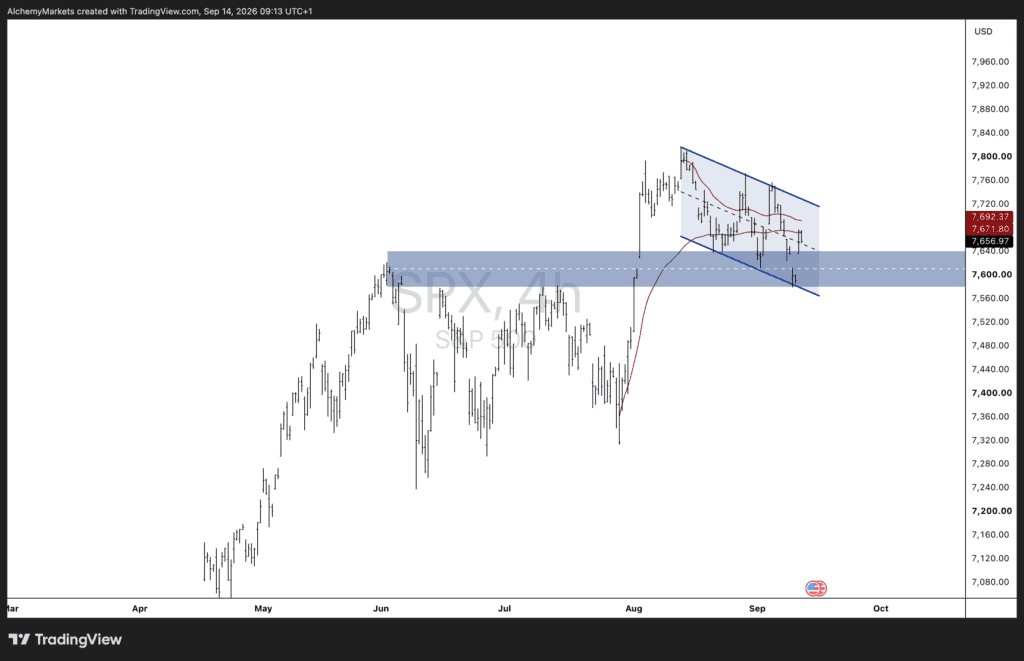
Technically, the S&P 500 enters this event-heavy week in a vulnerable but important position.
Following the August peak near 7,800, price has been making a series of lower highs inside a descending channel. The index is also trading below the short-term moving averages, showing that near-term momentum has weakened.
However, price has now fallen back into the 7,580–7,640 support area, which broadly corresponds with the previous June breakout region.
That makes this a particularly useful decision point.
Bullish scenario
For the bullish case, buyers need to defend this support zone and begin reclaiming the short-term trend structure.
An initial recovery back through roughly 7,670–7,700 would be constructive, while a break above the descending channel around 7,720 would provide stronger evidence that the recent move has simply been a correction within the broader uptrend.
From there, 7,760 and the 7,800–7,820 highs become the obvious areas to watch.
Fundamentally, that scenario becomes more likely if the Fed delivers the expected hike but resists validating a prolonged hiking cycle.
In simple terms:
25bp hike + cautious guidance + stable yields → support holds → potential bullish continuation.
Bearish scenario
The bearish setup becomes more compelling if the index loses the current support zone decisively.
A sustained break below approximately 7,580–7,600 would represent both a failure of horizontal support and a continuation through the lower portion of the descending channel.
That would suggest the market is no longer merely consolidating after the summer rally and could open the way towards the next lower support areas.
The macro catalyst for that break would likely be a more aggressive Fed message:
hike + additional tightening signalled + Treasury yields higher → valuation compression → support fails.
That is the key downside risk this week.
The chart is therefore giving us a useful framework: the market is sitting near support immediately before an event capable of deciding whether that support holds or breaks.
UK: inflation meets the Bank of England
The UK also has an unusually busy week.
Labour-market figures arrive on Tuesday 15 September, followed by August CPI on Wednesday and the Bank of England decision on Thursday. These dates are confirmed by the ONS and Bank of England calendars.
The labour market has softened, with weaker hiring helping to contain wage pressure. That matters because the Bank is likely to distinguish between the first-round effect of higher energy costs and evidence that those costs are generating broader wage and services inflation.
Headline inflation could therefore move above 3% without automatically producing another rate rise.
The Bank kept rates at 3.75% by a 6–3 vote in July, with the minority favouring a 25bp increase. The September meeting will show whether recent energy developments have shifted that balance further towards the hawks.
Our base case remains that the Bank stays on hold. The important question will be whether the vote becomes more hawkish and whether policymakers show increased concern about second-round inflation effects.
Canada: inflation remains the focus
Canadian inflation is another important early-week release.
Higher energy prices could push headline annual inflation above 3%, potentially adding to the Bank of Canada’s recent hawkish tone.
However, just as with the UK, the composition will matter more than the headline alone. If higher inflation is largely an energy story without broader persistence through underlying prices and wages, the case for an immediate policy response remains weaker.
The bigger picture
This week is ultimately about whether the global inflation shock is strong enough to restart a genuine tightening cycle.
Oil above $100, stronger US inflation and resilient activity have already moved the debate significantly. The ECB has tightened, markets expect action from the Fed, and investors are becoming increasingly sensitive to the possibility that the period of stable policy rates is ending.
For the S&P 500, that means the key relationship to watch is not simply Fed hikes = stocks down.
It is:
What does the Fed decision do to the expected path of rates and Treasury yields?
A one-off September adjustment that contains inflation expectations without producing a sustained rise in yields could allow equities to stabilise and resume their broader trend.
But if Warsh validates the idea that September is the beginning of renewed monetary tightening, the market may have to discount a higher cost of capital at exactly the point where the S&P 500 is testing technical support.
Weekly bias: neutral while the S&P 500 remains around the 7,580–7,640 support zone. A successful defence followed by a break of the descending channel would restore the bullish continuation case; a decisive loss of support alongside a hawkish Fed would shift the near-term balance towards a deeper correction.