Scritto da:


- Weekly Outlook
- Settembre 18, 2026
- 5 min di lettura
Oil Pulls Back as Supply Fears Ease — Can WTI Correct Towards Channel Support?
Oil markets head into next week with a noticeably different tone. After WTI surged above $105 earlier this month as attacks on Saudi Arabia’s East-West Pipeline raised fears of a major supply disruption, prices have now started to unwind part of that geopolitical premium.
The original rally was straightforward: disruption to the Saudi pipeline and reduced traffic through the Strait of Hormuz threatened a meaningful portion of global supply. WTI climbed to around $106 as markets priced the possibility that Saudi barrels could struggle to reach global buyers.
That story has since softened. Saudi Aramco is increasing Gulf exports through Ras Tanura and using ship-to-ship transfers around Oman, helping replace some of the disrupted Red Sea exports. Around 1–1.5 million barrels per day are expected to move through these alternative routes, which has reduced fears of an immediate shortage. At the same time, refined-product inventories have increased across several major markets and Chinese fuel exports have risen.
There is also now a monetary-policy headwind. The Federal Reserve raised rates by 25 basis points this week to 3.75–4.00% and maintained a relatively hawkish stance. Higher rates can weigh on expected economic activity and therefore future oil demand, while the stronger dollar following the decision adds another headwind to dollar-priced commodities.
So the short-term equation has shifted from:
supply disruption + geopolitical fear = higher oil
towards:
supply rerouting + tighter monetary policy + demand concerns = geopolitical premium unwinding
That leaves our base case biased towards a further corrective move in WTI next week, although Middle East risks remain high enough that the bearish view needs to remain flexible.
Next Week’s Economic Calendar
The US data towards the end of the week should be particularly important because markets will now be asking whether the Fed’s tighter stance is being accompanied by weaker economic momentum.
| Date & Time | Market | Event | Previous | Forecast | Why it matters |
|---|---|---|---|---|---|
| Wed 23 Sep – 09:00 | EUR | HCOB Manufacturing PMI | 52.7 | — | Another look at European industrial demand. Weakness could weigh on the euro and reinforce softer global growth expectations. |
| Wed 23 Sep – 09:30 | GBP | S&P Global Services PMI | 52.5 | — | Services remain crucial to the UK outlook. A weaker print could pressure sterling and strengthen expectations for easier BoE policy. |
| Wed 23 Sep – 14:45 | USD | S&P Global Services PMI | 56.5 | — | A major test of US economic resilience. A sharp slowdown would reinforce concerns around future oil demand. |
| Thu 24 Sep – 02:30 | AUD | Unemployment Rate | 4.50% | — | Labour-market weakness would increase pressure on the RBA and could weigh on AUD. |
| Thu 24 Sep – 08:30 | CHF | SNB Rate Decision | 0.00% | — | Any change in guidance could create volatility across CHF crosses. |
| Thu 24 Sep – 13:30 | USD | Initial Jobless Claims | 196K | — | A deterioration in claims would strengthen the US slowdown narrative following the Fed hike. |
| Fri 25 Sep – 10:15 | GBP | BoE Governor Bailey Speaks | — | — | Markets will listen for clues on inflation, growth and the future UK rate path. |
| Fri 25 Sep – 13:30 | USD | Durable Goods Orders MoM | 1.10% | — | Useful gauge of business demand. Weak investment activity would add to the softer-growth argument. |
| Fri 25 Sep – 15:00 | USD | Michigan Consumer Sentiment | 51.7 | 47.8 | Sentiment is expected to deteriorate considerably, potentially reinforcing growth concerns. |
| Fri 25 Sep – 15:00 | USD | Michigan 1-Year Inflation Expectations | 4.00% | 4.60% | Potentially the awkward print: weaker sentiment alongside higher inflation expectations would keep the Fed constrained despite softer growth. |
For oil specifically, the most interesting combination would be weaker US PMIs, softer durable-goods demand and falling consumer confidence. That would strengthen the demand side of the bearish oil argument.
However, rising inflation expectations would complicate things. It could keep Treasury yields and the dollar elevated, which is generally another headwind for crude, but it would also remind markets that energy-driven inflation pressures remain unresolved.
WTI Technical Outlook: Correction Towards Ascending Channel Support?
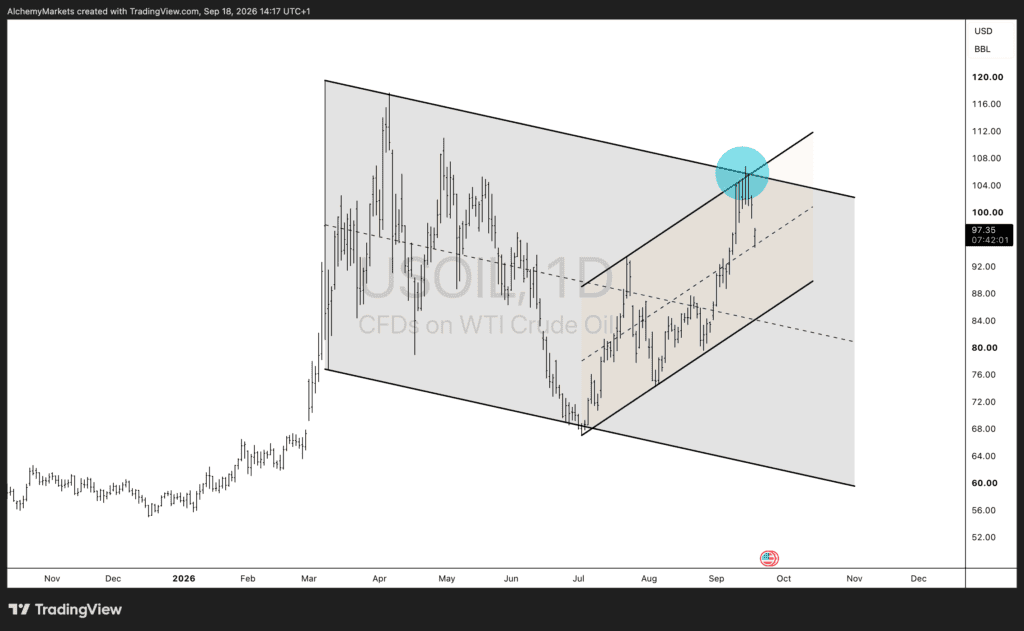
The technical picture fits the fundamental story surprisingly well.
WTI’s rally from the July lows has formed a clear ascending channel, but that recovery has now run directly into the upper boundary of the much larger descending channel that has governed price since the March/April highs.
That confluence around roughly $104–$106 acted as resistance, and price has subsequently fallen back towards $97.
This makes the current area important.
Our base case is that the rejection develops into a deeper correction within the rising structure rather than an immediate collapse of the broader recovery.
The next logical downside area would therefore be the lower boundary of the ascending channel, which is currently rising through roughly the low-$90s. That would allow WTI to correct the recent geopolitical rally while still preserving the higher-low structure that has developed since July.
In other words:
Bearish correction first; bigger trend decision later.
A sustained move back through the $104–$106 resistance zone would weaken this outlook and suggest geopolitical supply risks are once again dominating the tape.
Conversely, continued rejection below that region alongside softer US economic data would strengthen the case for WTI extending its correction towards ascending-channel support.
Bottom line
Oil’s story has changed at the margin. Saudi Arabia has found ways to reroute more supply, the immediate shortage fears have eased, and the Fed has introduced an additional demand headwind through tighter monetary policy.
That supports our near-term corrective bias in WTI towards the lower boundary of its ascending channel.
But this remains a correction call rather than a structural bearish oil call. Strait of Hormuz traffic is still well below normal levels and the broader Middle East supply situation remains fragile, meaning any renewed disruption could quickly bring the geopolitical premium back into the market.