Scritto da:


- Chart of the Day
- Giugno 3, 2026
- 5 min di lettura
Bitcoin Tests MicroStrategy’s Average Buy After Rare BTC Sale
Michael Saylor has long been known as the “Bitcoin Guy” to the public.
Through public appearances, interviews, and MicroStrategy’s pivot from enterprise software into Bitcoin accumulation, Saylor became one of the loudest corporate Bitcoin bulls in the market. That is why the latest sale caught attention.
On Monday, June 1st, 2026, MicroStrategy sold 32 BTC.
The amount was small compared with the company’s total Bitcoin holdings, but holders took it as a notable sentiment shift from one of Bitcoin’s biggest corporate bulls.
The sale was also used to help fund preferred-stock distributions, which are payments made to investors who hold MicroStrategy’s preferred shares.
In other words, Bitcoin was sold as a source of cash to meet an investor-payment obligation. A direct contradiction to Saylor’s usual “HODL and never sell” tone.
This comes while Bitcoin is trading near the Bitbo’s reported $66,384.56 average-buy price of MicroStrategy. If Bitcoin keeps falling, could MicroStrategy eventually need to sell more?
TA: If Bitcoin Fails Here, We Will See Lower Prices
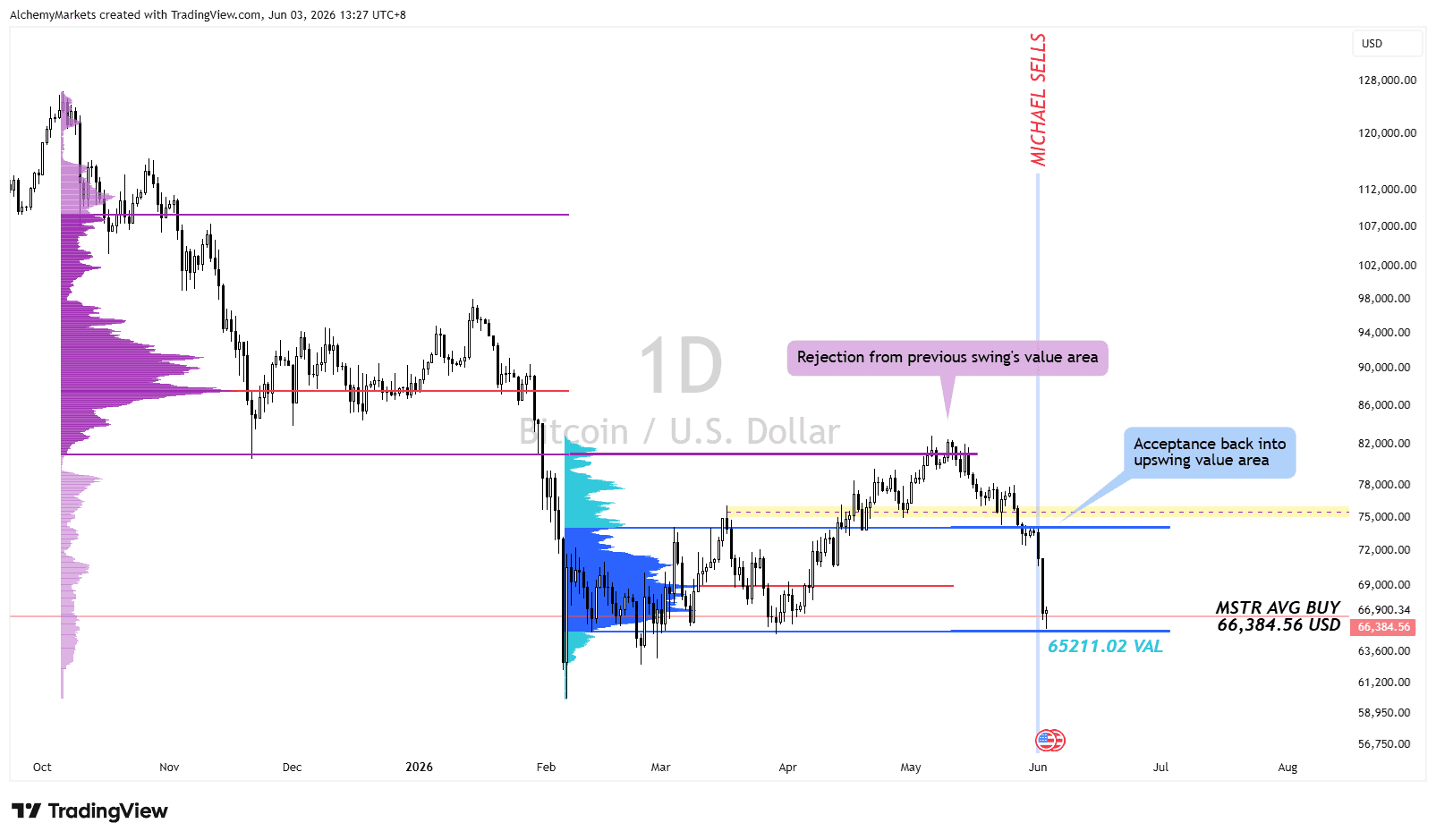
Bitcoin tried to move back into the $81,000 to $82,000 region, which marked the previous swing’s value area low, but failed and moved down lower. After MicroStrategy’s sale on Monday, the Bitcoin price fell by an additional -6.53% on Tuesday.
During the Asian session, it has already tapped into the $66,384 average buy price, which can be acting as support for now.
A value area low of the recent upswing since April to May at $65,211 also suggests there is some form of support at the current price zone. However, BTC price would need to hold here, and ideally break above $75K to signal bullish strength.
Daily closes above $66,384 to $67,000 would reduce near-term pressure and suggest buyers are still defending the area. Acceptance below $65,211 would keep the bearish continuation case active and increase the chance of a price decline.
Weekly Chart Points To $57.8K If Support Fails
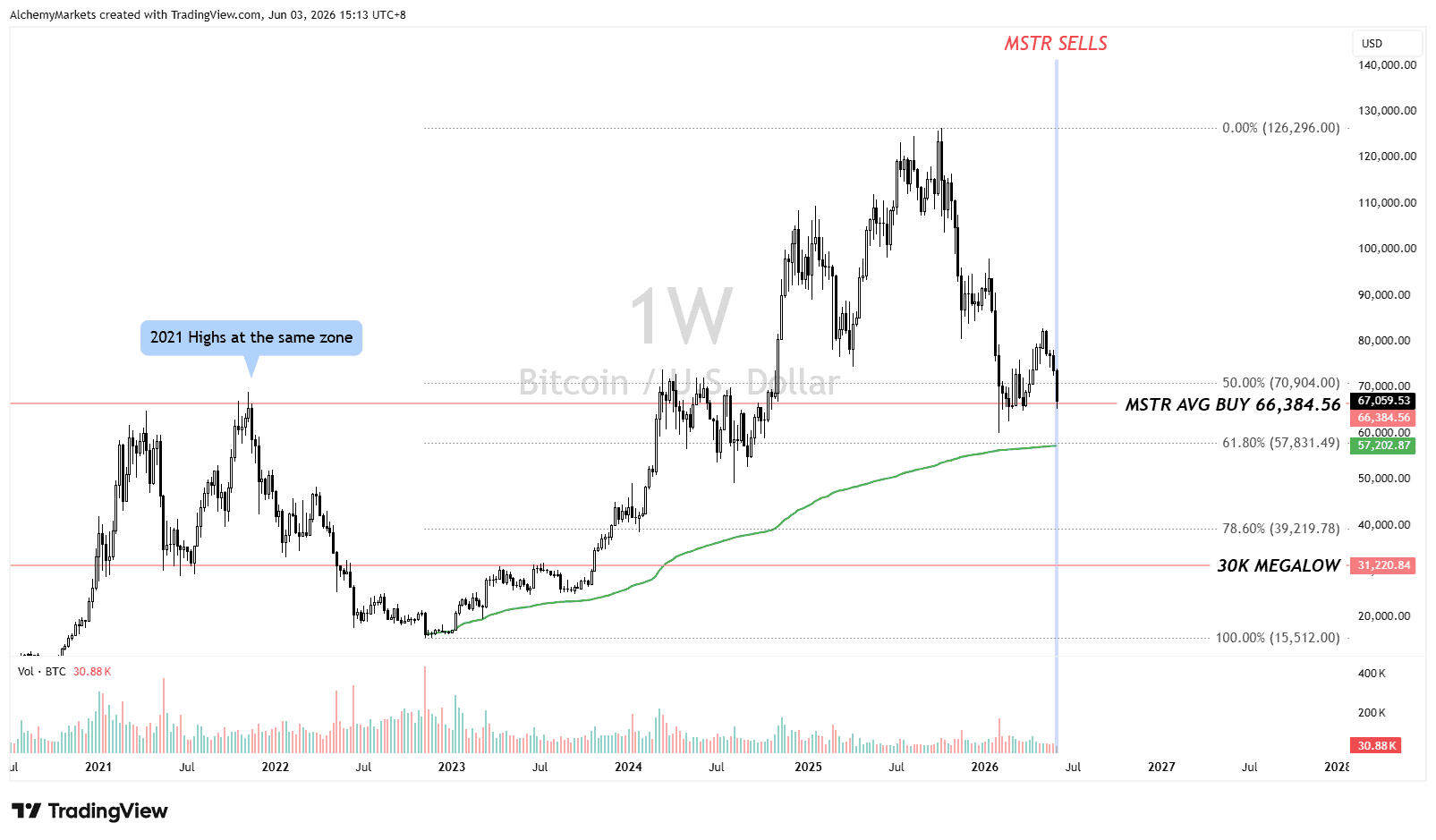
The weekly chart gives the next downside area to watch. Bitcoin has broken below the 50% Fibonacci retracement near $70,900. The next major Fib level is the 61.8% retracement, around $57,800.
That level has additional support confluence. It sits close to the anchored VWAP from the 2022 lows and near the old consolidation area where Bitcoin previously formed a bull flag before pushing higher.
That consolidation area also carried heavy trading activity, which makes it a logical zone for traders to watch if price moves lower.
This does not make $57.8k a guaranteed target. It makes it the next clear support cluster if Bitcoin loses the current $65k to $66k area.
What Happens If Bitcoin Breaches MicroStrategy’s Average Buy?
History suggests forced selling is not the usual outcome, but it also does not mean the first touch of MicroStrategy’s average buy price is automatically a bottom.
| i. In 2020, Bitcoin briefly fell below MicroStrategy’s early cost basis, and the company bought more. ii. In 2022, Bitcoin broke below MicroStrategy’s average buy around May and stayed underwater until roughly April 2023. From an average buy area near $30,700, BTC eventually dropped toward $15,760 in November, almost 49% below that level. |
MicroStrategy still avoided a major liquidation and continued to hold.
The 2022 comparison is useful because it shows both sides of the current risk. A break below MicroStrategy’s average buy price did not force the company to sell its stack, but it also did not stop Bitcoin from falling further. The market stayed weak for months before price eventually recovered.
The current setup is more complicated because MicroStrategy has now sold BTC for a funding-related reason.
| i. There was a previous sale in 2022, but that was easier to explain. MicroStrategy sold 704 BTC for tax-loss harvesting, then bought back 810 BTC shortly after. That made the move look more like an accounting decision rather than a change in Bitcoin strategy. ii. The latest sale is harder to dismiss in the same way. MicroStrategy sold 32 BTC to help fund preferred-stock distributions, meaning Bitcoin was used as a source of cash for payments tied to preferred shareholders. |
That does not mean MicroStrategy is about to dump its Bitcoin stack.
It does mean traders have less reason to assume the company’s BTC treasury is completely off-limits.
If Bitcoin keeps falling while MSTR’s premium weakens, traders may start questioning whether MicroStrategy can keep funding distributions and future Bitcoin purchases without selling more BTC or issuing equity on worse terms.
What Traders Should Watch Next
The first level is $66,384 to $67,000. A reclaim there would ease the immediate pressure and keep the current support test alive.
The second level is $65,211. Acceptance below that area would keep sellers in control and shift attention toward $57.8k.
That weekly zone matters because the 61.8% Fib, anchored VWAP from the 2022 lows, and prior high-volume consolidation area are all sitting close together.
MicroStrategy has handled cost-basis stress before. The current difference is that traders have now seen the company sell BTC for a funding-related reason, which makes the next break below its average-buy zone harder to ignore.