Written by:

- Weekly Outlook
- August 29, 2026
- 10 min read
The US Economy Is Growing — Just Not in the Usual Way
There is something unusual happening beneath the surface of the US economy.
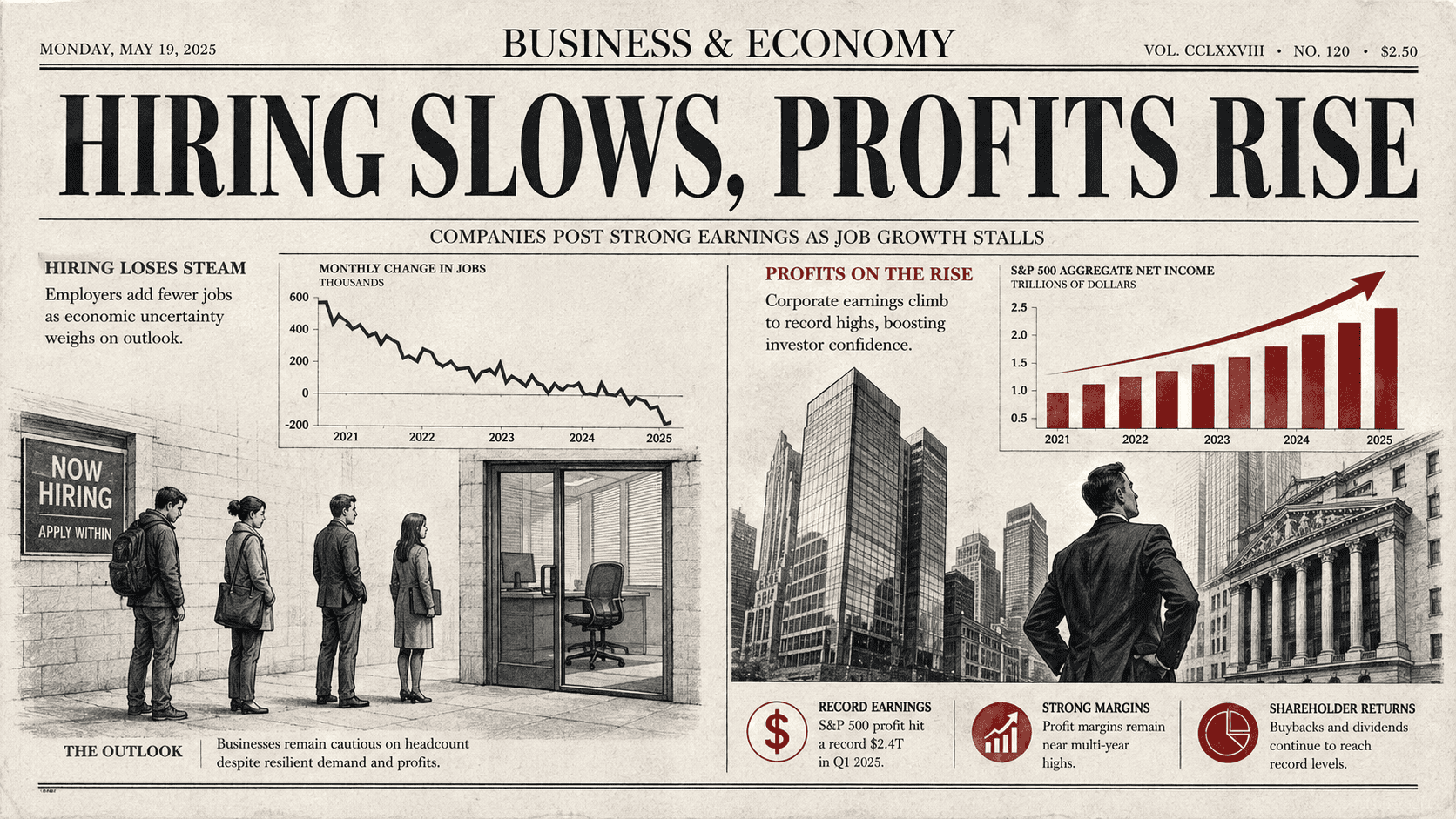
If you looked only at the labour market, you could easily conclude that the cycle is deteriorating. July payrolls fell by 23,000, previous months were revised lower and hiring across the economy has slowed considerably. The consumer is also becoming more cautious, housing remains constrained by expensive mortgages and confidence remains weak.
Yet look at the corporate side of America and the picture almost flips.
US manufacturing is expanding, new orders and backlogs have improved, corporate investment remains strong and companies continue pouring money into artificial intelligence, data centres, electrical infrastructure and equipment. Productivity is rising, corporate profits remain healthy and underlying private domestic demand has been considerably stronger than headline GDP suggests. In Q2, real final sales to private domestic purchasers grew at a 4.2% annualised rate even though headline GDP grew just 1.5%.
The US therefore appears to be developing into what we might call a “profit-rich, job-poor expansion.”
That is important because this is not the traditional economic cycle where stronger GDP automatically means businesses hire more people, wages rise and household consumption does most of the heavy lifting.
Increasingly, the chain looks different:
Capital investment → productivity → output → corporate profits
rather than:
Employment → wages → consumption → growth.
AI and data-centre investment sit right in the middle of that transition.
The spending does not stop with Nvidia GPUs. It travels through servers, networking equipment, cooling systems, transformers, switchgear, power generation, grid infrastructure and construction. The result is an increasingly broad industrial supply chain benefiting from the capital expenditure required to build the next generation of computing infrastructure.
Nvidia’s latest earnings reinforced that view. The company delivered another strong quarter and guided towards continued exceptional growth, helping reassure markets that the AI infrastructure spending cycle remains intact. Nvidia shares subsequently rallied sharply, while strength spread into several semiconductor and AI-infrastructure names.
But there is a vulnerability hidden inside this otherwise constructive story.
The more marginal US growth becomes concentrated around AI, data centres and corporate capital expenditure, the more important that spending cycle becomes to the broader economy.
The US consumer is not collapsing, but it is no longer firing on all cylinders. Housing is weak. Hiring has slowed sharply. That means if the AI investment cycle eventually decelerates before the household side of the economy has recovered, one of the strongest pillars supporting growth could disappear without another obvious engine ready to replace it.
That does not mean AI is currently a bubble.
It means AI-capex concentration has become a macro risk worth monitoring.
The warning signal would not necessarily be hyperscaler spending turning negative. Markets would probably react considerably earlier.
If capex growth moved from, for example:
+40% → +30% → +20%
while semiconductor orders, electrical-equipment backlogs and manufacturing new orders simultaneously began slowing, that could tell us that the investment cycle had reached its peak even while absolute spending remained enormous.
For now, however, the evidence points towards the opposite.
The corporate side of the US economy remains resilient and increasingly investment-led. The question facing markets next week is whether the weaker labour economy can remain contained while that corporate engine continues running.
And conveniently, next week’s economic calendar tests both sides of that argument.
The Week Ahead: Labour Meets Manufacturing
The US calendar between 1–4 September is unusually useful because several releases directly test the divergence we have just described.
Tuesday — ISM Manufacturing & JOLTS
Tuesday arguably gives us the first major test.
The ISM Manufacturing PMI for August is released at 10:00 ET / 15:00 UK time. July’s index jumped to 55.6, firmly above the 50 level separating expansion from contraction, while the August consensus currently sits around 55.3.
The headline matters, but the internal composition matters considerably more.
We should be watching New Orders, Backlogs, Production and Prices Paid.
The bullish economic chain would be:
New Orders remain strong → backlog holds → production remains elevated.
That would reinforce the argument that the corporate/manufacturing cycle is genuinely accelerating.
A sharp reversal in orders would be much more significant than a small miss in the headline PMI because it would attack one of the strongest leading components of our current US growth thesis.
The JOLTS report lands at the same time and tests the opposite side of the economy.
Job openings were previously around 7.36 million, and the important question is whether openings, hiring and quits continue drifting lower.
The current labour problem looks much more like a hiring recession than a firing recession. Employers are reluctant to hire, but unemployment claims have not yet shown widespread layoffs.
JOLTS can tell us whether that distinction remains intact.
Wednesday — ADP Employment
Wednesday brings the ADP private payroll report.
Private employers added only 44,000 jobs in July, following another slowdown in private hiring. The next report is scheduled for 2 September.
ADP should never be treated as a direct forecast for Friday’s official payroll number, but it provides another independent look at hiring across company sizes and industries.
For our macro thesis, the important question is less whether ADP prints 40,000 or 70,000.
It is whether private hiring begins stabilising.
Another extremely weak report would strengthen the argument that the labour slowdown is persistent rather than simply noise from one disappointing payroll print.
Thursday — ISM Services, Productivity and Trade
Thursday is another busy session.
The ISM Services PMI arrives at 10:00 ET / 15:00 UK time, following a July reading of 54.1. ISM has confirmed that the August report will be released on Thursday, 3 September.
Services remain the much larger part of the US economy, making New Orders and Business Activity particularly important.
If manufacturing remains strong but services new orders begin deteriorating, it would strengthen the idea of an increasingly narrow capital-goods expansion.
If both remain healthy, however, the economic expansion suddenly looks considerably broader.
Earlier on Thursday, markets also receive revised Q2 productivity and unit labour cost data.
This may not receive the attention of payrolls, but it is extremely important to the story we are discussing.
Higher productivity allows companies to produce more without hiring proportionately more workers. If productivity remains strong while unit labour costs stay contained, it would provide another piece of evidence explaining how corporate profits can remain strong despite weak employment growth. The BLS has scheduled the report for 08:30 ET on 3 September.
Friday — Non-Farm Payrolls: The Main Event
Friday’s August employment report is the week’s major macro catalyst.
Consensus currently centres around approximately +45,000 non-farm payrolls, after July’s -23,000, with unemployment expected around 4.2% versus 4.1% previously.
The BLS will release the report at 08:30 ET / 13:30 UK time on Friday, 4 September.
But again, the headline payroll number should not be analysed in isolation.
We want to look at:
Payroll growth
Unemployment
Average hourly earnings
Weekly hours
Participation
Private-sector employment
Revisions
The cleanest outcome for risk assets would probably be some stabilisation in payroll growth without a renewed acceleration in wages.
That would suggest:
labour is not collapsing → recession risk falls
while simultaneously:
wage pressure remains contained → Fed/rates risk does not increase dramatically.
The uncomfortable outcome would be another very weak payroll number accompanied by rising unemployment and falling weekly hours.
That would begin pushing the labour story beyond merely weak hiring and closer towards a deterioration in household income and consumption.
At the other extreme, unexpectedly strong payroll and wage growth could reassure markets about the economy but simultaneously increase pressure on Treasury yields and expectations for tighter monetary policy.
That is why the reaction function matters.
The market isn’t simply asking:
“Are jobs strong?”
It is asking:
“What does this tell us about growth, inflation and the Fed?”
Economic Calendar — Key US Events
| Day | UK Time | Event | Previous | What Matters |
|---|---|---|---|---|
| Tue 1 Sep | 15:00 | ISM Manufacturing PMI | 55.6 | Watch New Orders and Backlogs — does the corporate/manufacturing acceleration continue? |
| Tue 1 Sep | 15:00 | JOLTS Job Openings | 7.36m | Tests whether weak hiring remains contained or labour demand is deteriorating further. |
| Wed 2 Sep | 13:15 | ADP Employment | +44k | Independent check on private-sector hiring ahead of payrolls. |
| Thu 3 Sep | 13:30 | Q2 Productivity & Costs | — | Strong productivity could help explain strong profits despite weak job creation. |
| Thu 3 Sep | 15:00 | ISM Services PMI | 54.1 | New Orders/Business Activity tell us whether strength extends beyond manufacturing. |
| Fri 4 Sep | 13:30 | Non-Farm Payrolls | -23k | Main test of whether the labour slowdown is stabilising or spreading. |
| Fri 4 Sep | 13:30 | Unemployment Rate | 4.1% | A material rise would make the labour deterioration harder to dismiss. |
| Fri 4 Sep | 13:30 | Average Hourly Earnings | +0.1% m/m | Key for inflation/rates reaction alongside payroll growth. |
Official release dates are confirmed by BLS and ISM calendars.
Technical Focus: Nvidia Breaks Out
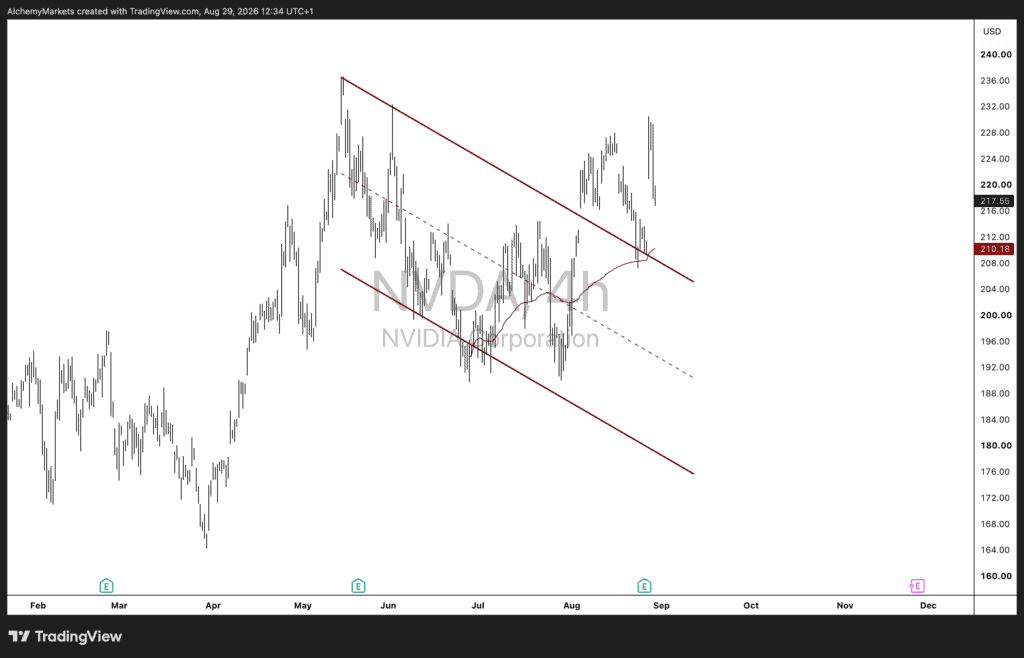
The fundamental AI narrative also has an interesting technical expression this week through Nvidia (NVDA).
Following its latest earnings release, Nvidia surged sharply and broke above the recent consolidation area, with the stock closing around $228 following the post-earnings move. The breakout follows another strong set of results and guidance that helped ease some of the market’s concerns around the durability of AI infrastructure spending.
From a technical perspective, the important feature is not simply the size of the earnings gap.
NVDA is now attempting to establish a fresh breakout while remaining above the anchored VWAPs drawn from the recent swing high and swing low.
That keeps the underlying trend structure constructive.
Anchored VWAP is particularly useful here because it gives us a read on where the average participant positioned from those important turning points is currently sitting.
As long as price remains above those anchored averages, buyers from the recent trading range remain broadly in control.
The next technical test is therefore continuation rather than simply chasing the initial earnings move.
A sustained hold above the breakout area would suggest the market is accepting higher prices and could allow momentum to build towards a retest of the previous all-time-high region around $235–236. Nvidia’s previous record high was approximately $235.74.
A failure back beneath the breakout zone and the anchored VWAP structure would change the picture.
That would suggest the strong earnings reaction had failed to generate sustained follow-through — particularly noteworthy given how important Nvidia has become as the market’s proxy for the broader AI-capex cycle.
This makes NVDA more than just another technical setup this week.
It is effectively one of the market’s live votes on the macro story itself.
If investors continue rewarding Nvidia despite already enormous expectations, it suggests the market still believes:
AI capex → infrastructure demand → earnings growth
has further to travel.
If that breakout fails despite another exceptional earnings report, however, it would be worth paying attention.
Sometimes the most useful information is not the fundamental news itself, but whether the market is still willing to pay more for it.
The Bottom Line
Next week should help answer one of the most important questions facing the US economy.
Can a capital-intensive corporate expansion continue carrying growth while the labour-intensive household economy remains weak?
For now, the answer appears to be yes.
Manufacturing, AI infrastructure spending, corporate investment, productivity and profits remain important sources of strength. Labour and housing remain the vulnerabilities, while the consumer is cooling rather than collapsing.
That leaves us with an unusual but increasingly clear regime:
profit-rich, job-poor expansion.
Tuesday’s ISM and JOLTS reports test both sides of that divergence immediately.
Thursday tells us whether services and productivity support the story.
And Friday’s payroll report tells us whether weak hiring remains contained — or whether the weakness is beginning to travel into the broader economy.
Meanwhile, Nvidia provides the market’s own real-time verdict.
For now, the AI-capex engine is still running — and price is beginning to agree.