Written by:


- Weekly Outlook
- November 21, 2026
- 7 min read
S&P 500: Can Wall Street Find Support After a Brutal Week of Selling?
US equities endured a difficult week as concerns surrounding artificial intelligence valuations and the prospect of further Federal Reserve interest-rate increases triggered a sharp retreat across Wall Street.
The S&P 500 finished Friday at 6,910.39, falling 3.7% during the session and entering correction territory, while the technology-heavy Nasdaq suffered even steeper losses. What initially appeared to be a reassessment of AI-related valuations has developed into a broader deterioration in risk appetite.
At the centre of the sell-off are two interconnected concerns: whether the enormous investment being directed towards artificial intelligence will generate sufficient returns, and whether interest rates will remain restrictive for longer than investors previously anticipated.
The AI sector has been a major driver of equity market performance, supported by expectations of sustained capital expenditure, rising demand for computing infrastructure and strong earnings growth. However, investors are increasingly questioning the financing requirements and profitability of these investments.
This shift in sentiment has placed particular pressure on technology companies and businesses exposed to the AI infrastructure supply chain. With valuations already reflecting substantial future growth, even modest doubts surrounding the outlook can lead to significant repricing.
Meanwhile, the Federal Reserve has provided little reassurance.
Minutes from the October FOMC meeting, published on Wednesday, revealed that policymakers remained concerned about persistent inflation, with further interest-rate increases viewed as potentially necessary to restore price stability.
The prospect of tighter monetary policy creates an additional challenge for equities. Higher interest rates increase financing costs and reduce the present value of expected future earnings, particularly for growth companies whose valuations depend heavily on profits projected further into the future.
Interestingly, US Treasury yields declined sharply towards the end of the week as investors sought safer assets amid the equity sell-off. This suggests that concerns surrounding financial conditions and the sustainability of equity valuations are beginning to compete with inflation fears.
The central question heading into next week is whether the recent decline represents a correction within the broader bullish trend or the beginning of a more sustained deterioration in market sentiment.
With Thanksgiving shortening the US trading week, attention now turns towards inflation data, economic growth and several important technical support levels that could help determine the S&P 500’s next move.
Economic Calendar: Thanksgiving Week Puts Core PCE in Focus
The coming week will be shortened by the US Thanksgiving holiday on Thursday, with equity markets also closing early on Friday.
Nevertheless, Wednesday’s economic releases could prove particularly important given the market’s heightened sensitivity to Federal Reserve policy expectations.
Wednesday, 25 November – Core PCE Price Index
The Federal Reserve’s preferred inflation measure, the core Personal Consumption Expenditures (PCE) Price Index, will take centre stage.
Core PCE is expected to increase by approximately 0.3% month-on-month, suggesting underlying inflation remains elevated relative to the monthly pace of roughly 0.17% consistent with achieving the Fed’s 2% annual inflation target over time.
A stronger-than-expected reading could reinforce expectations of additional monetary tightening, placing further pressure on equities and particularly interest-rate-sensitive technology shares.
Conversely, a softer reading could offer some relief by reducing concerns over the extent of future interest-rate increases.
Wednesday, 25 November – US GDP, Third Quarter (Second Estimate)
The latest estimate of third-quarter economic growth is also scheduled for release, following an initial annualised growth reading of 3.4%.
A substantial revision is not anticipated, although the report will provide further insight into the resilience of the US economy.
Robust growth could reassure investors that economic activity remains healthy. However, in the current environment, unexpectedly strong figures could also reinforce expectations that the Federal Reserve has room to maintain tighter monetary policy.
Beyond the headline numbers, investors will be watching whether falling petrol prices can support household purchasing power, particularly against a backdrop of subdued wage growth, concerns over job security and recent declines in household wealth.
Ultimately, the market’s reaction may depend less on whether the economic figures appear strong or weak in isolation, and more on how they influence expectations for Federal Reserve policy.
Technical Analysis: S&P 500 Approaches a Critical Test
Monthly Timeframe: Anchored VWAP Support Comes Into Focus
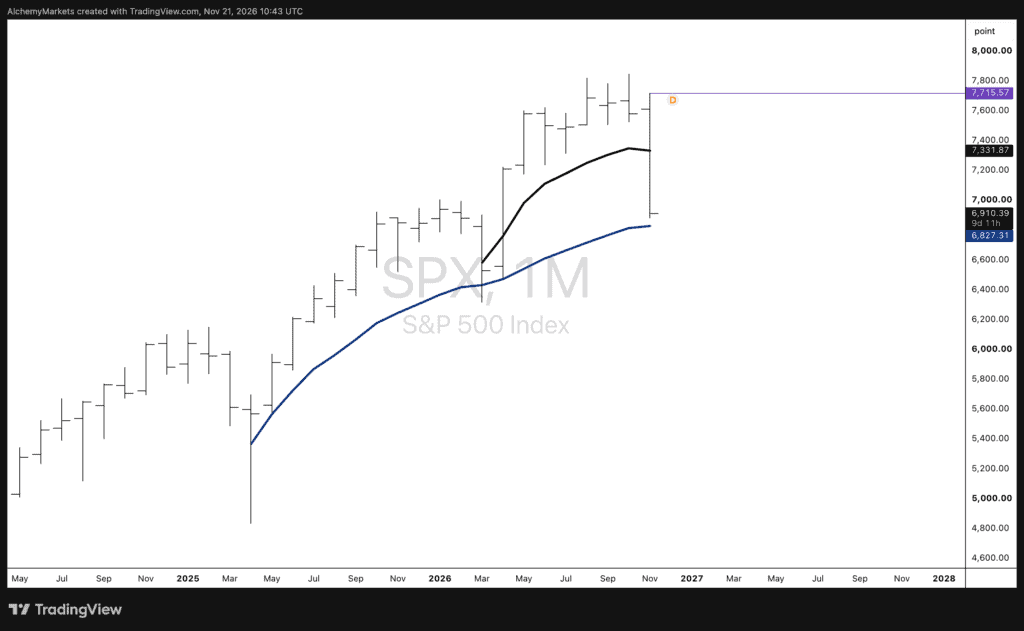
The monthly chart illustrates that the S&P 500 remains within a broader upward trend, despite the recent sharp correction.
However, the latest selling pressure has pushed the index below its shorter-term anchored VWAP, currently situated around 7,332, bringing attention towards the longer-term anchored VWAP near 6,827.
This lower anchored VWAP represents an important area to monitor, as it reflects an average traded-price benchmark since its selected anchor point.
A successful defence of this region, followed by a recovery in price, could suggest that buyers remain willing to accumulate equities at lower levels and that the broader bullish structure remains intact.
Such a development could create the conditions for a recovery towards 7,332, followed by the 7,440–7,466 resistance region.
However, a sustained move below 6,827 would represent a more concerning technical development, suggesting that selling pressure is extending beyond the initial correction and potentially opening the door to a deeper retracement.
A temporary break below this level followed by a decisive reclaim would present a different picture. Such a recovery could indicate that selling pressure is exhausting, particularly if supported by improving market breadth and renewed buying momentum.
The monthly outlook therefore remains cautiously constructive on the broader trend, but the immediate risk is skewed towards further weakness until meaningful support and price stabilisation emerge.
Daily Timeframe: Sharp Breakdown Leaves Buyers Under Pressure
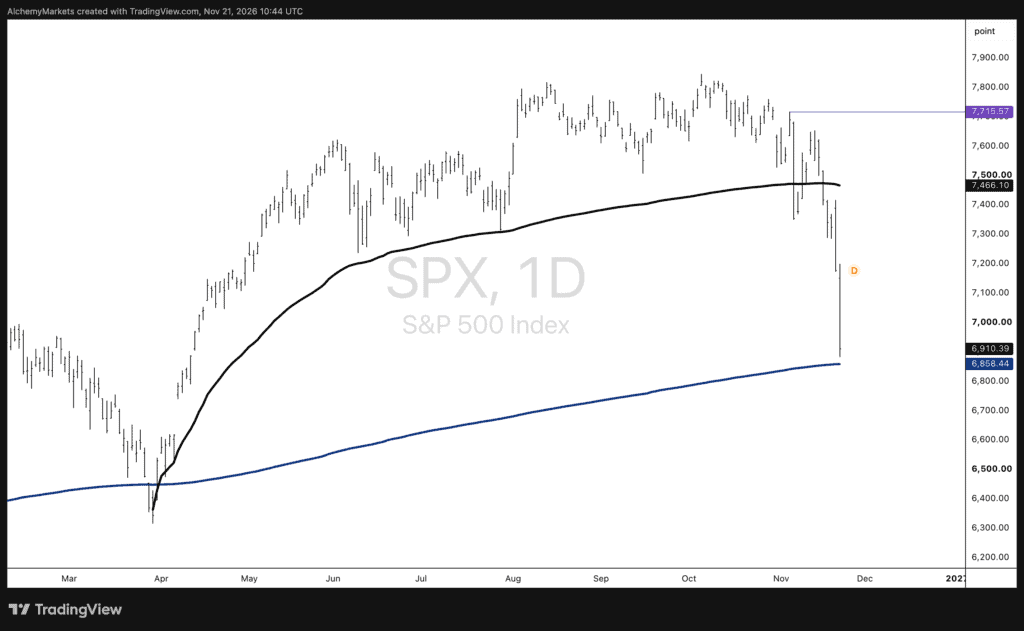
The daily chart presents a more immediate bearish picture.
Following several months of consolidation near the highs, the S&P 500 has experienced a decisive decline, breaking beneath its shorter-term anchored VWAP around 7,466 and accelerating towards the longer-term anchored VWAP near 6,858.
Friday’s sell-off brought the index to 6,910, leaving it just above this important technical reference.
The speed of the decline highlights a clear deterioration in short-term momentum, with successive lower highs and lower lows suggesting sellers have regained control.
The 6,858–6,827 region now becomes particularly important, as both the daily and monthly anchored VWAPs are concentrated within a relatively narrow range.
If buyers successfully defend this area, an initial recovery towards 7,200 may emerge, with further resistance around 7,440–7,466.
Nevertheless, any recovery would need to be assessed carefully. A temporary rebound following such aggressive selling does not necessarily signal that the correction has ended.
A sustained recovery above the broken anchored VWAPs, accompanied by improving price structure, would provide stronger evidence of returning bullish momentum.
Alternatively, a decisive breakdown beneath the 6,827 support area could strengthen the bearish outlook and expose the index to further downside, with 6,600 emerging as a possible subsequent support region.
Outlook: A Critical Week for Market Confidence
The S&P 500 enters the final full week of November at an important crossroads.
The combination of stretched AI-related expectations, uncertainty surrounding Federal Reserve policy and deteriorating short-term price momentum has created a more challenging environment for risk assets.
However, with the index approaching an important cluster of anchored VWAP support levels, the possibility of a technical recovery should not be dismissed.
Our immediate outlook remains cautious to bearish, with the 6,827–6,858 region likely to play an important role in determining whether the recent correction stabilises or extends further.
A softer-than-expected core PCE reading could provide a catalyst for a recovery, particularly if Treasury yields and interest-rate expectations move lower. Conversely, persistent inflation and continued weakness in technology shares could reinforce selling pressure.
With Thanksgiving likely to reduce trading activity later in the week, investors should also remain mindful of thinner liquidity and potentially exaggerated price movements.
For now, the priority is to observe whether buyers can establish support rather than assume that the recent decline has already run its course.
The key question for the week ahead: can the S&P 500 defend its longer-term anchored VWAP and begin rebuilding bullish momentum, or will a breakdown signal that the market’s correction has further to run?