Verfasst von:


- Opening Bell
- August 5, 2026
- 5 Min. Lesezeit
Markets Have Priced a Hormuz Deal Already. Did They Do it Too Soon?
Trading this market has become an exercise in changing your mind before the next headline does it for you.
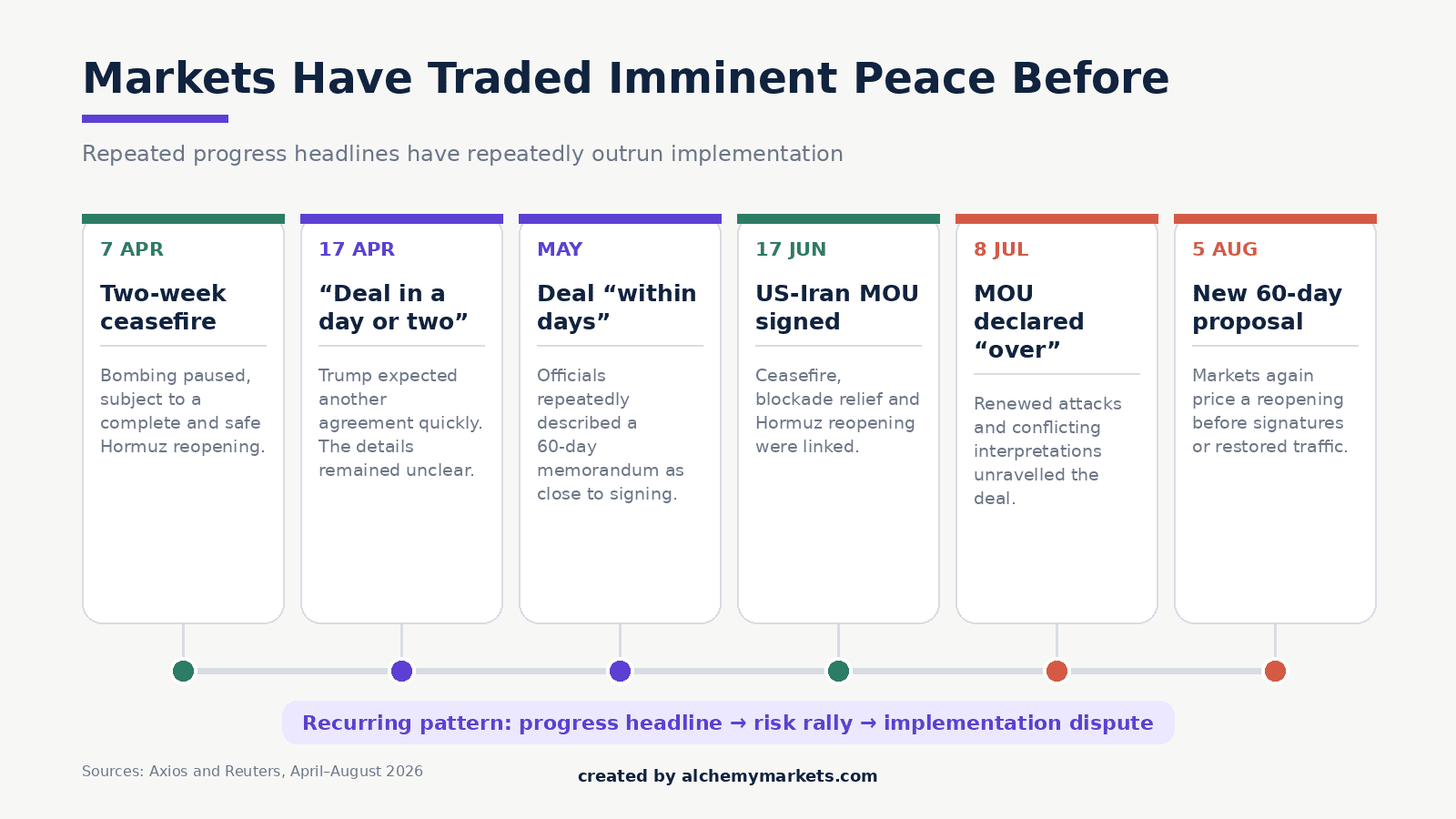
Just when the next escalation looks unavoidable, another imminent peace deal appears and government intervention is suddenly around the corner. This is at least the fourth major deal cycle markets have traded since April.
The latest reaction was enthusiastic. The S&P 500 reached another record, while lower oil and softer yields helped technology shares recover.
NOTE: At the time of writing, Nasdaq has pushed above 30,000, be wary that markets may continue to move higher despite the divergence between reality and expectations.
Maybe markets are exuberant. Maybe they are simply desperate for good news.
Either way, oil is pricing a deal that has not been signed, enforced or reflected in physical flows.
So what is the US-Iran deal in discussion?
The current peace deal can be a little confusing since we’ve already jumped through so many different iterations.
So what’s got the markets excited about this one?
Well, this is a reported 60-day framework for the opening of the Strait of Hormuz, where Iran and Oman, countries that sit on opposite aisles of the body of water, are coming together to set agreements on shipping arrangements.
They must determine which routes ships use, who coordinates passage, whether fees are charged and how mine clearance is handled.
Currently, there is no official agreement confirmed. That will happen later on today, but of course, markets are behaving as if this is a done deal, and are rallying on even as we speak.
This divergence makes the rally fragile and dangerous to chase.
And let’s say even if a deal is done, we have to consider that:
- Markets have already priced it in, get ready for a retracement.
- Look at how the previous 60-day agreement went; it was rife with constant escalation and deescalation.
In other words, we could be getting a scenario of “same same, but different”, as James Franco says in The Dictator.
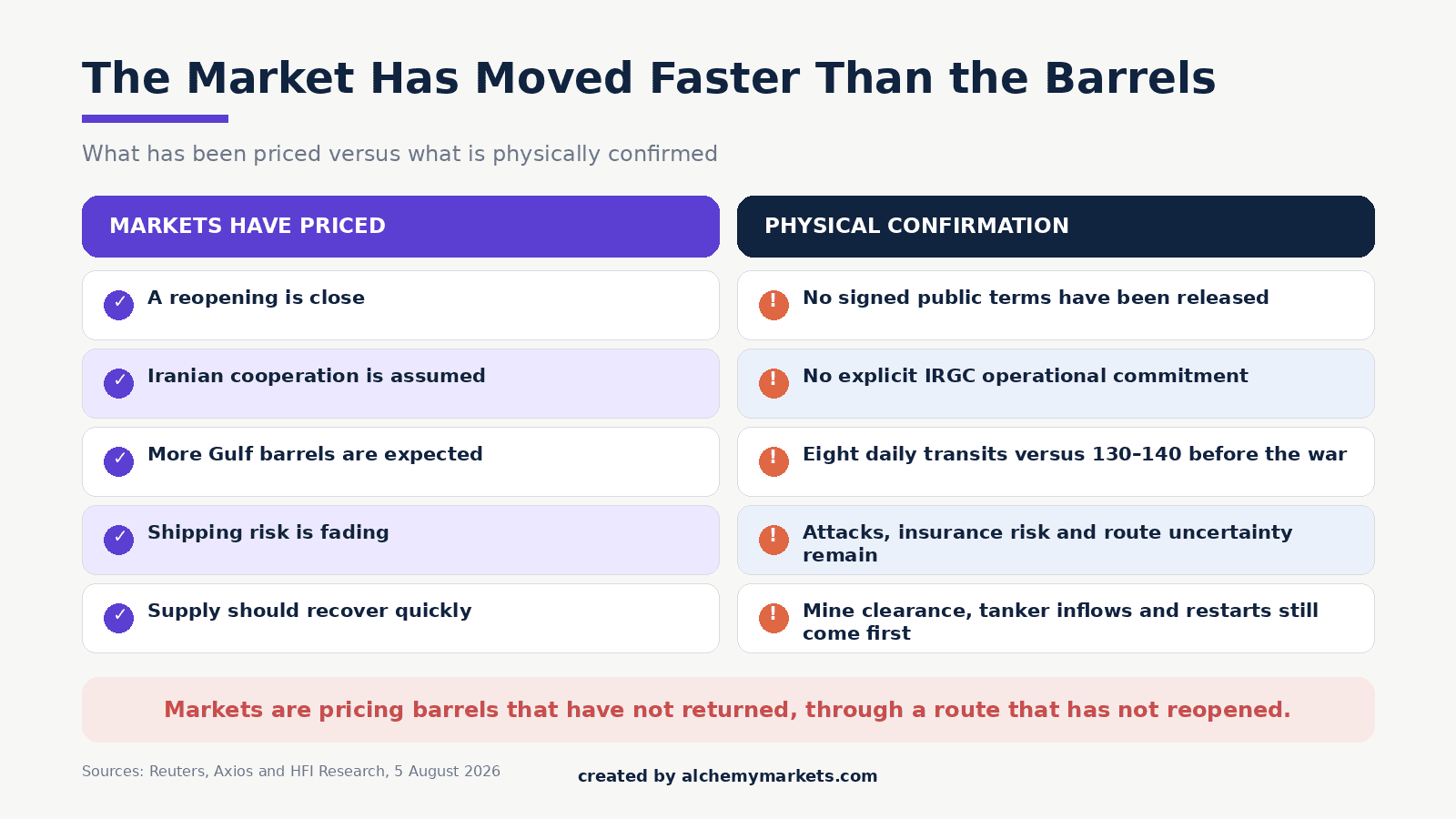
Market Prices Changed; Physical Shipments Have Not
As exuberant as markets are, visible shipping has not confirmed the relief trade.
Recent tracking showed only around eight recorded crossings in a day, which is not any different from last week. Much less if you compare it with roughly 130 to 140 daily transits before the war.
AIS gaps mean some vessels may be travelling without normal signals, but the difference is still too large to call this normalisation.
MarineTraffic’s latest update is the evidence worth watching. Political statements can change within hours. Tanker movements, route choices and the willingness of crews and insurers to use the strait are much harder to fake.
Reopening Hormuz is also not like flipping on a light switch… Empty tankers must enter the Gulf before producers can load them and restore exports. If Iran controls inbound passage, a deal could increase traffic, but not immediately restore pre-war oil flows.
So it comes down to this: the reality and current optimism is divergent.
A signature can change expectations in one afternoon, but it cannot instantly clear mines, repair processing units, restore insurance cover or return vessels that have already rerouted around the region. That process takes months and even years.
What Has to Follow for Oil’s Discount to be Justified
The best-case outcome is that this deal is straightforward.
Iran and Oman publish matching terms, the IRGC accepts them, Washington adjusts its blockade, vessel traffic rises and insurers allow tankers to return. That would validate the oil sell-off and give equities more room to extend their recovery.
The middle outcome is less comfortable. A deal is announced, but traffic remains weak, Iranian control remains disputed or operators refuse to return at scale. Oil could initially fall and then recover once the market realises that a political agreement has not restored physical barrels.
The negative outcome does not require another dramatic escalation. A delayed announcement, weaker terms or renewed disagreement would be enough to unravel this recent rally from the market.
If crude rebounds, inflation expectations and Treasury yields could rise again, placing renewed pressure on the Nasdaq and other high-valuation assets.
Technical view
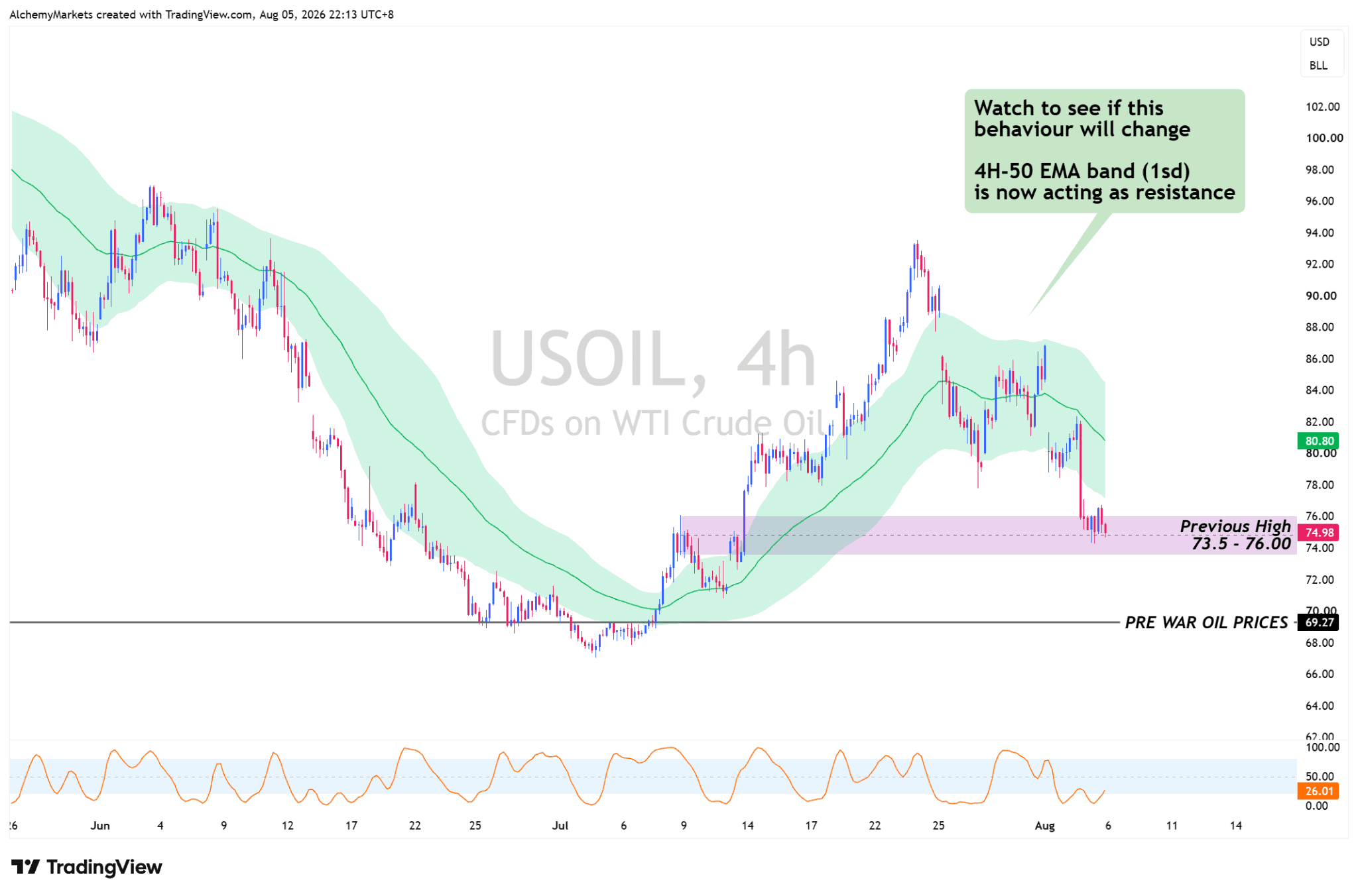
WTI is testing previous-high support at $73.50-$76.00, while the four-hour 50-EMA band has flipped into resistance. A break and hold above the band would improve the rebound case; failure keeps the pre-war area near $69.27 in view.
Brent is testing a similar previous-high zone at $77.18-$80.59. A sustained reclaim of the 4 hour 50-EMA band would improve the recovery case, while failure leaves the pre-war level near $73.60 exposed.
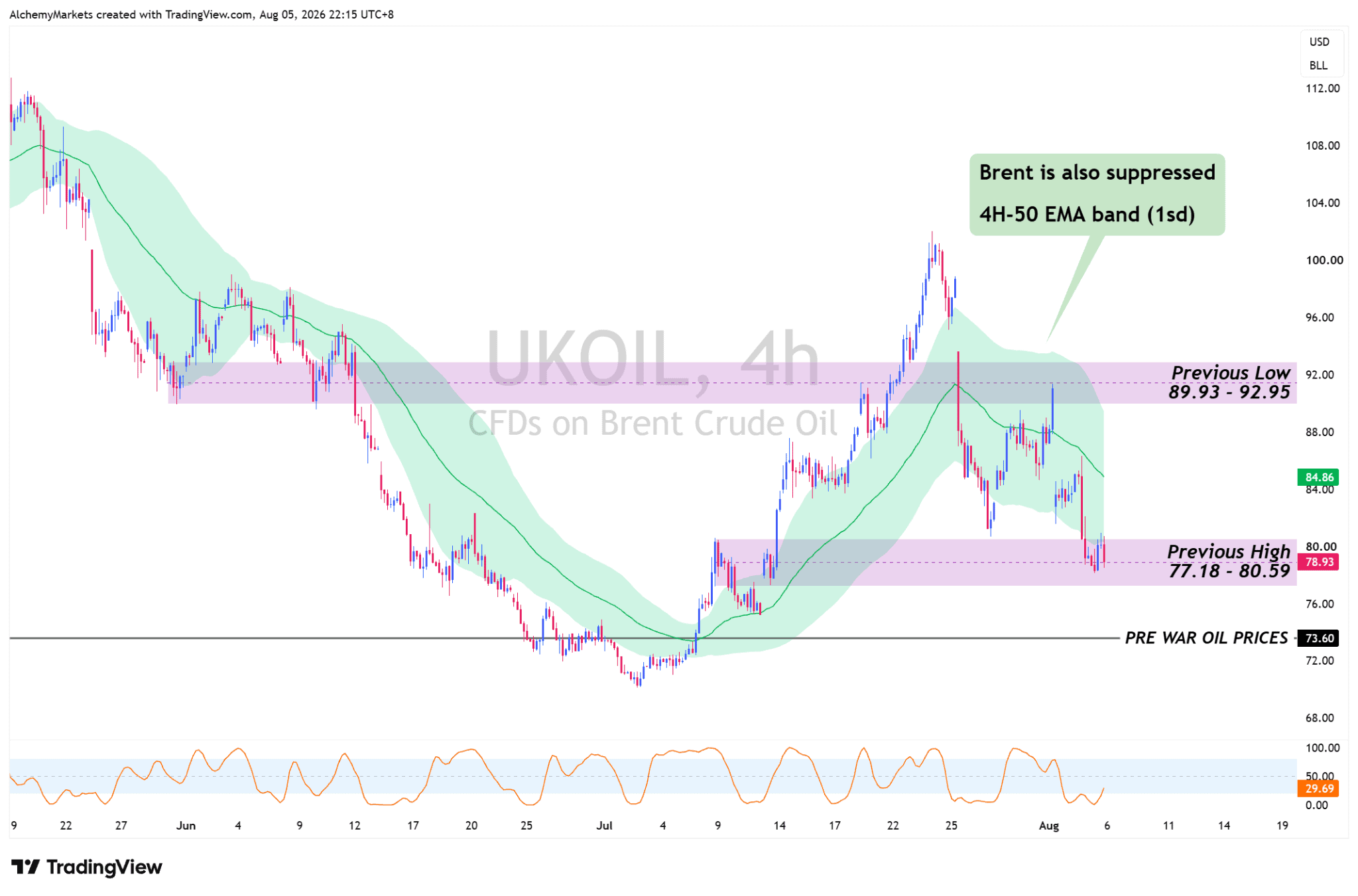
Note that both assets sit in solidly oversold territory, on top of a previous high, while the markets have already priced in the deal.
In my technical view, that combination supports a sooner-rather-than-later bounce. Of course, markets may simply ignore the setup for a while longer.
Bottom Line
The deal may happen. It may even prove more durable than the previous attempts.
But markets have moved from “talks are progressing” to “the barrels are coming back” without waiting for matching signatures, IRGC implementation or a meaningful recovery in shipping.
Oil does not need another major escalation to rebound from here. The question is: will the reopening of the Straits remain uncomplicated enough for the markets to not care?
We’ll let you decide.