Verfasst von:


- Opening Bell
- August 20, 2026
- 4 Min. Lesezeit
AI drops, Healthcare Surges as Moderna Gets Closer to Cancer Cure
Yesterday, the US Treasury did something interesting right before the market open.
It announced that it would double its long-term Treasury buybacks from $2 billion to at least $4 billion per operation, targeting 10 to 30 year bonds.
Everyone with a pinch of understanding about bonds would know this was intended to lower long-term yields, which have been putting pressure on the equities market.
Interestingly, the most rate-sensitive AI names such as AMD, Nvidia and Nebius did not receive a boon, but surprisingly fell.
All while another sector rose as a star…Healthcare.
This came as Moderna and Merck had just announced positive findings from their collaborative cancer vaccine research on melanoma.
Melanoma is often considered the deadliest form of skin cancer. If diagnosed after it has spread to distant organs, the five-year relative survival rate falls to around 35%.

Recent findings have been nothing short of exciting and optimistic.
Cancer is so difficult to treat partly because our immune system can fail to recognise cancer cells as a threat. Tumours can also suppress the immune response against them.
Moderna’s personalised mRNA treatment, intismeran, aims to overcome this by helping a patient’s T-cells recognise the melanoma as a threat. Then, Merck’s Keytruda helps stop the cancer from suppressing that immune response.
Needless to say, this optimism has been reflected in Moderna and Merck share prices.
Moderna rose by around 176% in a single day, gapping up by around 50 points.
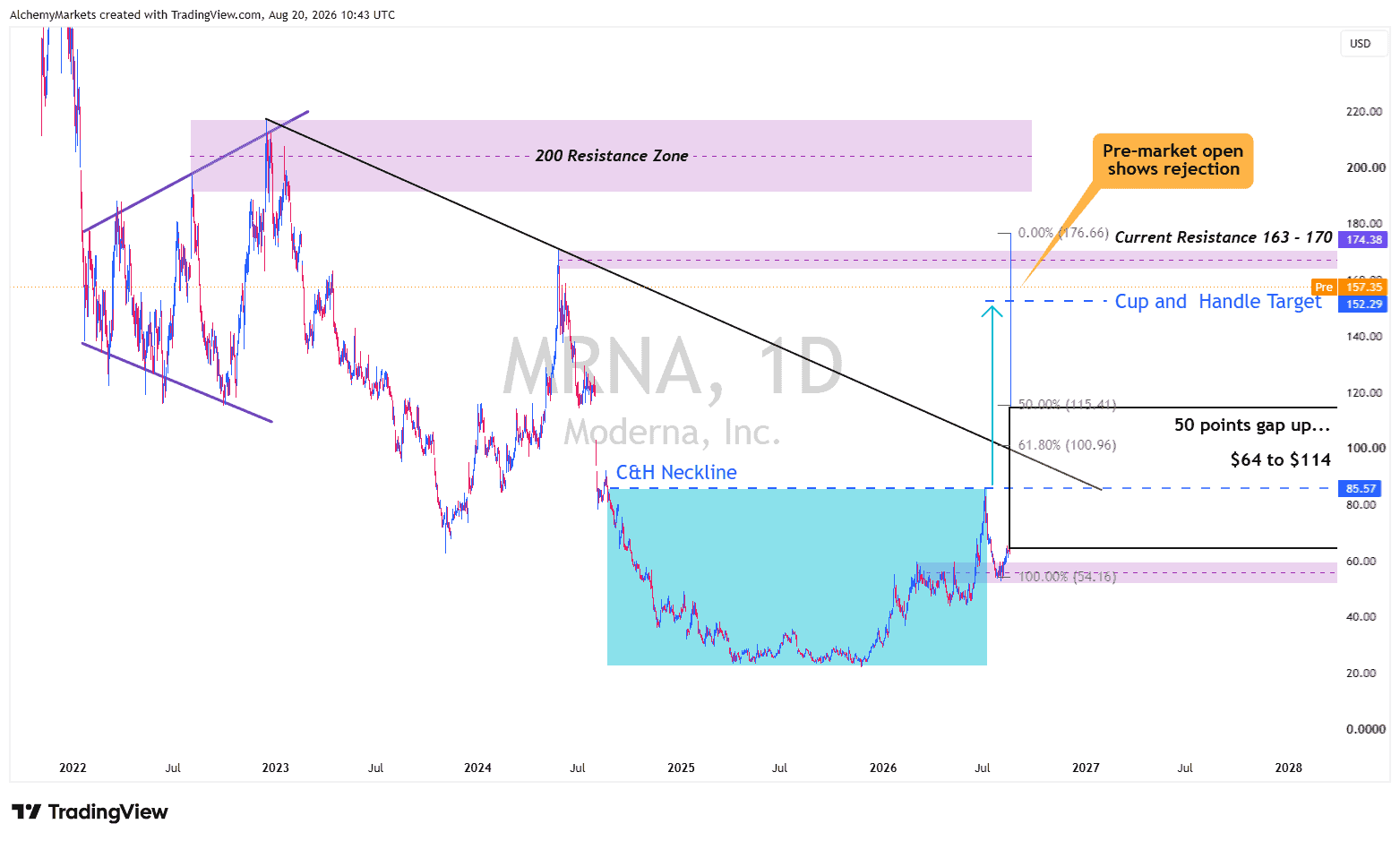
| TA read: 🔹After a strong explosion in price, Moderna could be facing rejection at a previous high 🔹Pre-market shows a gap down below that 163-170 zone. 🔹Price may revisit 114 as support, with a full gap closure potentially taking it back towards 64. |
And Merck & Co. experienced a rise of around 12% into all-time highs near $152.
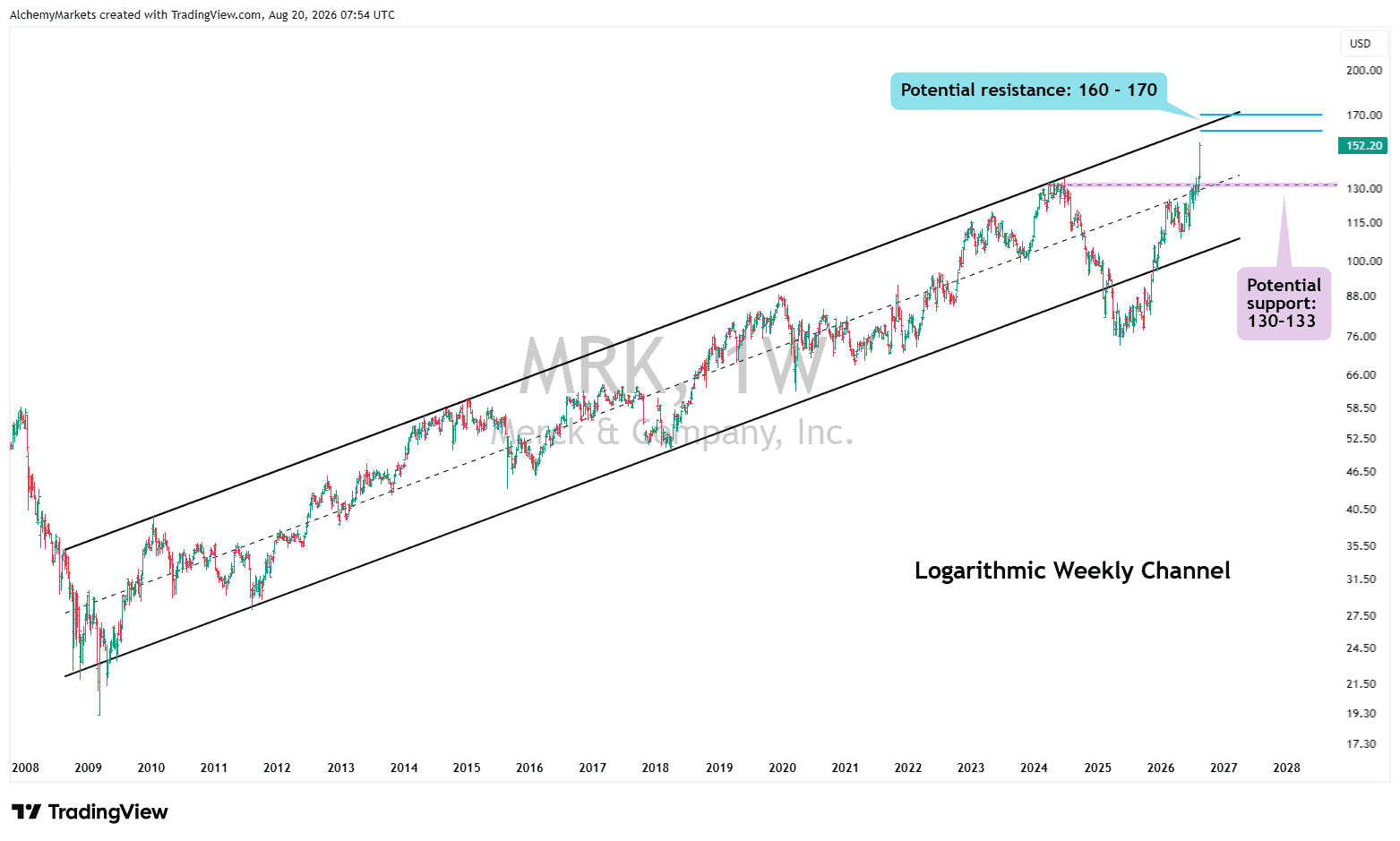
| TA read: 🔹Merck is in a logarithmic rising channel. 🔹It may now face resistance at the channel’s high. 🔹A retracement here could bring prices to 130-133, the previous high + midline intersection. |
The XLV Healthcare SPDR ETF, on the other hand, tells us that healthcare was already in a bullish trend; and this rise was no different.
It has broken above, then consistently found support at its 20-day EMA band (set to 1 standard deviation) since May this year.
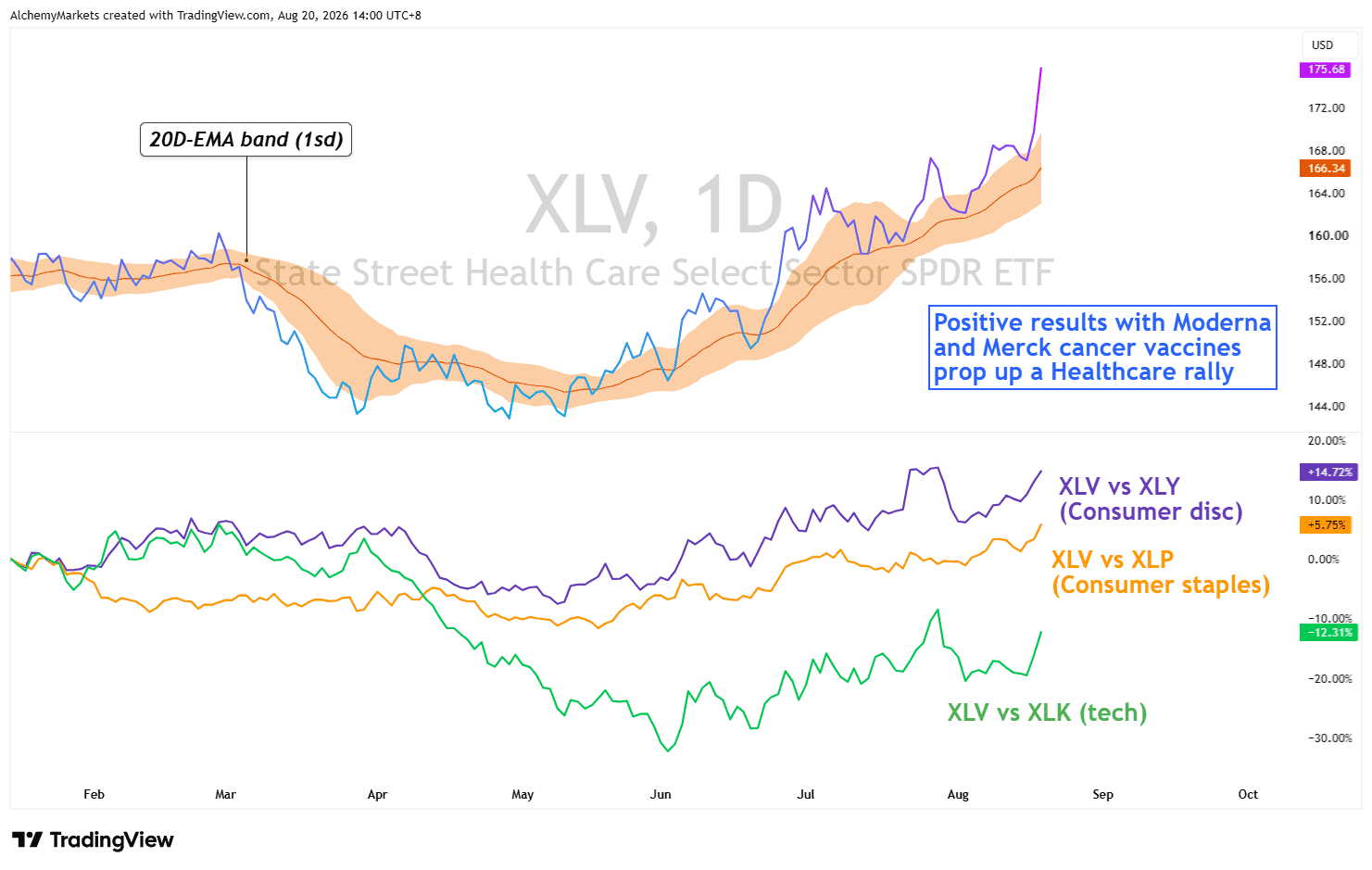
So for now, there is no trend change; healthcare as a sector remains bullish as long as it is above the 20D-EMA band.
Markets appear to be rotating some investments from the tech sector (XLK) into healthcare (XLV). Whether or not this can be sustained will only be clear in the next few weeks.
Additionally, healthcare has been outperforming Consumer Discretionary (XLY) and Consumer Staples (XLP) for the duration of this month.
Will healthcare continue to outperform Consumer & Tech?
Walmart has now reported earnings, with US comparable sales rising 2.6% versus 3.8% expected. So that’s a miss.
But the miss was not quite as weak as the headline suggests.
Excluding changes to pharmacy pricing, comparable sales grew around 3.4%, while transactions still rose 1.5% and average ticket increased 1.1%. Consumers and investors are just becoming more selective, a similar story to what Nike is currently experiencing.
So, for consumer stocks, the battle is more “sector-within”, rather than moving together as a whole like healthcare.
Then there is tech.
Long-term yields have already pulled back from their highs, but the most rate-sensitive AI names have not immediately regained leadership.
That makes the next few sessions important. If yields continue falling and tech still struggles to recover, healthcare’s relative strength starts to look less like a temporary defensive move and more like a genuine shift.
If tech quickly rebounds as yields fall, then this may prove to be more of a temporary rotation than a lasting change in leadership.