Verfasst von:


- Chart of the Day
- Weekly Outlook
- Oktober 3, 2026
- 4 Min. Lesezeit
Soft US Jobs Data Shifts the Focus Back to the Fed
The US labour market delivered another reason for the Federal Reserve to move carefully. September non-farm payrolls rose by just 29,000, well below expectations of around 90,000, while July and August were revised down by a combined 60,000 jobs. Unemployment also edged up to 4.2%, while annual wage growth slowed to 3.0%.
This is not yet a labour-market collapse. Layoffs remain relatively low and the rise in unemployment partly reflected more people returning to the labour force. Instead, the picture increasingly resembles a low-hire, low-fire economy: companies are reluctant to recruit aggressively, but they are not yet cutting workers at recessionary rates either. The important part for markets is that weaker hiring is now being accompanied by softer wage growth, reducing the risk that the labour market becomes another source of persistent inflation.
That matters because Federal Reserve officials were already leaning towards patience. New York Fed President John Williams and Vice Chair Philip Jefferson have both indicated that policymakers have time to assess incoming data before tightening policy again. Following the jobs report, expectations have shifted further towards the Fed leaving rates unchanged at the 27–28 October meeting, with the debate increasingly moving towards whether another hike is required in December instead.
For markets, this leaves inflation as the more important side of the Fed’s dual mandate. The jobs report has made an October hike harder to justify, meaning it would likely take a material upside inflation surprise — particularly when September CPI arrives on 14 October — to revive that debate. Until then, next week’s data is more likely to refine the growth picture than completely rewrite the rates outlook.
US services and the consumer take centre stage
The first major release comes on Monday with the ISM Services PMI. The September report is scheduled for 5 October, and because services dominate the US economy, the details beneath the headline will matter. In particular, markets should watch Business Activity and New Orders for evidence that underlying demand is either maintaining momentum or beginning to follow the softer labour data lower.
The interesting contradiction is that business surveys have remained considerably more resilient than household confidence. The University of Michigan’s final September Consumer Sentiment Index fell to 48.1, with its forward-looking Expectations Index dropping to 46.3. Preliminary October data arrives on Friday.
That divergence creates an awkward backdrop for the Fed. Strong services activity would suggest the economy can absorb restrictive policy for longer, while another deterioration in consumer expectations would reinforce concerns that households are becoming increasingly cautious. For now, that argues for exactly the sort of slow-and-steady approachFed officials have recently been signalling.
Canada: jobs could keep December tightening in play
Canada’s September employment report is also due on Friday, 9 October.
The previous report was weak, with employment falling by roughly 42,000 in August while unemployment held at 6.4%. A rebound in September would therefore help reassure the Bank of Canada that the labour market is stabilising rather than rolling over.
Canadian markets are already considering the possibility of further tightening later in the year. With the policy rate still relatively low compared with some developed-market peers and the Canadian dollar having weakened, a firmer labour print could keep a December rate increase firmly in the conversation.
EUR/USD: Can the euro rebound from channel support?
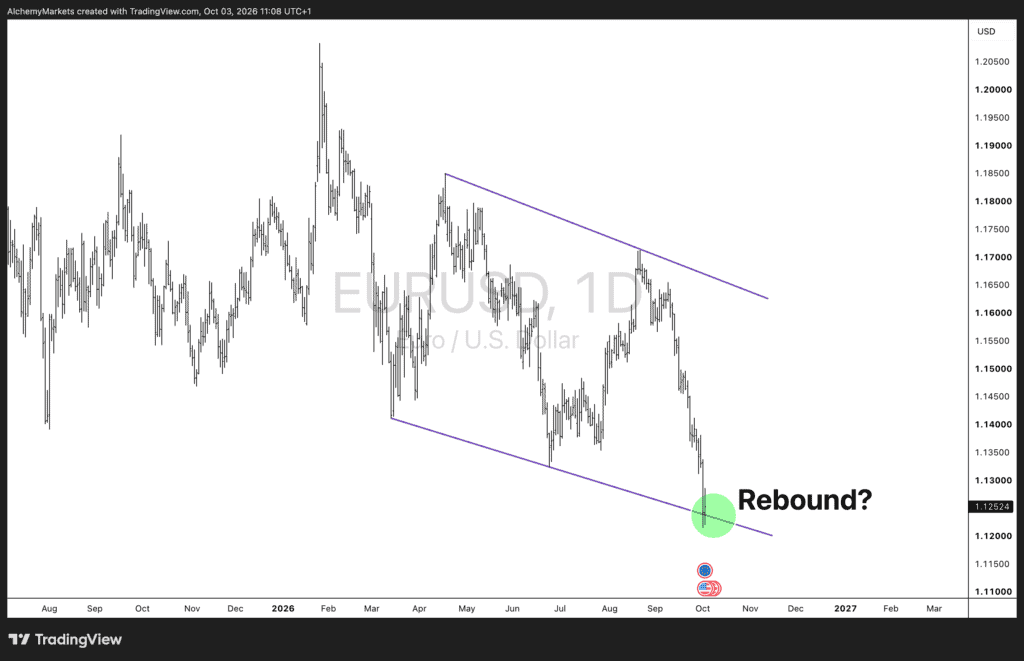
Technically, EUR/USD has returned to an important area around the lower boundary of its descending channel, currently close to the 1.12 region.
The broader structure remains bearish: the pair continues to print lower highs and remains contained beneath falling channel resistance. However, the latest decline has carried price directly into an area where buyers previously responded, creating scope for a short-term corrective rebound.
The key distinction is between a bounce and a trend reversal. Holding the lower channel boundary could allow EUR/USD to retrace towards the mid-channel area around 1.14–1.15, particularly if softer US data keeps Treasury yields and the dollar under pressure. A stronger move would still need to reclaim the descending resistance line around 1.16–1.17 before the broader bearish structure begins to materially change.
Conversely, a decisive break beneath the lower boundary would weaken the rebound case and suggest that the downtrend is accelerating rather than exhausting.
For next week, therefore, the euro sits at an interesting technical inflection point: support is present, but the bulls still need confirmation. The US data calendar may determine whether that support becomes the start of a corrective rebound or merely another pause within the prevailing downtrend.